

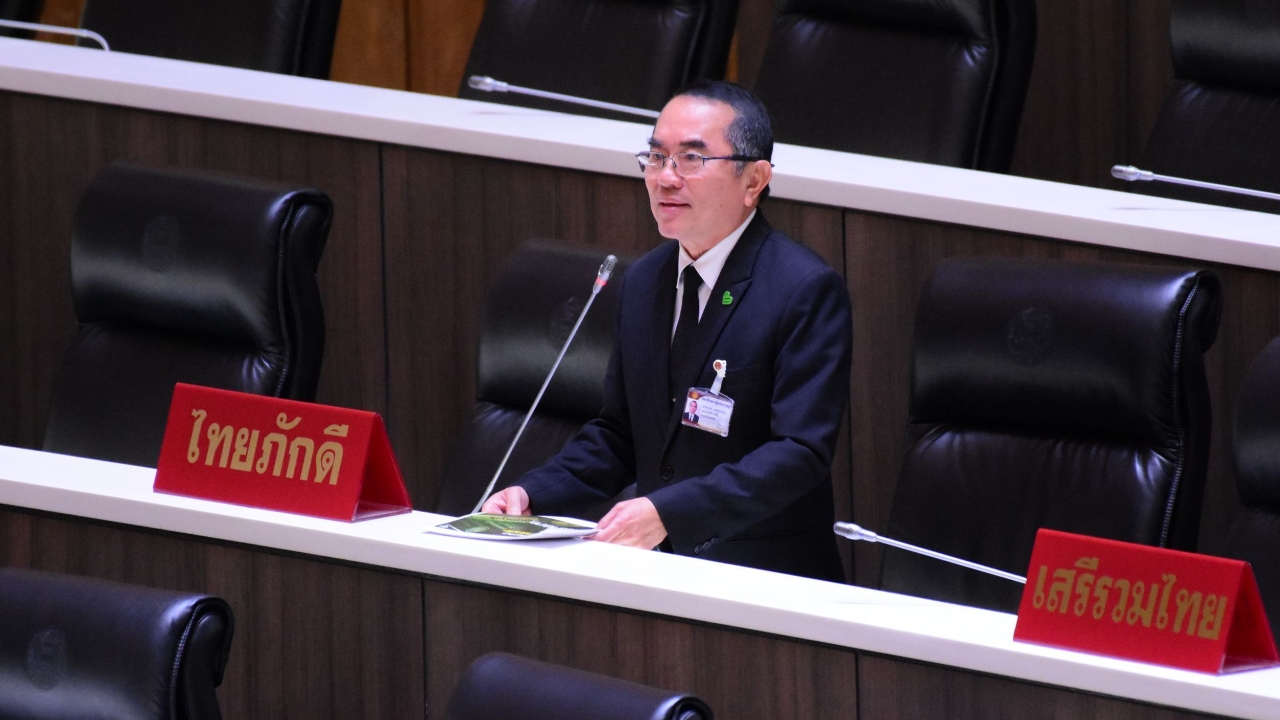
Dr. Warong criticized the government as playing at running a business, failing to truly control oil prices and causing price hikes across the country. He pointed out that the 'Thai Help Thai Plus' program is used for electioneering and temporary relief, questioning how people can survive. He urged not to lock alternative energy solely to solar cells, warning it benefits certain capital groups aiming for kickbacks to some parties.
On 26 Aug 2026 GMT+7 at the Parliament during a session chaired by Mr. Sophon Sarum, Speaker of the House, the urgent royal decree granting the Ministry of Finance authority to borrow up to 400 billion baht to address energy crisis impacts and support the country’s energy transition was considered. Dr. Warong Dechkitvikrom, party-list MP and leader of the Thai Pakdee Party, commented that the borrowing plan splits into two parts: 200 billion baht to help citizens with the energy crisis and 200 billion baht for clean energy transition. He questioned Deputy Prime Minister and Finance Minister Mr. Akiniti Nitithanprapas, asking why, knowing the crisis stems from energy prices, the government does not control energy prices for the people. Instead, it claims price control is impossible and must follow market mechanisms like Singapore. But Thailand’s economy differs from Singapore’s, as Thailand relies on diesel and oil as production inputs across transportation, industry, agriculture, and fisheries, unlike Singapore. Therefore, liberalizing prices like Singapore is unsuitable.
The energy crisis from early 2026 until now saw the Anutin government controlling diesel prices like child’s play, initially suppressing prices then letting them rise until people were shocked at 50 baht per liter, now 38 baht per liter. This has driven consumer goods prices sharply higher. The government used 'Thai Help Thai Plus' to assist people but only partially, mainly for electioneering—to temporarily ease symptoms with paracetamol rather than curing the root cause. If the government addressed the root cause, prices would not have risen so much. He asked how people will live four months after the 'Thai Help Thai Plus' program ends, when aid stops but prices remain high.
Dr. Warong also said the state welfare card project, or poor people’s card, was mishandled by the government’s new criteria. Originally, there were 13.2 million poor people, with 12.7 million registering plus several million new poor registering, totaling 18.8 million. After the government’s criteria adjustment, social media heavily criticized issues like children deducting parents’ tax. Recently, the government announced that of the 18.8 million registered, 9.5 million passed the criteria, 9.3 million did not. Of the original poor, 6.3 million passed from 12.7 million, meaning 6.4 million original poor people were reclassified as rich. This government has caused stress and pressure on the public. Are these original poor no longer to be cared for under Anutin’s administration because they are now considered rich? People are not bank customers; the poor are the country’s owners whom the government must sincerely care for. He called on those managing the project to restore welfare card rights to all original poor people, leaving new poor criteria decisions to them.
Dr. Warong further said that regarding the second plan for clean energy transition, there is still no clear project plan. If urgent, there should be clarity on what basic actions will be taken, yet after four months, no projects have been approved. He heard that in July, the government planned to install solar roofs for 400,000 households with 10,000 baht aid each, then in August increased to 1 million households with 50,000 baht aid each. The plan changed rapidly within one month, seeming like a rush to find something to do without clear conclusions. He trusts Mr. Akiniti’s sincere words but not those implementing it, fearing kickbacks benefiting certain parties or political groups. He urged Mr. Akiniti to open opportunities for other alternative energy crops, not just lock the plan to solar cells that only benefit some business interests through kickbacks.