

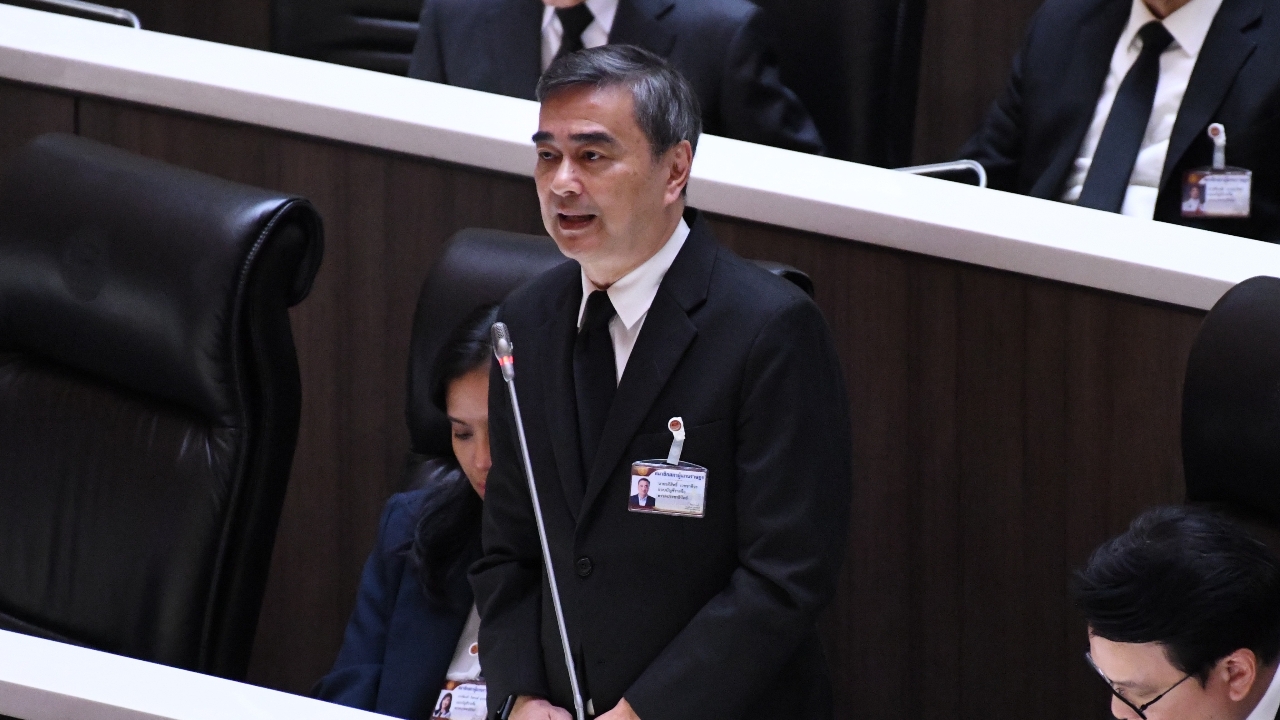
The Democrat Party leader outlined four reasons to challenge the decree in parliament, warning against creating burdens that push public debt to its ceiling.
On 26 Aug 2026 GMT+7, during a House of Representatives meeting to consider the Royal Decree granting the Ministry of Finance authority to borrow 400 billion baht to address the energy crisis and facilitate the country's energy transition, Abhisit Vejjajiva, party-list MP and leader of the Democrat Party, stood to oppose and firmly vowed not to approve this decree.
Abhisit cited four main reasons to reject the loan decree: It violates legal provisions and lacks urgent necessity—citing expert testimony to the Constitutional Court that the decree does not meet the urgency conditions; It fails to address the root problem—the government allowed fuel prices, a key cost, to escalate without tackling the cause but plans to spend this loan which will be depleted within just four months; It increases economic risk—this borrowing will push public debt to GDP up to 70 percent, risking financial instability if future crises occur; And it lacks a clear energy transition strategy—half the budget lacks a clear plan, while allowing many data centers that increase fossil fuel energy use, with unclear government intentions whether power line investments are for public benefit or to favor data centers.
The Democrat leader also expressed concern that allowing budget reallocations or using funds for energy skills training projects in some ministries risks opening doors to corruption and political favoritism. He compared that during past crises like the Tom Yum Goong or the Global Financial Crisis, borrowed funds still helped stabilize the economy and raised GDP growth by up to 5 percent.
“I firmly state that if this decree passes parliament and is enforced, we will not see significant change in economic growth, and the people will continue to face energy problems. Therefore, I cannot support approval of this decree,” Abhisit concluded.