

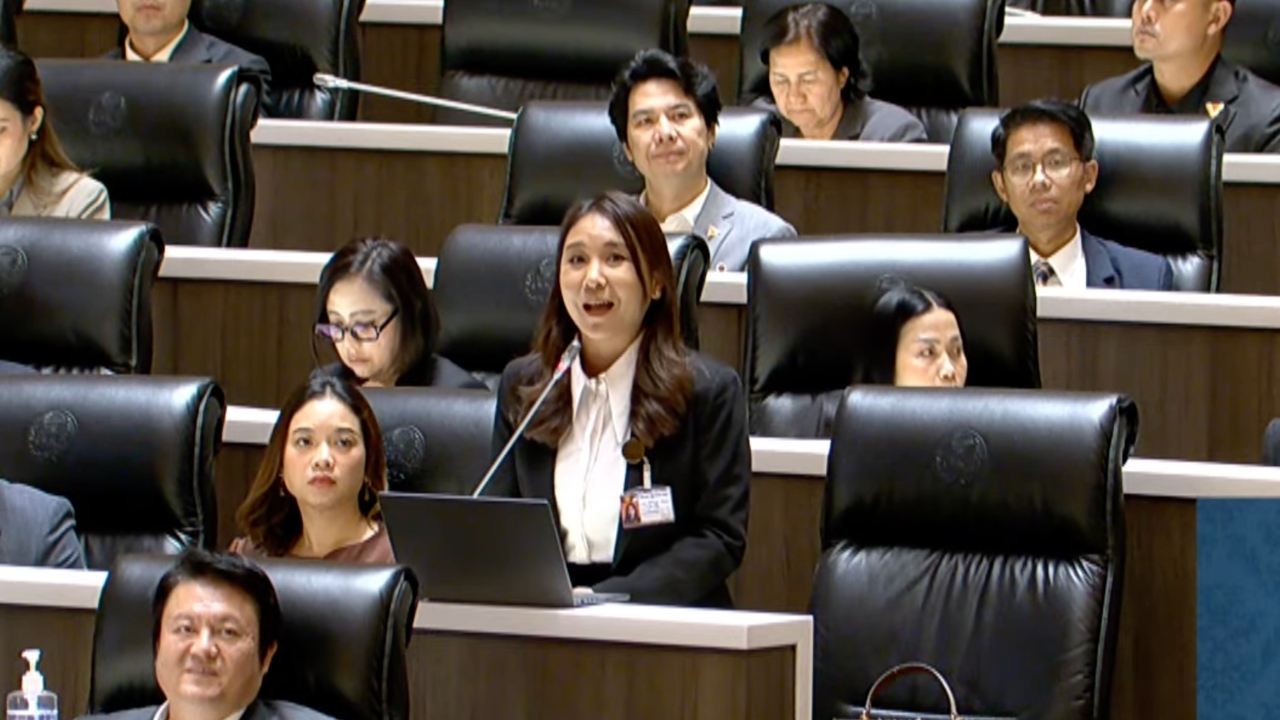
Sirikanya concluded the debate on the 400 billion baht loan decree, warning that the government is setting a precedent by borrowing over the parliament's head. She fears public debt could approach 70% of GDP without a clear energy transition plan, risking new forms of corruption, and urges the National Anti-Corruption Commission (NACC) to monitor closely.
On 26 Aug 2026 GMT+7, during a House of Representatives session, the draft decree authorizing the Ministry of Finance to borrow 400 billion baht to address energy crisis impacts and support the country's energy transition was considered. Sirikanya Tansakul, a party-list MP for the People's Party, summarized the opposition coalition's debate.
Sirikanya said that although the Constitutional Court ruled the decree did not violate Section 172 paragraph one, she respects the ruling but believes the broad interpretation of “economic security” sets a harmful precedent. Future governments could issue loan decrees for almost any general policy without a crisis justification.
For example, if bureaucratic problems are deemed to affect economic security, the government could issue loan decrees to reform the bureaucracy or pay early retirement to civil servants. Moreover, dissenting judges and expert witnesses raised concerns about separation of powers, vague plans and projects, and insufficient cost-effectiveness data. Unlike normal budget processes allowing parliamentary scrutiny before spending, this decree lets parliament review only after funds are spent.
Sirikanya continued that despite the urgency claim, 113 days after issuing the decree, the screening committee approved only one Thai Help Thai Plus project. With the fiscal year 2027 budget starting in about a month, she questioned why the government did not choose a law specifying detailed plans and projects for normal parliamentary consideration.
She warned the decree might undermine economic security itself. Including compensatory borrowing for the 2027 fiscal deficit, public debt could rise to 69.4% of GDP, assuming 2.5% economic growth and 2.2% inflation. If either misses targets, debt could exceed 70% immediately. Borrowing 400 billion baht would increase interest payments by at least 10 billion baht annually. Yet the government offers no clear repayment plan or contingency if debt exceeds the ceiling.
Regarding the first 200 billion baht, the People's Party agrees with borrowing to aid the public and sees economic conditions warrant urgent help but disagrees with the approach, especially the Thai Help Thai Plus program requiring citizens to co-pay 40%, which contradicts principles of direct relief.
She questioned how Thai Help Thai Plus could address rising factory closures and unemployment, while unemployment insurance claims reached 2.37%, the highest in 4-5 years since the COVID-19 crisis.
On the remaining 200 billion baht for the energy transition plan, four months have passed without any approved projects. This reflects the government's lack of a real work plan or clear targets for increasing clean energy or reducing fossil fuel use.
Consequently, agencies keep proposing shifting projects—from old car trade-in schemes to public transport switching to EVs, then narrowing to EV taxis, before reverting to seven types of public vehicles. Questions remain if the Solar Rooftop one million households project can truly add 5,000 megawatts and align with the Power Development Plan (PDP).
Sirikanya stated the government should end the practice of letting agencies propose procurement projects. For example, a circular from the Department of Local Administration lists projects ranging from solar streetlights, solar sports fields, solar-powered systems, to EV garbage trucks and ambulances—raising serious corruption concerns. Approval delays may stem not from unfinished energy transition plans but from unresolved kickback negotiations.
The corruption risk factors are complete here: monopoly on decision-making excluding parliament, wide discretionary powers without clear plans, and lack of accountability mechanisms due to absent success metrics. This may be a “new innovation in corruption,” risking centralized rent-seeking through specification locking and innovation account codes. The NACC should urgently audit since the government requires all projects to be screened by 30 Sept.
Sirikanya concluded that the People's Party supports borrowing to aid people but demands targeted, effective measures directly benefiting intended groups, not fallback on half-half style programs. They also support a 100% energy transition but insist on detailed plans, targets, clear screening processes, and proper parliamentary oversight.