

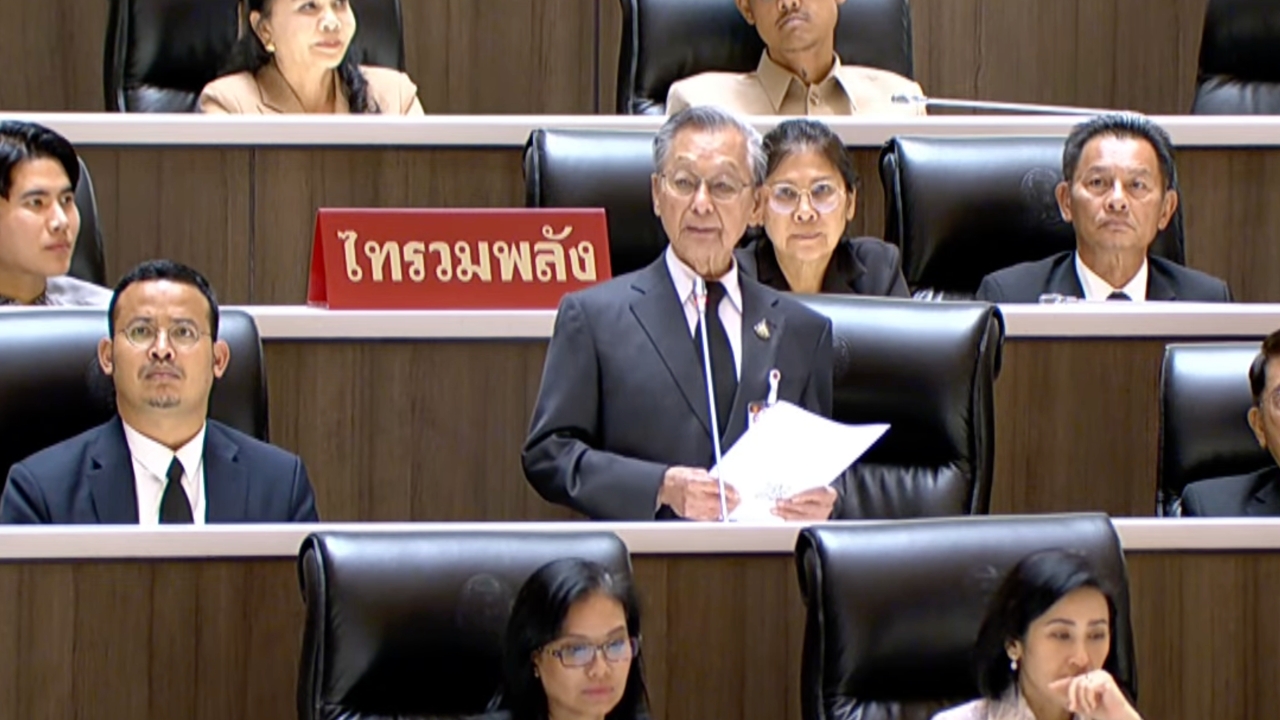
Chuan emphasized the need to remind Constitutional Court judges not to let politics interfere or let personal debts of gratitude influence their rulings. He urged repayment of personal debts through benefits to the nation and called on senior officials to awaken their conscience and not submit to improper politicians.
At 6:00 p.m. on 26 August 2026, at the Parliament, during a House of Representatives session, Chuan Leekpai, a Democrat Party list MP, spoke against the government's 400-billion-baht loan decree. He said he was among 133 MPs who jointly petitioned under Article 173, paragraph one of the Constitution, for the Constitutional Court to determine whether the decree met the urgent necessity condition in Article 172. Although the court unanimously approved Section 5(1) concerning loans to help the public and farmers, it voted 7 to 2 against Section 5(2) promoting efficient energy use, with two justices ruling it did not meet the urgent necessity condition. Out of respect for the court's discretion, Chuan regarded the Constitutional Court as a pillar of the nation that must uphold principles firmly. He expressed support for the court, led by its president and other justices, including Sarawut Songsivilai, noting recent structural changes with the appointment of a former Department of Highways director as a justice, differing from the usual legal or administrative backgrounds. Although Sarawut is capable and good, this reflects political interference altering the court's structure. He urged all justices to remain the nation's pillar and not let debts of gratitude sway their rulings. Such debts should be repaid after one's death, such as attending funerals, and should not compromise national principles. He said he has always supported and protected the judiciary and does not want to see political interference.
Chuan continued that he and fellow MPs filed the petition not due to the behavior of the petitioner but because they sincerely considered that the decree did not meet the unavoidable urgent necessity condition under Article 172, paragraph two. The heart of democracy is the separation of powers among legislature, executive, and judiciary. The executive must respect and not encroach on the legislature. A true executive elected by the people should not fear parliamentary scrutiny nor evade legislative processes for convenience. The facts, now over four months since the law was enacted, clearly show there was no genuine urgent necessity.
He recalled past lessons from violations of principles, citing unrest in the three southern border provinces, where over 51 violent incidents recently occurred. These problems began when past executives disregarded the rule of law, exercising power by arresting and deciding the fate of offenders without due process, fueling ongoing conflict causing over 7,000 deaths to date. He stressed the need to uphold principles; otherwise, governance will collapse. The Constitution's preamble warns that past crises arose from lack of guidance, disregard for rules, corruption, fraud, and power distortion. Therefore, the current situation requires caution to prevent history from repeating. He urged all senior officials to serve as the nation's foundation, not yield to improper political pressure, and guide politicians to act rightly to save the country from crisis.