

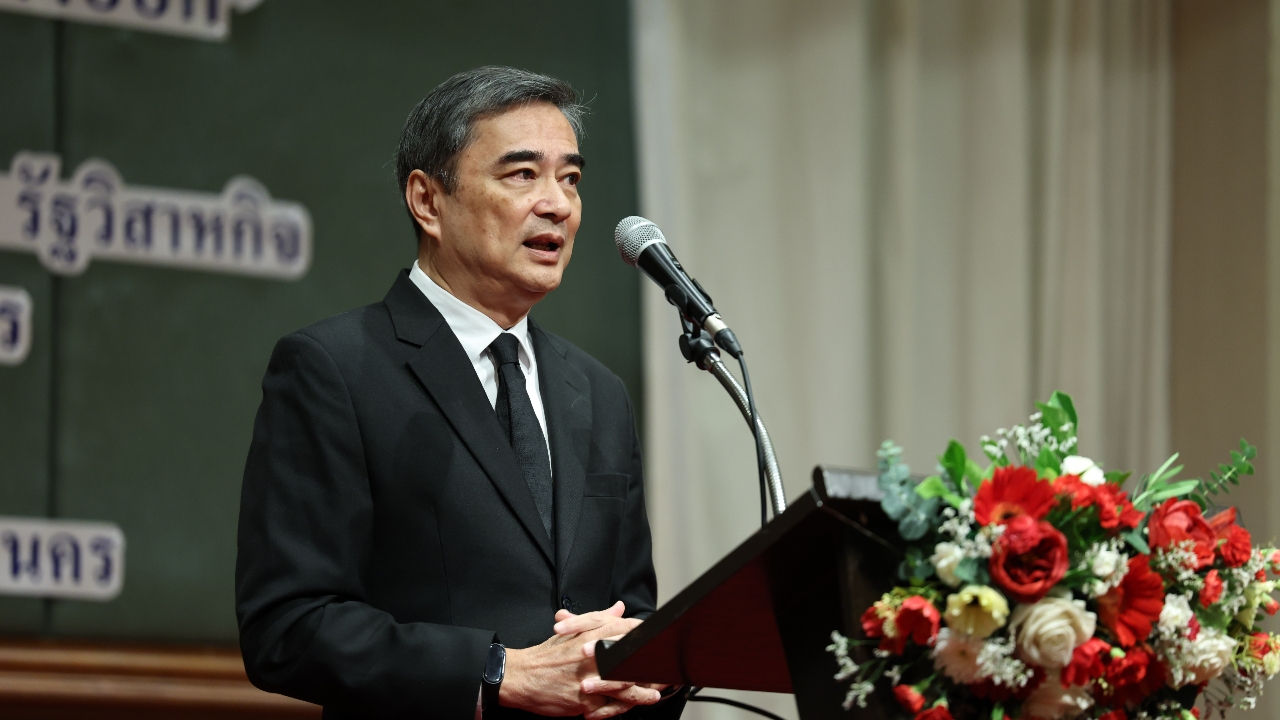
Abhisit emphasized that the crisis of trust in independent organizations is real, resulting from political parties and politicians seeking state power through comprehensive interference and sending people to seize these organizations. He suggested constitutional amendments regarding the origins of independent organizations and the Senate.
At 9:00 a.m. on 28 August 2026 at the Rama Gardens Hotel in Bangkok, the Parliamentary Committee on Court Affairs, Independent Organizations, Prosecutor Organizations, State Enterprises, Public Organizations, and Funds, together with the King Prajadhipok's Institute, held an academic seminar titled "Crisis of Trust in Independent Organizations: Origins and Solutions." Abhisit Vejjajiva, party-list MP and leader of the Democrat Party, serving as a committee member, chaired the seminar and delivered a keynote speech titled "Lessons from 30 Years of Independent Organizations." He stated that although Thailand uses a parliamentary system, it has established many independent organizations, unlike other countries with parliamentary systems that often do not have such bodies. In many countries, there is not even a vote of no confidence, as politicians themselves take responsibility—from MPs to ministers to the prime minister—as a social mechanism to check irregularities. For example, in Japan, the UK, Australia, and Canada, if a politician fails to take responsibility, their party will handle it. Australia and the UK often change prime ministers by this mechanism, where the party decides the leader has to go. However, in Thailand, almost every party still operates as if it has an owner, making it very difficult to use this mechanism, except between the owner and the prime minister or the party's top executives.


Abhisit explained that the concept of independent organizations arose from the democratic principle that elected officials hold power. Since 1992 and the 1997 constitution, this idea was included in the supreme law for the first time, establishing bodies like the Constitutional Court, Administrative Court, Election Commission (EC), Ombudsman, Auditor General, and Human Rights Commission. These were created to oversee politicians who misuse power or enter office improperly. He spoke because today there is a crisis, with many people thinking of abolishing all such organizations and relying solely on elections to decide. He warned against this cyclical pattern. There was hope with the first EC that issued red and yellow cards prompting repeated elections, but politicians kept finding ways to interfere with independent organizations. The 2007 constitution introduced a mixed Senate system—partly elected, partly appointed—replacing direct elections. The current constitution, drafted by a military junta that wrote its own rules and prepared to be players, advanced this further by designing the Senate selection system, an unprecedented political innovation worldwide. Now, there is a complete system where groups plan to seize the Senate mechanism to place people in independent organizations, linked with ruling parties and the executive branch.

"The problems and origins of independent organizations' interference have worsened as agencies expand their domains and block participation in oversight. Beyond being controlled by certain groups, today it is very difficult to use or scrutinize independent organizations. It is no surprise that we are discussing a crisis of independent organizations. We must consider solutions. What I see now is that if we have a new constitutional drafting process, it is a golden opportunity to review this issue. I still believe we need a network of independent organizations to check politicians' power. If politicians and parties cannot build trust that they will self-regulate, at minimum, efforts must be made to amend two provisions: 1) the origins of independent organizations, and 2) the origins of the Senate, which selects independent organizations. Additionally, distorted mechanisms must be fixed, such as allowing the Speaker of the House discretion over submitting cases to the National Anti-Corruption Commission. If amending the constitution is difficult, related rules must be improved to make independent organizations more transparent. We cannot remain idle. If we do, and parties occupy the Senate and place their people in independent organizations that protect the executive and Senate from wrongdoing, with no one able to oversee them because the Speaker blocks it, I feel these people are using freedoms to undermine the regime itself. Democracy is not just elections; it is responsibility to the people," Abhisit said.