

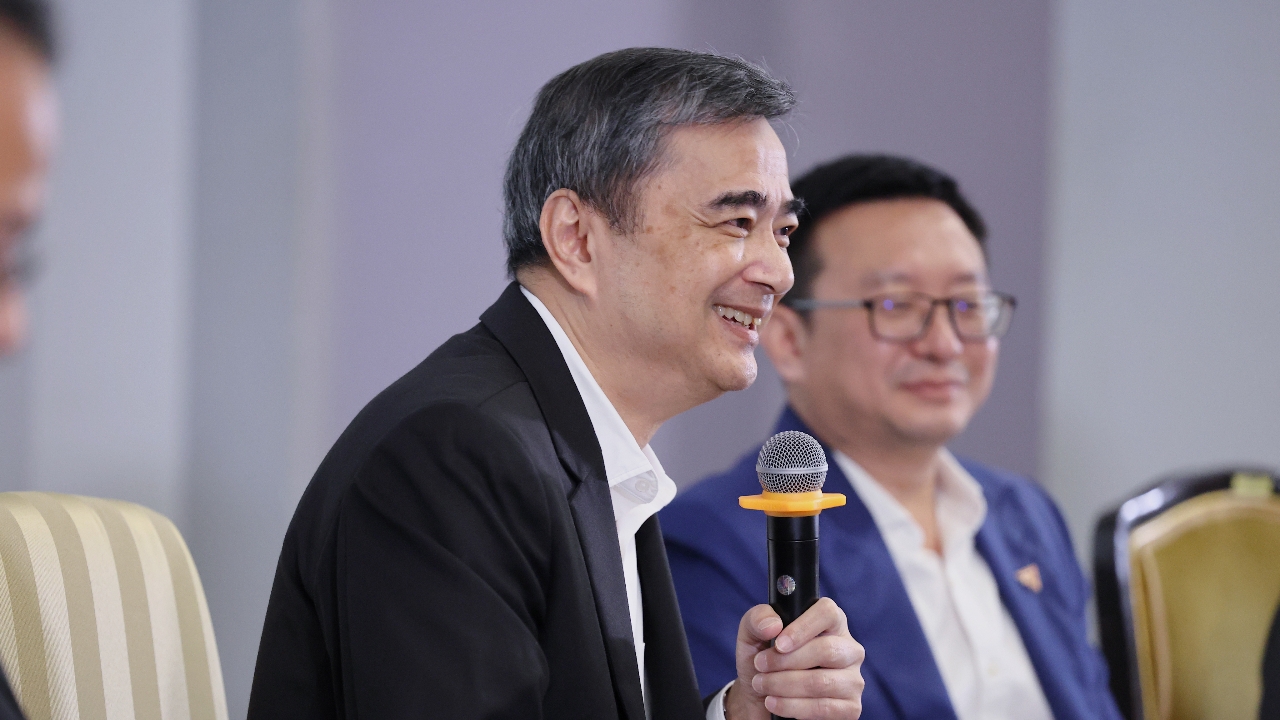
Abhisit Vejjajiva tasks opposition leaders with amending the constitution regarding the appointment of senators and independent organizations, cautioning about vote-rigging in the Constitution Drafting Assembly alongside the Sak Siam case. He firmly states the Senate vote-rigging case on 14 September will not conclude, criticizing the Election Commission for stalling and insisting it cannot evade responsibility.
On 29 August 2026, reporters noted that during the second session of the opposition leaders' forum in the House of Representatives annual budget year 2026, a question arose about opinions on Senate vote-rigging and what would happen if the Election Commission did not submit the case to the Supreme Court's election division. Abhisit Vejjajiva, party-list MP and leader of the Democrat Party, said he wished to clarify that sharing a stage did not mean agreement on all issues. He agreed with some points but differed in analysis on others.
He agreed on the need to push for a new constitution with a Constitution Drafting Assembly (CDA) but warned to beware of "CDA vote-rigging." He said this could deepen, with new rules written to legitimize current practices even more heavily. They may not fear the justice system because if unsuccessful, there are still safeguards—as seen today. He asked opposition leaders to act since the Democrat Party is small and lacks sufficient votes, emphasizing the need for constitutional amendments clause by clause, especially on the Senate and independent organizations, encouraging society to help find ways to change.
Abhisit added there are two key tests now: whether oversight mechanisms can truly check everyone, and the pending matter of requesting the Speaker of the House to forward the impeachment of the National Anti-Corruption Commission (NACC) members handling a case. Sak Siam Chidchob, former Minister of Transport, concerning hidden shares at the Supreme Court, which on Thursday, 27 August, was explained by Sopon Sarum, Speaker of the House, as being under review by an expert committee.

At a panel discussion of the Parliamentary Commission on Judicial Affairs, Independent Organizations, Prosecutors, State Enterprises, Public Organizations, and Funds, Wut Tingsamit, a former senior Supreme Court judge, stated clearly that the law requires sending the case to court if there is reasonable cause. Previously, the Speaker acted merely as a messenger, but now discretion is used. If there is suspicion, the case must be sent. It has been 83 days, implying reasonable suspicion, otherwise the matter would have been closed. Therefore, this important matter must be closely followed.
Abhisit continued on the Senate vote-rigging, noting recent reports of celebrations in advance suggesting that by 14 September everyone will escape consequences. He emphasized that the Election Commission is not the judge; if it has credible evidence, it must forward the case to the court. The question is how to measure credible evidence, at what level. However, judging by comments from Sawaeng Boonmee, Secretary-General of the Election Commission, who previously warned before the Senate election that vote-rigging is very serious and cautioned candidates accordingly, citing Supreme Court rulings that even candidates merely discussing vote exchanges are committing offenses.

But Sawaeng Praditpanya changed that stance to say exchanges are allowed, recently clarifying the elements of the offense, emphasizing that there must be clear evidence of offering benefits. Yet Supreme Court rulings in August 2025 on a Senate election case, where the Election Commission was the petitioner and two candidates were respondents, made it clear that merely chatting via the Line app constitutes an offense under Section 62 of the Organic Act on the Senate. Similar rulings followed in September and November 2025, regarding simple vote exchanges without further behavior, as consistently presented at opposition events. Thus, anyone thinking the matter will end on 14 September is mistaken; much more evidence has surfaced later.
"Will the Election Commission dare deny that these matters relate to their discretion? Even if they claim the Senate vote-rigging case is closed, their own matter is not. We must take legal action against them. Mr. Supachai Jaisamut should not misunderstand; this is our rightful legal action. Previously, the Election Commission set a precedent through its actions, which courts accepted as genuine offenses. So why, when the misconduct is heavier and more systematic, has the case not been sent to the Supreme Court? I am monitoring and supporting society's efforts to investigate this. Though obstacles remain, it is our duty to continue. Therefore, I firmly declare that anyone thinking the matter will end on 14 September is wrong—it will definitely not end then."