

The government is promoting a "Model Village Water Supply System" that removes arsenic using synchrotron and nanotechnology, applying Thai research to restore clean water to communities along the Kok River.
On 30 Aug 2026, Major Phatdarasmi Thongsaluaykorn, Deputy Spokesperson for the Prime Minister's Office, stated that as arsenic and heavy metals became pressing water quality issues for communities, research must move beyond the lab to practical solutions. Therefore, the government supports the Ministry of Higher Education, Science, Research and Innovation (MHESI) to deploy Thai research in the field by developing a "Model Village Water Supply System" to remove arsenic and heavy metals in areas along the Kok River in Chiang Rai Province.
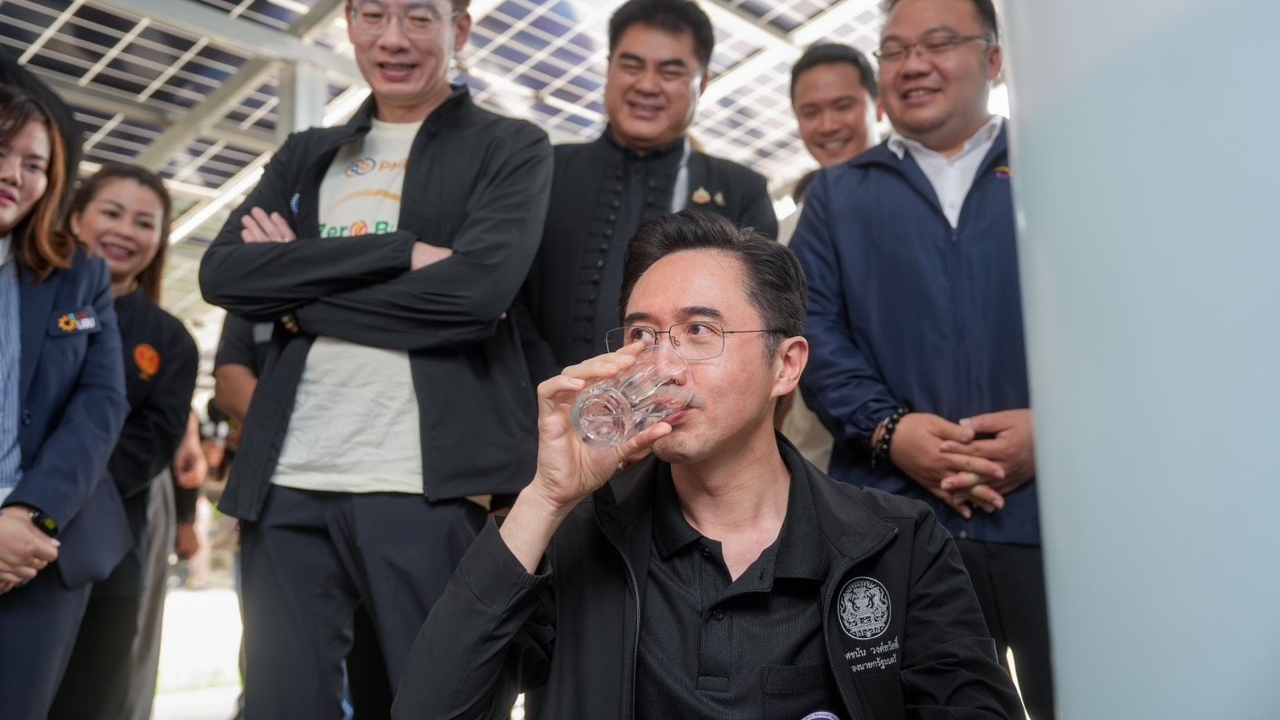
On 29 Aug 2026, Mr. Yotsanan Wongsawat, Deputy Prime Minister and Minister of MHESI, visited Chiang Rai to preside over the handover of the model village water supply system for arsenic removal to the Ban Muang Ngim and Ban Rim Kok communities. This enables local authorities to improve water quality and care for residents, addressing issues of turbidity, arsenic, and heavy metal contamination in the area.
The filtration system results from a partnership between the Synchrotron Light Research Institute and NANOTEC. The Synchrotron Institute used synchrotron light technology to analyze arsenic characteristics to guide appropriate treatment methods, while the National Nanotechnology Center (NANOTEC) applied nanotechnology knowledge to develop adsorbent materials specific to arsenic and heavy metals, then integrated these into a community water filtration system.
The developed system can capture 100% of arsenic, and the filter material can be regenerated for reuse, reducing long-term maintenance costs. It has been installed and is operational in pilot areas along the Kok River, covering more than 700 households. Additionally, Ban Farm Samphanthakit has a water treatment system serving over 250 households, and Ban Muang Daeng School in Mae Sai District has installed filtration systems to serve over 700 students and staff.
The Deputy Spokesperson for the Prime Minister's Office emphasized that clean water is fundamental not only for drinking water but also for health and quality of life, including cooking, hygiene, agriculture, and livelihoods. When water quality changes, communities need scientific data and appropriate technology to manage risks and confidently safeguard their daily water usage.
Mr. Yotsanan stated that MHESI aims for research to be applied practically rather than remaining unused. While the ultimate solution to arsenic contamination in the Kok River is controlling pollution at the source, this takes time. In the meantime, people need clean water for consumption, so science and technology must be applied locally alongside long-term efforts.
Besides the model village water system, NANOTEC has developed "AquaNano," a nano-technology drinking water production and filtration device with water quality monitoring, which can be adapted into mobile units for disaster situations. It can produce up to 250 liters of clean water per hour, supporting both community use and emergencies.
This technology is the work of Thai researchers primarily using domestic materials, helping reduce reliance on foreign technologies and showing potential for adaptation to other areas. The government is ready to support collaboration among research institutions, local authorities, and communities to expand water innovation to other high-risk regions.