

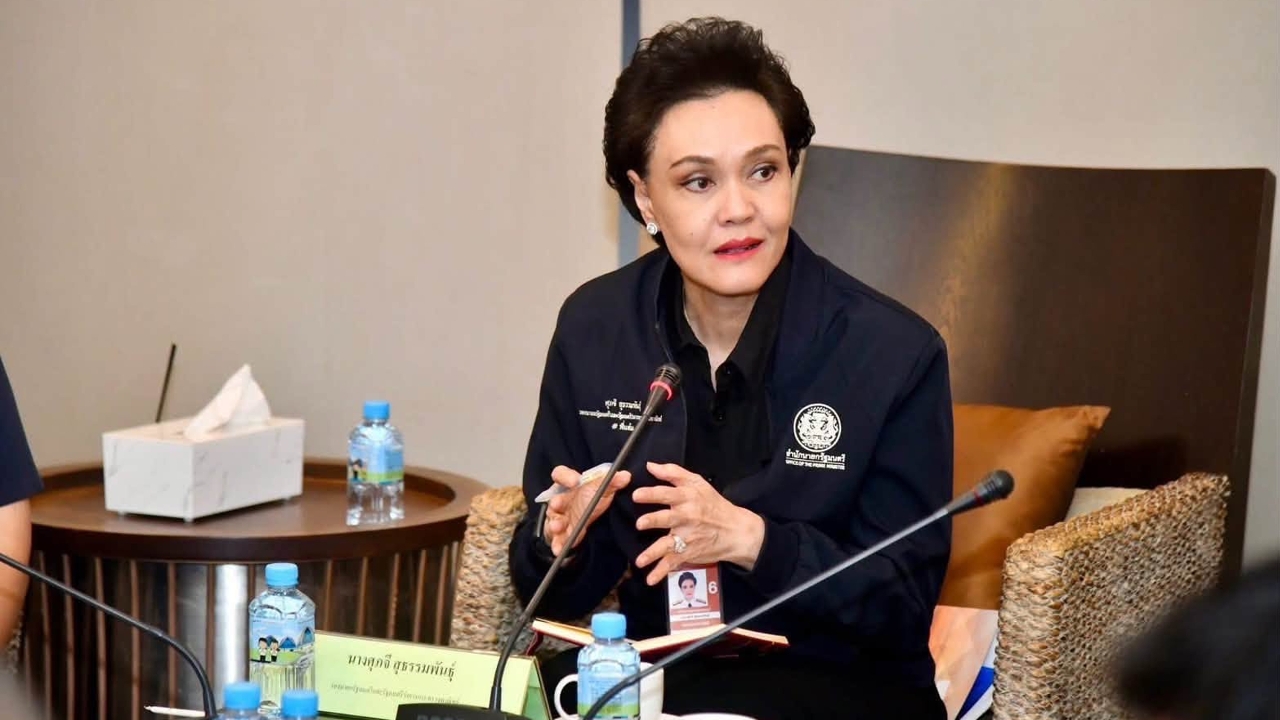
Supachai presents figures showing Thailand's exports have grown continuously for 25 months, advancing three balances: market, products, and income, while distributing opportunities to SMEs, farmers, and small entrepreneurs.
On 30 Aug 2026 GMT+7, Supachai Suthumpun, Deputy Prime Minister and Minister of Commerce, posted on her personal Facebook about Thailand's export situation, highlighting continuous export growth for 25 months. She stated that in July 2026, exports were valued at 34.7891 billion USD, a 21.6% increase, while the total for the first seven months reached 231.531 billion USD, growing 18.2%. Although continuous export growth is a good sign, the more important question is “Why is it that when exports grow, the public still does not feel the economy has improved or that their incomes have increased accordingly?” The post includes the following content:
"Thailand's export figures have grown continuously for 25 months. In July 2026, exports amounted to 34.7891 billion USD, up 21.6%, and for the first seven months, totaled 231.531 billion USD, growing 18.2%. But a more important question than 'how much exports grow' is: why is it that when exports grow, people still don't feel the economy is better or that incomes have risen? This is the challenge we need to reconsider: the 'structure' of Thailand's exports shows that what we must urgently address are three balances: market balance, product balance, and income balance." Supachai also said,
1. Market balance: In the past, we have relied heavily on traditional markets, especially major ones like China and the US. Amid economic and geopolitical volatility, we must accelerate opening new markets, diversify risks, and create more opportunities for Thai products to reach consumers in many countries.
2. Product balance: Many exported products are produced in Thailand mainly through contract manufacturing, while the proportion of Thai local content remains insufficient.
Therefore, the challenge is not just to increase exports, but to ensure every export generates more value and income within Thailand, especially in agriculture and food sectors involving many people. Our agricultural products have recently expanded after several years. Moving forward, we will use food security as a key strategy in trade negotiations and creating new opportunities. Global events like wars, natural disasters, and raw material shortages require us to shift from a Just in Time to a Just in Case approach, building a resilient supply chain capable of handling volatility. Thailand's strength in food security can then promptly meet global emergency needs.
Thailand must position itself as an essential part of this supply chain.
3. Income balance: Currently, Thailand has about 30,000 export businesses; around 23,000 are SMEs, and about 7,000 are large enterprises. However, over 80% of export income is concentrated among large exporters. This explains why growing export figures may not widely benefit smaller players.
Supachai added that the Ministry of Commerce's role is not just to grow export numbers but to ensure that growth is more widely distributed.
• Expand new markets to reduce dependence on traditional ones.
• Increase local content so more export value remains within the country.
• Create opportunities for SMEs, farmers, and small entrepreneurs to benefit more from exports.
Because the ultimate goal is not just "Thailand exports more"
but "Thailand and its people benefit more from exports."
This is the meaning behind building the balances of market, products, and income that are currently underway.