

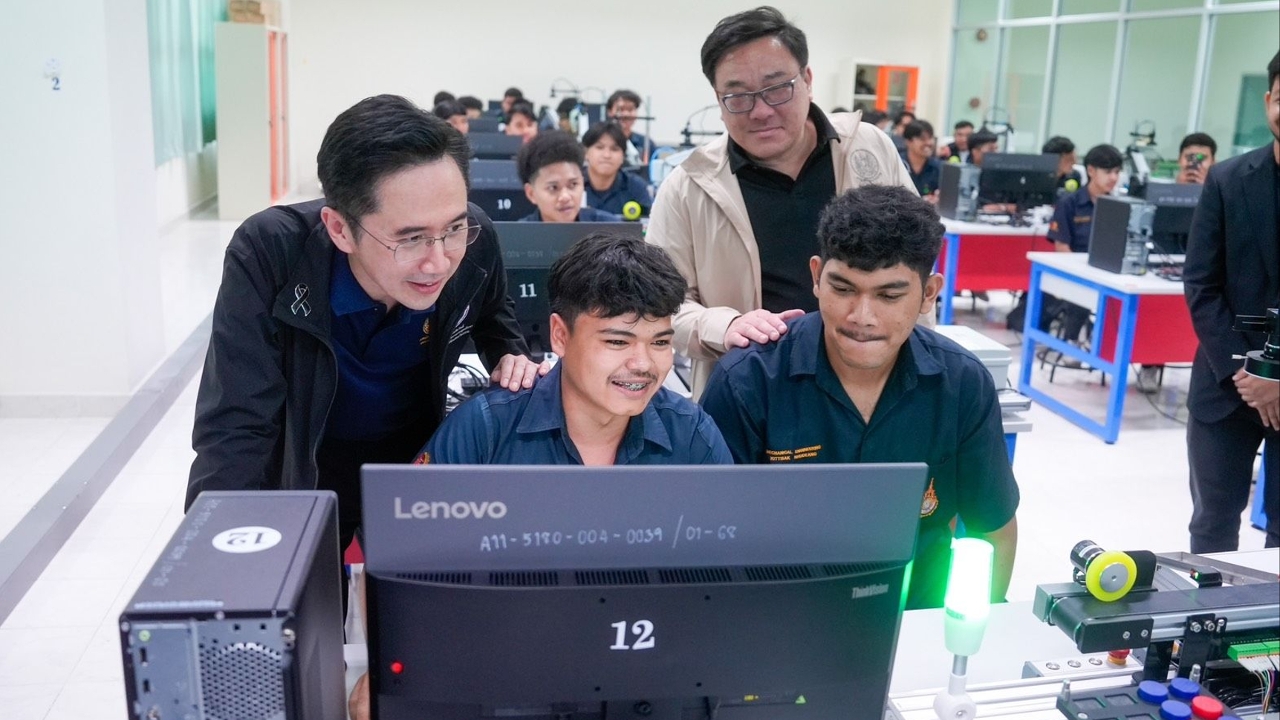
Yotchanan, accompanied by two ministers, visited Rajamangala University of Technology Srivijaya (RMUTSV) to drive innovation into practical application. They launched a rapid water warning center to address recurring water issues and integrated solutions, while also developing a robotic workforce to enhance human capital.
On 30 Aug 2026 GMT+7, Deputy Prime Minister and Minister of Higher Education, Science, Research and Innovation (MHESI), Yotchanan Wongsawat, along with Minister of Labour Julphan Amornwiwat and Minister of Social Development and Human Security Nikorn Somkalang, traveled to Songkhla province to conduct official duties ahead of the upcoming offsite Cabinet meeting scheduled for 31 Aug and 1 Sep. They inspected research and innovation support at RMUTSV and participated in a workshop to develop the five southern provinces.
During the visit to RMUTSV, the delegation toured the Water Situation Monitoring Center at the Faculty of Engineering, which serves as the second War Room for monitoring water conditions in Hat Yai district and Songkhla province. This center integrates real-time water resource information systems and weather forecasting to analyze flood and drought trends and provides accurate early warning alerts to communities to minimize damage to lives and property.
In addition, the center monitors salinity levels in Songkhla Lake, alleviating difficulties for farmers across more than 300,000 rai surrounding the lake. It also plays a vital role in conserving the Irrawaddy dolphin, a rare endangered species found only in Songkhla Lake in Thailand, which is one of five freshwater habitats worldwide for this dolphin species.
Next, the delegation visited the Robotics and Automation Training Center, a key hub for upskilling and reskilling industrial technology workforce in southern Thailand. The center showcased innovations in industrial robotics and automated production systems developed by faculty and students. Discussions included developing high-competency workforce curricula to supply local industries and support the growth of future industries.

Yotchanan stated that universities must lead in applying science and technology to solve real societal problems, from fundamental water management that ensures public security to advanced robotics skills driving economic growth. The Faculty of Engineering at RMUTSV has demonstrated its capacity to be a concrete support for communities and industries.
These efforts reflect the government’s human capital development policy, which advances the use of technology and academic research as key mechanisms to enhance citizens’ quality of life while building a skilled workforce to drive Thailand’s long-term economic progress.
Furthermore, Yotchanan chaired a workshop promoting inclusive development in the five southern provinces: Songkhla, Satun, Yala, Narathiwat, and Pattani. The focus was on social dimensions and human capital development. The meeting saw full cooperation from relevant ministers, provincial governors, government agencies, private sector representatives (including chambers of commerce, industrial councils, tourism industry councils, YEC groups), civil society, and local MPs. They presented subgroup findings to the Prime Minister and Cabinet, facilitating exchange of views and joint conclusions.
Subsequently, Yotchanan met with the Thai Shrimp Association, which presented proposals to upgrade Thailand’s shrimp industry through science and technology. Yotchanan and Julphan listened to the association’s concerns regarding severe shrimp disease issues. They received proposals to apply science and technology to support shrimp farming. Agencies under MHESI, including the National Research Council of Thailand (NRCT) and the National Science and Technology Development Agency (NSTDA), are ready to support related research. A Shrimp Breeding Research and Development Center, located in Chaiya district and collaborating with BIOTEC NSTDA, Prince of Songkla University, and Mahidol University, has been operating for some time.

Yotchanan then chaired a water management meeting for southern Thailand involving MHESI agencies and local universities. He listened to disaster management feedback and provided policy guidance. He emphasized that flood and drought solutions from central to southern regions must align infrastructure design, including housing and roads, with the country’s budgetary context. MHESI will strengthen scientific data support to prioritize and assess suitable urban models. Given budget constraints, full urban restructuring may be difficult, so solutions must fit local contexts alongside community preparedness and adopting circular economy principles.
He added that emergency response cannot rely solely on military forces indefinitely; sustainable management systems must be established. Songkhla is seen as a key model for learning to develop integrated science, research, and innovation in water management linking the entire country from north to south.
Yotchanan further stated that the development of warning systems must be balanced to avoid desensitizing the public to alerts during real emergencies. He praised the efficient data system of the Office of National Water Resources (ONWR), which can identify bedridden patients and water flow directions. The next major goal is year-round integrated collaboration to shift from reactive problem-solving to genuinely strengthening and preparing communities. The mission concluded at 17:30.