

Veerayut brought People's Party leaders to Ayutthaya to hold a meeting establishing the party branch, opening a discussion that raised the observation that pollution and corruption problems are concentrated in 'deep blue provinces.' They referred to these as areas with entrenched political networks aligned with the blue political faction.
On 30 Aug 2026 GMT+7, Veerayut Kanchuchat, deputy leader of the People's Party, attended the official founding of the party branch in Phra Nakhon Si Ayutthaya province. He was joined by key party figures including Natthawut Buapratum, party executive committee member, Rakchanok Srinok, and Karunpon Thiansuwan, a party-list MP from the People's Party.
In the morning, People's Party members from Phra Nakhon Si Ayutthaya gathered at Jok Talat Phlu restaurant in Ayutthaya to hold a meeting to establish the party branch. The meeting passed a majority vote approving the creation of the party branch and its committee, marking the official start of the party's local branch in Phra Nakhon Si Ayutthaya.
Former MP Tawiwong Totawiwong, representing Ayutthaya constituency 1, highlighted the importance of party branches as mechanisms enabling the party to respond to members’ views and attract more resources for local work. He noted that the 2017 Political Party Act requires parties to seek opinions from provincial branches and representatives before issuing policies. Establishing branches also entitles areas to receive budget allocations from the Political Party Development Fund.
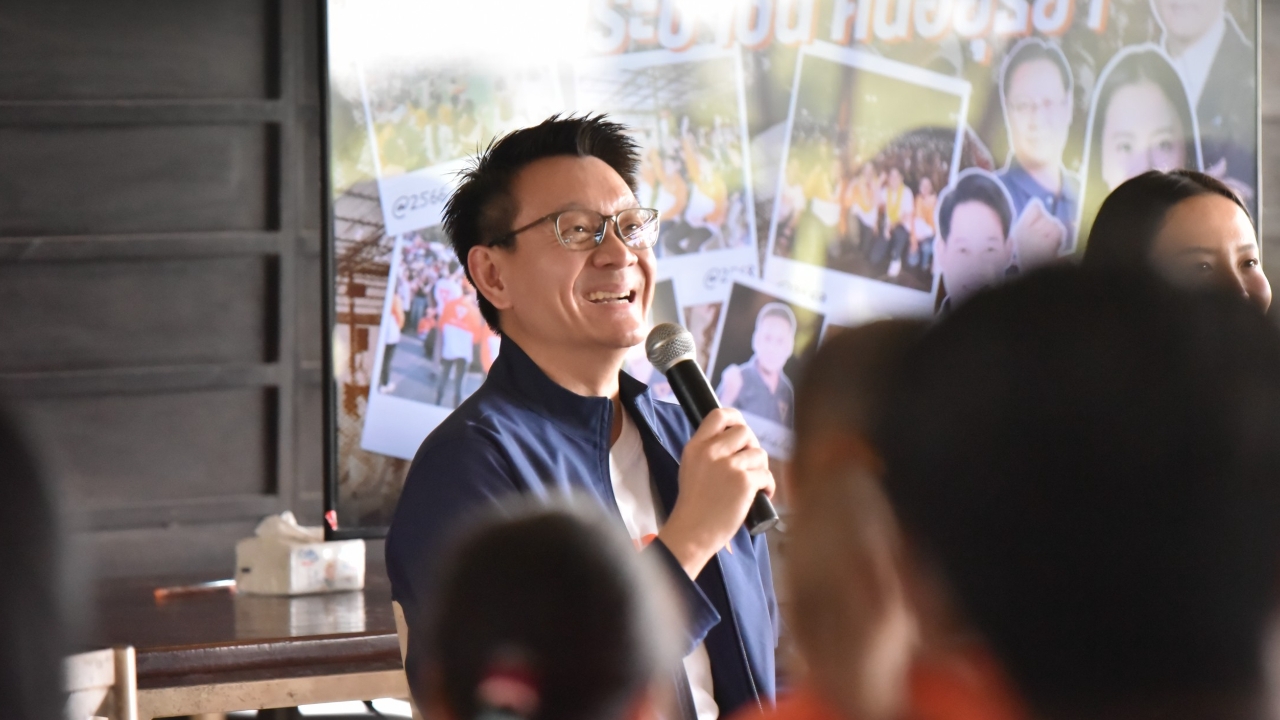
Afterwards, Veerayut led MPs and former People's Party candidates Tawiwong Totawiwong and Charin Wongpanthien to a public forum, allowing party members to ask questions and exchange views on issues the party is pushing, such as the TH-AI Passport project and exposing corruption in other programs.

Veerayut invited participants to note that the pollution and corruption issues frequently reported in the news all occur in 'deep blue provinces' where local political networks are linked to the blue regime. These networks benefit each other to the extent that they turn a blind eye and neglect strict oversight, and instead harass and sue citizens who expose problems to silence them.
One participant shared personal experience of being sued and bullied to hinder career growth after exposing organizational corruption. They urged the party to seriously push for legal and other measures to protect whistleblowers. In addition to advocating the draft Anti-SLAPP legislation, Veerayut pointed to the party’s 'Whistleblowers Get Paid, Corrupt Fall Apart' policy as a key mechanism to tackle corruption in agencies.
Meanwhile, Rakchanok and Karunpon added that MPs and the party’s central leadership cannot advance large social agendas alone. They invited party members and the public to participate according to their strengths. They pointed out that the ability of Ayutthaya residents to unite in establishing a party branch is a positive sign that will help strengthen local efforts.
Rakchanok cited an example of how the power of the people surpasses leaders’ voices by reducing bias against the party and sharing accurate information with close contacts, especially amid rampant fake news on social media. Online communities and the public play a crucial role in using their relationships to disseminate correct information—something MPs and their teams cannot always reach.

Beyond hot societal issues, party members raised local problems for the party to follow up on, such as road surface damage from resurfacing on Bang Krasan–Bang Pa-in route, concerns about urban planning compliance amid signs of gray Chinese investment encroaching on Ayutthaya’s real estate via nominees, and complaints about illegal hotel operations. The provincial working group received these complaints and coordinated with relevant committees for resolution.
The People's Party aims to establish branches in all provinces to give members a platform to express opinions and to unite efforts to translate the party’s policy agenda into tangible local actions.

