

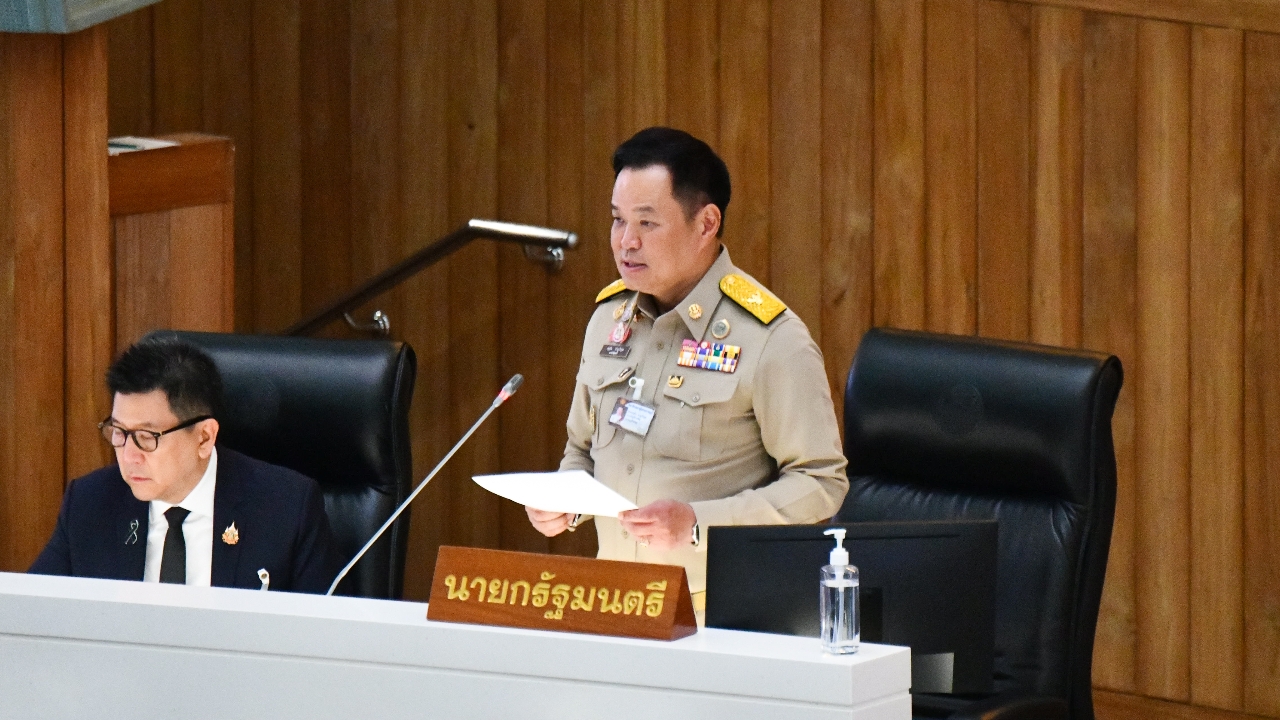
The Prime Minister explained to the Senate that the energy crisis caused by the Middle East conflict has affected oil prices and living costs. Normal funding sources are insufficient, making it necessary to borrow 400 billion baht, emphasizing this is a last-resort measure with strict financial discipline applied.
On 31 August 2026 at 09:00, in the Senate meeting room, Prime Minister Anutin Charnvirakul presented the royal decree empowering the Ministry of Finance to borrow 400 billion baht to address the impacts of the energy crisis and support the country's energy transition to the Senate.
The Prime Minister explained that the Middle East conflict has disrupted production, infrastructure, and energy transportation routes, especially the Strait of Hormuz, resulting in tight global oil supply and rising energy prices. Thailand imports nearly 50% of its oil from the Middle East and remains highly dependent on fossil fuels, affecting production costs, prices of goods and services, living costs, and purchasing power.
He stated the government must use the royal decree because normal funding sources and fiscal tools are insufficient and untimely for the situation. The 2026 mid-year budget of 99 billion baht is already allocated to multiple urgent tasks, with an additional 140 billion baht needed. Even with a 50 billion baht contingency fund, the funds remain inadequate.
Meanwhile, about 72% of the 2026 budget has been disbursed and must cover remaining plans for the year. The loan to cover the budget deficit is about 17 billion baht. The 2027 budget of 3.788 trillion baht will start in October 2026, which is too late to address urgent needs.
The Prime Minister said although the government has implemented various fiscal measures, these are still insufficient, making the royal decree an urgent tool. It has one goal, two objectives, and three approaches. The goal is to preserve economic stability. The objectives are 1) to assist citizens, farmers, and businesses affected, and 2) to reduce fossil fuel dependence quickly. This will be done by lowering living costs and occupational expenses, supporting domestically produced renewable and alternative energy, and developing skills and energy innovation.
The loan of up to 400 billion baht is divided equally: 200 billion baht to help citizens, farmers, and businesses, and 200 billion baht to improve energy efficiency, accelerate the transition to renewable and alternative energy, and develop skills and innovations in energy. The Ministry of Finance may borrow or issue bonds with Cabinet approval by 30 September 2027.

The Prime Minister emphasized this loan is a last resort after the government tried to manage funds within existing laws. The borrowing will remain under fiscal discipline, expecting the public debt to GDP ratio not to exceed 70%. Plans for borrowing and repayment will be systematic to control costs and spread risks. Projects using the loan must be carefully screened to ensure they meet objectives, are urgently needed, cost-effective, not duplicated with other budgets or funds, and executable immediately.
He concluded by saying the energy crisis is a severe and urgent emergency that cannot be avoided. The government therefore requests the Senate's approval of the royal decree to address the energy crisis impacts, safeguard economic stability, and drive the country’s energy transition.
Finally, the Prime Minister expressed gratitude for the Senate members’ comments, advice, suggestions, and concerns raised during the session. The government will consider these carefully in its operations, affirming full compliance with laws and regulations to maximize public benefit from the loan spending, and thanked the Senate for the opportunity to present the royal decree draft today.
