

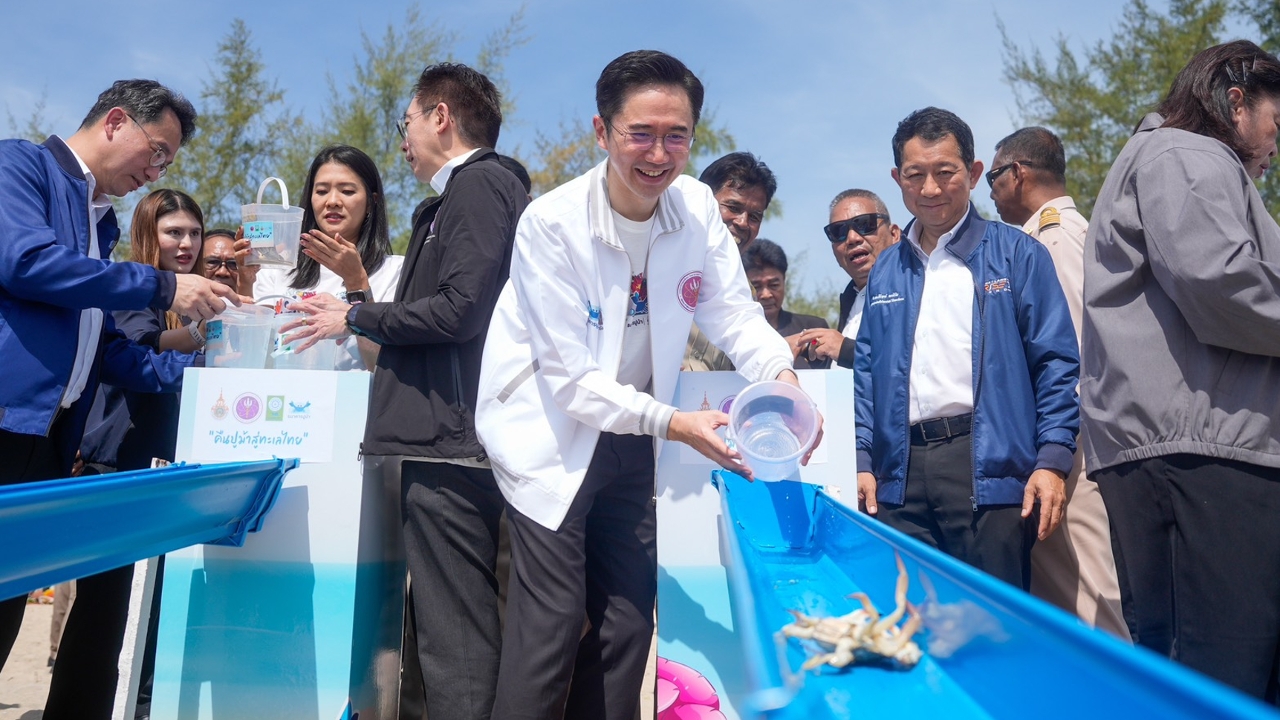
“Yotsanan” leads the Ministry of Higher Education, Science, Research and Innovation team to Songkhla, promoting innovations such as the “Blue Crab Bank” and “Coral Dome” to restore Thai seas on a global scale, aiming to drive community economic development.
On 31 Aug 2026 GMT+7, Mr. Yotsanan Wongsawat, Deputy Prime Minister and Minister of Higher Education, Science, Research and Innovation, visited Songkhla to monitor government inspections and deliver policies supporting research and innovation to enhance community capabilities and environmental conservation. The visit was at the Economic Aquatic Animal Hatchery Conservation Center in Phang Sai group, Kradangnga Subdistrict, Sathing Phra District, Songkhla Province. Mr. Supachai Pathumnakul, Permanent Secretary of MHESI, and other executives accompanied him. This site visit during the Cabinet's mobile meeting aimed to directly hear citizens’ issues to translate them into policies focused on sustainably improving the quality of life for southern residents.
Mr. Yotsanan spoke about the origins and key inspiration behind advancing the national marine resource conservation agenda, citing the royal initiative of Her Royal Highness Princess Sirivannavari Nariratana Rajakanya. He said, “I was inspired by Princess Sirivannavari from visiting her exhibition at Siam Paragon. She cares deeply about marine conservation and is involved in waste collection efforts. We want to find ways to get the whole world to help preserve our southern seas, including the Andaman and Gulf of Thailand areas, by inviting talented people worldwide to bring technology and turn the south into a Living Lab for collective conservation efforts.”
To continue this vision, MHESI plans to announce a policy to transform biodiversity into economic value under the concepts of “Nature Positive” and “Nature Financing” at the global STS Forum in October. The goal is to attract international organizations such as the UN and UNICEF to collaborate and position Thailand as a global leader in marine conservation.
For driving the community economy or Local Growth Engine, MHESI has strengthened the Blue Crab Bank project by integrating advanced technology like Digital Twin systems to collect and analyze data on water quality, weather, pollutants, and E. coli bacteria. This supports planning crab releases to maximize survival rates. They also aim to innovate around the Blue Crab Bank center by linking with Science Parks and startup groups to enhance processing, add product value, and attract international investment back into the area.
Simultaneously, development will extend beyond marine resources to increase the value of terrestrial natural resources such as oil palm, rubber, bamboo, herbs, and renewable energy. This includes promoting the Andaman Wellness Corridor economic zone, with Thaksin University playing a leading role in driving this initiative.
Additionally, preparations are underway to improve health infrastructure. He noted, “We are discussing adding a second hospital in Hat Yai to ensure everyone has access to the best healthcare.”
Regarding research progress, the National Research Office reported tangible successes impacting ecosystems and communities. The “Coral Dome” project acts as an underwater wave barrier and fish habitat supporting 64 species, restoring 2.99 rai of beach. Currently, 797 new domes are being installed in Singhanakhon District. The “Return Blue Crab to Thai Seas” project has expanded to 565 sites across 20 coastal provinces, increasing blue crab populations by an average of 67%.
At the event's conclusion, Mr. Yotsanan chaired the presentation of certificates to 24 outstanding research projects and awarded the “Local Growth Engine” emblem to 28 networked Blue Crab Banks. He expressed gratitude for the seamless collaboration from all sectors, including MHESI, the Department of Fisheries, Ministry of Natural Resources and Environment, Ministry of Interior, local university networks, civil servants, and political officials, all working together toward the ultimate goal of securing sustainable economic stability and quality of life for future southern generations.