

The Senate approved the 400 billion baht loan decree, but senators criticized the loan budget for the energy transition, noting only a single page outlining the 200 billion baht request without details. Senator Nantana accused the government of aiming to allocate funds to insiders in the solar energy sector instead.
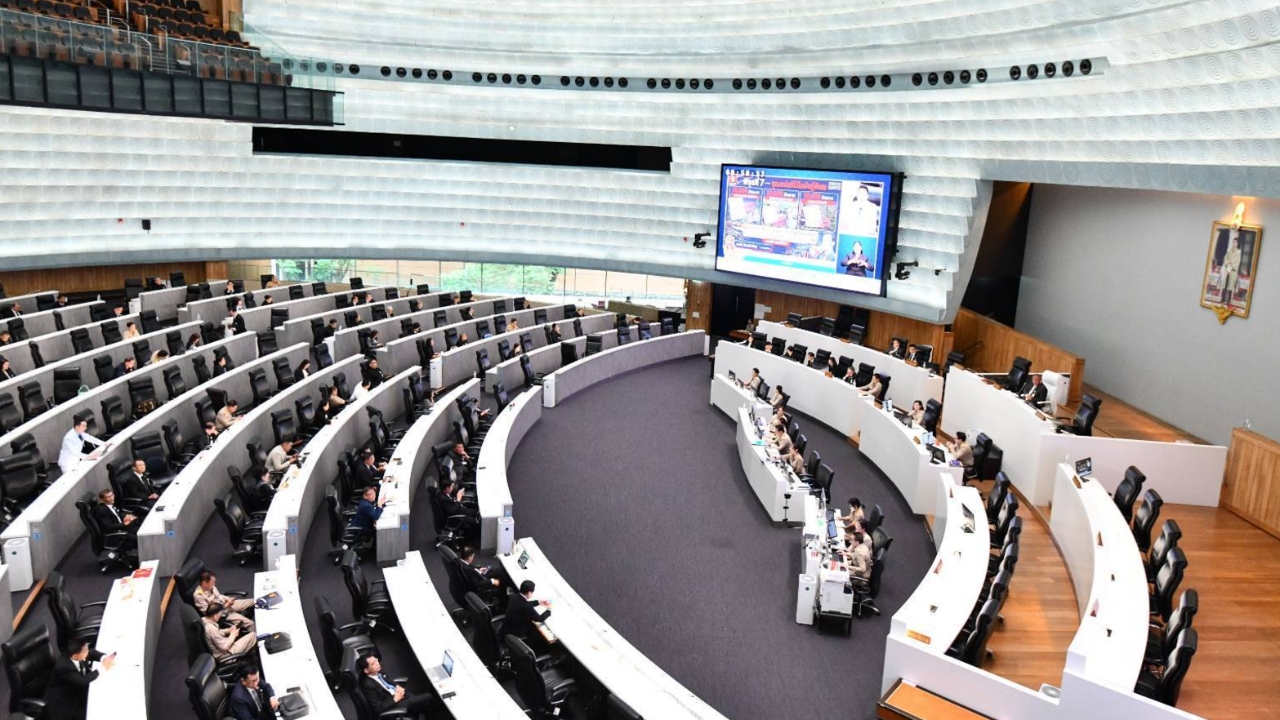
At 09:30 on 31 August 2026, the Senate convened at the Parliament, chaired by General Kriangkrai Sririk, Deputy Senate President, to consider the emergency decree authorizing the Ministry of Finance to borrow 400 billion baht to address the energy crisis and facilitate the country's energy transition. Prime Minister and Interior Minister Anutin Charnvirakul explained the necessity of borrowing due to the energy crisis and that the 2026 budget is insufficient to cover the scale of impact and costs. Fiscal measures alone cannot solve the problem promptly. Without this loan decree, the crisis would prolong and increase systemic economic risks. The decree aims to ensure energy security, support citizens, farmers, and businesses affected, reduce fossil fuel use rapidly, and promote domestic renewable and alternative energy. The government has tried managing existing funds but found it inadequate, so borrowing 400 billion baht is a last-resort option.
Anutin affirmed that the borrowing would not affect public debt management, which is capped by law at 70%. The loan use is cost-effective, urgent, and non-duplicative, subject to committee screening and in accordance with the attached schedule. Last week, the House approved the measure, and following legal procedures, the government submitted it to the Senate for consideration. He requested the Senate's approval so the decree can be enforced as intended to solve economic and energy problems and improve citizens' quality of life.
Reporters noted that during his statement to the Senate, the Prime Minister spoke with a hoarse voice and coughed intermittently. He explained to the Senate that he is treating a bronchial condition with medication, which is improving, but he felt it necessary to attend personally to demonstrate the government's commitment and respect for the Senate's decision-making.
Senator Lieutenant Wuttipong Pongsuwan expressed concern that the 200 billion baht energy transition budget appears contradictory and questioned whether it addresses the right problems. Public debt is nearing 70%, with annual interest exceeding 200 billion baht, which is worrisome. Domestic borrowing could affect SME operators' ability to obtain loans. Furthermore, the 200 billion baht energy transition loan details are limited to a single page with only 5-6 lines, averaging tens of billions per line. The specifics are unknown to senators, though outsiders may have some knowledge. He urged the government to investigate to prevent policy-level corruption. He trusts Energy Minister Ekniti Nitithanprapas as honest but warned that others might insert inappropriate elements, especially among many local governments. He urged vigilance against misuse of government authority. If national energy security is achieved at the cost of fiscal insolvency, future generations will bear an annual interest burden of 200 billion baht.
Senator Nantana Nantavaropas argued that using loans while the economy is struggling is like pouring chili paste into a river. She criticized the plan to spend 200 billion baht on promoting rooftop solar installations on houses as a short-sighted idea with hidden agendas. She questioned who benefits, why the government focuses so heavily on solar energy when other energy forms exist. Installing rooftop solar costs 150,000 to 300,000 baht, which is unaffordable for most. The Bank of Thailand reports that 88% of Thai people have less than 50,000 baht in bank accounts, while only 2% have over one million baht. Thus, over 90% cannot afford solar panels. She questioned if the 200 billion baht loan benefits only this 2%. If one million households each borrowed 200,000 baht, 200 billion would go to the solar industry insiders, increasing household debt in Thailand from 16.4 million million baht to 16.66 million million baht. The government should allocate limited resources to the most needy, helping those struggling first.
At 12:50, Lavorn Sangsnit, Permanent Secretary of the Ministry of Finance and chairman of the loan screening committee, explained concerns that the projects lack detail and are like signing blank checks. He admitted many projects have yet to submit formal proposals. However, if the decree passes the Senate, good projects will be proposed with official proposals, and not all will be approved. Projects must pass the screening committee’s thorough review beyond the decree’s brief details. Criteria include urgency and lack of budget allocation, ability to proceed immediately upon approval and completion by 30 September 2027, and cost-effectiveness with economic benefits. After approval, spending effectiveness will be evaluated. The Ministry of Finance must report loan use and outcomes to the Senate within 60 days after fiscal year-end. He assured transparency, professionalism, and clear responses to public concerns. As chairman, he confirmed that approved projects will align with the decree’s intent to genuinely facilitate the energy transition.
Deputy Prime Minister and Finance Minister Ekniti Nitithanprapas affirmed the loan decree is urgently needed, as this crisis differs from past economic crises. Second quarter economic data confirm that without this decree, the crisis would worsen. The crisis comes in waves: first, global oil prices rose 60-70%; second, inflation from high transport costs; third, private consumption contraction causing unemployment and business closures. This wave threatens to leave lasting economic scars. Thailand is a top importer of oil and natural gas in Asia, leading to a nearly 600 billion baht current account deficit in the second quarter alone, revealing economic weakness. Thus, energy transition must proceed urgently. He used the analogy that Thailand’s house has a leaking roof requiring buckets to catch water. Borrowing continuously without investing to fix the roof is futile. If more storms come, buckets will still be needed. Transitioning energy reduces oil and gas imports. On transparency concerns, all projects funded by this decree will be clear, cost-effective, and free from corruption. Project proposals will be publicly available online for scrutiny. Collective effort will strengthen the country. Today, Thailand must reinforce its house and replace the roof so future storms strengthen the nation.
Reporters reported that after all members finished debating, the Senate voted to approve the 400 billion baht loan decree with 135 in favor, 11 against, 28 abstentions, and 1 not voting.