

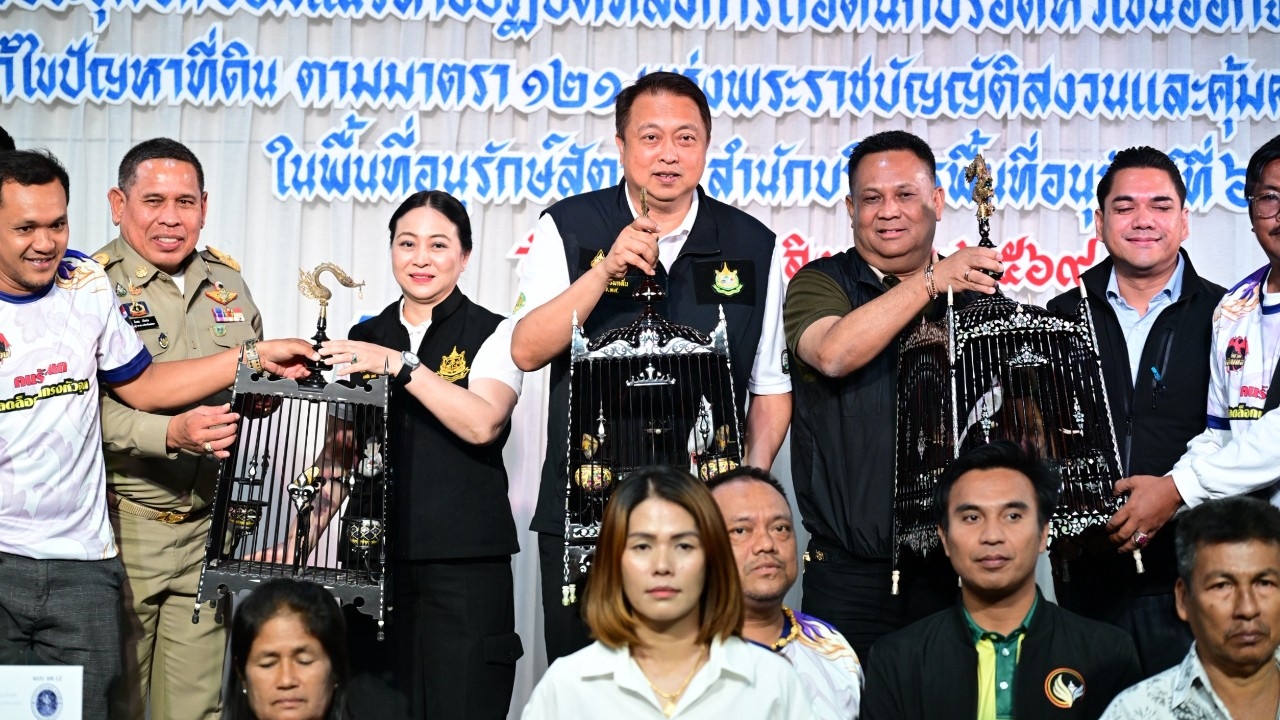
Sutachai, Minister of Natural Resources and Environment, signed to unlock and adjust the legal status of the "Helmeted Bulbul," or "Nok Krong Hua Chuk," fulfilling a long-awaited demand of southern residents, presenting it as a gift, and moving forward to create balance where "people can live and nature can live."
31 Aug 2026 GMT+7 Mr. Sutachai Chomklin, Minister of Natural Resources and Environment, presided over a meeting to rehearse operational guidelines following the legal status adjustment of the Helmeted Bulbul and presented land use or residence rights documents (OS.12) within protected forest areas at the S Hotel in Hat Yai, Songkhla province. Present were Mrs. Rawiwat Phuridet, Permanent Secretary of the Ministry; Mr. Attapon Charoenchansa, Director-General of the Department of National Parks, Wildlife and Plant Conservation; ministry executives; Mr. Sangkhom Koedko, Deputy Governor of Songkhla; Mr. Somyot Playduang, Member of Parliament for Songkhla's 3rd constituency; related agencies; and local residents who welcomed and participated in the meeting.
Mr. Sutachai said today is an important day for the southern people after signing the ministerial regulation to adjust the legal status of the "Helmeted Bulbul", or "Nok Krong Hua Chuk." This has been awaited for a long time by breeders and propagators in the South. He intends this action as a gift from the Ministry of Natural Resources and Environment, promoting community economy alongside natural resource conservation.
The legal status adjustment aims to align with the lifestyle, culture, and economy of communities, especially in the South where people have long been connected to breeding and propagating these birds. It allows these activities to proceed legally and develop into professions generating community income.
"The southern people have waited a long time for this. Today, I have signed to unlock the Helmeted Bulbul, which is a gift to the southern people. But I emphasize that unlocking does not mean allowing wild bird capture. We must still protect and seriously combat illegal hunting to preserve the wild bird population."


Going forward, the Ministry of Natural Resources and Environment will promote proper and systematic breeding to increase captive bird numbers, reduce pressure on wild populations, and create economic opportunities for breeders and propagators. A database and identification marks for the birds will be developed to trace origins and regulate effectively, working closely with local breeding networks.
The Minister emphasized that this regulatory adjustment must accompany conservation. If in the future a significant decline in wild Helmeted Bulbul populations occurs, the government and relevant agencies can review measures and enhance protection levels. The key goal is to build a balance where "people can live and nature can live," allowing community economies to grow alongside natural resource preservation.
The Department of National Parks held a meeting in Songkhla to rehearse operational guidelines after the legal status adjustment of the Helmeted Bulbul, preparing controls for breeding, database creation, measures to prevent wild bird capture, and prevention of releasing captive birds into the wild, which could affect native bird populations.
The Permanent Secretary of the Ministry added that the Ministry aims to balance natural resource conservation with improving people’s quality of life and economy by collaborating with agencies and networks to ensure sustainable and proper resource use.
Additional reporting notes that the ministerial regulation mentioned by Mr. Sutachai was officially published in the Government Gazette today (read the Government GazetteMinisterial Regulation Designating Certain Wildlife as Protected Species (3rd Edition) B.E. 2569 (2026))


Meanwhile, Mr. Attapon revealed that the Department of National Parks is carefully preparing measures to support the Helmeted Bulbul status adjustment, focusing on preventing wild bird capture, controlling breeding, monitoring wild populations, and creating identification marks and databases for systematic oversight.
In addition to the bird status adjustment, Mr. Sutachai also presented land use or residence rights documents (OS.12) to residents in the Songkhla Lake Wildlife Sanctuary, Ko Mak Subdistrict, Pak Phayun District, Phatthalung Province, to secure housing and farmland, reduce disputes between the state and people, and enable community participation in forest conservation.
The responsibility area of Conservation Area Office 6 (Songkhla) covers Songkhla, Phatthalung, Trang, and Satun provinces. The Department of National Parks has surveyed and managed 401 villages with 37,585 households across more than 358,481 rai of protected forest area. It will expedite recognition of land use rights in other areas alongside promoting livelihoods and community development to ensure residents’ security, coexistence with forests, and advance the goal of "people can live, communities are strong, nature survives" sustainably.