

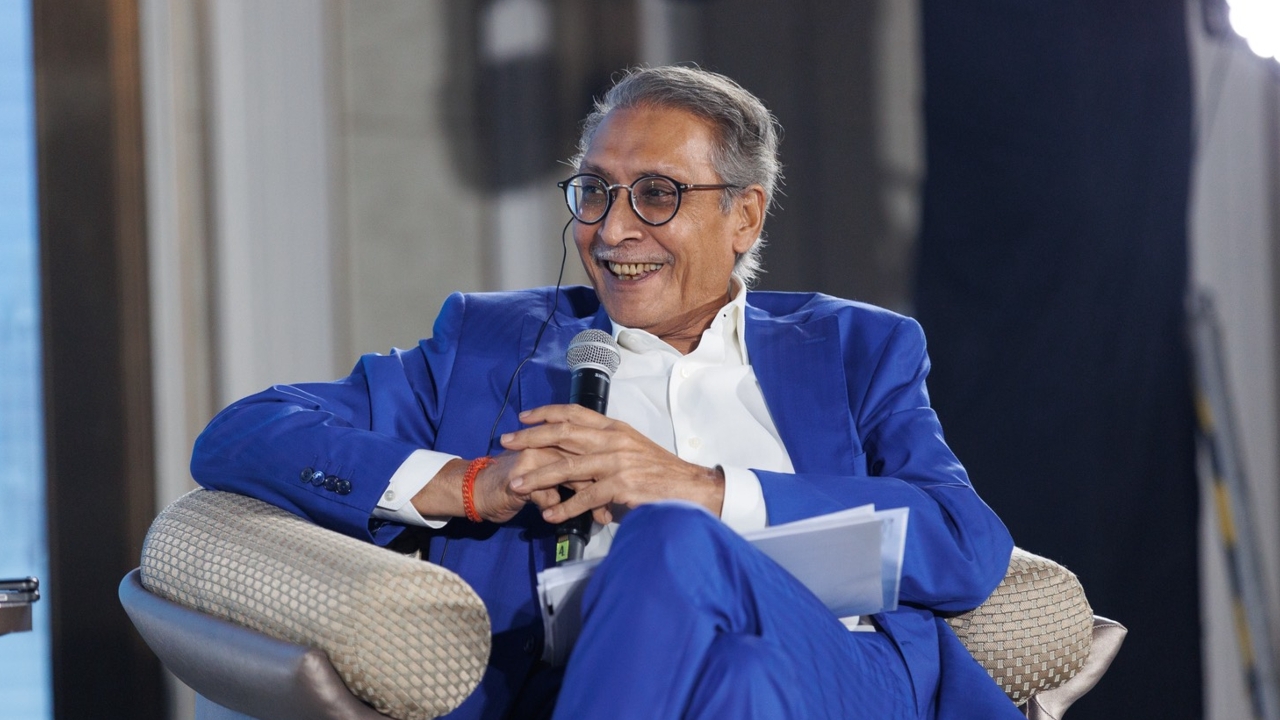
Aloke recounted his company’s history of weathering every global economic storm through organizational flexibility and restructuring. He praised Bangkok’s still-developing potential and encouraged foreign firms to relocate their bases here. He also advised Thailand to lift restrictions and enable state enterprises to adopt a more proactive role.
On 31 Aug 2026 at the Eastin Grand Hotel Phayathai, Thairath Group hosted the THAIRATH FORUM 2026: THAILAND IN THE NEW GLOBAL ORDER under the theme “Transforming Thailand’s Economic Strategy.” The event featured Special Professor Dr. Surakiart Sathirathai, Chairman of Chulalongkorn University Council and former Deputy Prime Minister; Mr. Arthit Nanthawitaya, CEO of SCB X Public Company Limited; Mr. Prasit Boondoungprasert, CEO of Charoen Pokphand Foods Public Company Limited; and Mr. Aloke Loehia, CEO of Indorama Ventures Public Company Limited. They analyzed economic challenges, sought opportunities, and explored Thailand’s path forward in the new global order, with Mr. Supachon Klinsuwan as moderator.
When asked about IVL’s global revenue and factory distribution, especially in the U.S. and Europe amid uncertainties over trade policies and tariffs under Donald Trump, Aloke explained his strategy for managing the portfolio and diversifying industrial risk. He said that a key challenge for any private company is the 'Founder’s Dilemma'—the difficulty of passing leadership from one generation to the next to sustain the business.
Over the past 35 years, he has learned much like other organizations. They needed to establish a firm position for IVL in the petrochemical industry.
"I began by moving here alone with my family—my wife and two children at the time (our third child was born here in 1993)—with a starting family capital of 10 million USD in 1988. Then, in 1997 during the Asian financial crisis, Thailand faced its biggest crisis. Many friends encountered severe problems. Interest rates in Thailand soared to about 15%, while U.S. dollar interest rates were only half that. So, companies that didn’t manage exchange rate risks were heavily impacted. We faced another challenge in 2008 from the global financial crisis, which affected our Western operations," Aloke said.

He added that a business like IVL depends on many factors. They have a management team and strive to operate as efficiently as possible. He feels very fortunate to be in Thailand, which serves as the hub for all key stakeholders. Although their customers are worldwide, their entire support base is in Thailand. Starting with 10 million USD, their business has grown tremendously, expanding from one factory to over 100 globally. As a founder, continuous improvement is essential, and risks should not be concentrated in one place. That’s why about 25 years ago, in 2002, he began investing abroad in the U.S., before the Shale Gas era, acquiring a distressed business. That marked the start of their global success.
"I believe we chose our target customers and markets well. We want to stay close to our customers. As I’ve said before, the 1997 crisis taught us the importance of scaling up business. To achieve the right scale, we undertook backward integration," Aloke explained.

He also stated they pursued forward integration by building a strong downstream business in Brazil. Regarding current crises like in Iran, he said these are not new problems, having faced similar situations in 2022 during the Ukraine war, which severely impacted them because their raw materials require refining but they do not own refineries. Two-thirds of their business is in the West, where oil majors have slowed refinery investments due to electrification trends, limiting raw material availability. They have managed these challenges and will be even more resilient in 2026, when results from efforts in flexibility, organizational restructuring, value chain integration, and operational clusters in the U.S., Brazil, Europe, and Indonesia will become evident.
"Looking back, I feel very proud because Thailand gave IVL the opportunity to grow and succeed. It is also where my family lives, so it truly is our home. Although not everything has been smooth, overall 8 out of 10 things have turned out very well," Aloke stated.

When asked about IVL’s global supply chain perspective amid emerging markets like India and the shift of manufacturing bases to ASEAN reducing business risk, and whether this region can become a new main economic engine, Aloke said that on a macro level, the question is how Asia can seize opportunities from new markets such as India and the influx of investors relocating to Southeast Asia. Where does Thailand fit into this picture? Thailand has an excellent business ecosystem developed over 3–4 decades. For example, the petrochemical cluster in Map Ta Phut is outstanding and competitive globally, supported by a strong supply chain network. The automotive sector, a key industry, is bolstered by EV growth, maintaining strength. The electronics sector also excels in producing PCBs and components.
Thailand also benefits from medical tourism and the overall tourism industry, which are strengths enhancing the country’s image. In terms of capital markets, Thailand is second only to Singapore in Asia by market size. So why not fully leverage the capital market we have?
Additionally, the Lower Mekong Subregion offers vast opportunities, especially in business ecosystems and the food industry—not just general production or growth. This region has a combined population of 250 million, which is still growing.
"For me, if I had to choose where to expand business, I see Africa as a bigger opportunity than India, because the Indian market is saturated and Indian entrepreneurs are highly skilled, making competition very tough. So, I prefer Africa," Aloke said.

Aloke also considers entering untapped or untested markets very interesting and sees this as an opportunity for IVL and Thailand. He believes Thailand should explore its capital market potential more. The country offers excellent talent attraction measures, low personal income tax, great food, top-tier service personnel, high-quality medical schools and international schools, and excellent safety.
"I recently read a World Bank report stating Bangkok still has much room to improve. So, I see this as a great opportunity. Before coming on stage, we discussed that many foreign companies should relocate their operations to Bangkok instead of Hong Kong or Singapore because Bangkok is better, safer, and much more livable."
Asked how his large business will move forward without leaving SMEs behind amid global crises, Aloke cited CPF’s example, which works with thousands of small farmers. Their group, PTT, has a large supply chain. Coming from abroad, they invested and grew in Thailand, becoming a billion-dollar company. His son-in-law started a packaging business with a single factory in Thailand. The 1997 financial crisis made many Thai families determined to be debt-free, though growth is still necessary.
"I think that’s the SME situation. Personally, I see some differences. For example, in India, we have automotive business supporting our customers consistently. We believe in Thailand’s potential and benefit from the Board of Investment’s incentives, like 10-year tax exemptions. We support customers by transferring technology and attracting Japanese companies to invest in Thailand with us. This is new and involves significant technological shifts, such as moving from crushing used plastic bottles for pellet production to directly using bottles in manufacturing with energy-saving technology."
Aloke added that they have strong confidence in their potential, especially in North America where they have shale gas resources and a fully integrated production process from upstream gas to downstream petrochemical products. They are the only company worldwide with such full integration. Meanwhile, Europe faces high energy costs and competitiveness issues due to the 2022 Ukraine crisis, which Thailand should monitor closely.
"I have been watching the situation closely. It is crucial not to let energy costs rise uncontrollably because that impacts you. India, with 1.4 billion people, naturally experiences high growth. What I want to learn from today’s news is about the goal of 5% economic growth over the next decade until 2037. Can we achieve this? I believe we can without doubt. But we must open doors to opportunities and expand business abroad. Both foreign and Thai investments overseas will be key to reaching that goal. You mentioned Chulalongkorn University, a leading institution in central Bangkok with many distinguished professors. I think we just need to better utilize financial institutions and capital markets, and entrepreneurs must be willing to take more risks."
In summary, regardless of business size, if you have some risk tolerance combined with Thailand’s policies and facilities plus global factors, you have a high chance of success when you open doors and expand outside Thailand.”
When asked about expectations for government policy and the idea that 'the government must be a sponge,' as a leader of a major Thai business, Aloke said that when the Deputy Prime Minister and the Governor of the Bank of Thailand met for discussions, he recommended removing various restrictions, especially enabling state enterprises to take a more proactive role. This would allow Thailand to move beyond being merely a transit point to becoming a true hub, like Dubai or Abu Dhabi. Currently, regulations limit activities such as producing goods in one province but selling in another, which should be revised. He sees enormous opportunities similar to Singapore’s model, where businesses access matching funds from government-supported financial institutions. If Thai state enterprises expand operations, they could advance into the Lower Mekong Subregion or extend connectivity to Vietnam to build complete supply chains and road transport systems. He recalled that after the 1997 economic crisis, recovery was fueled by massive infrastructure investment. Therefore, if the government increases spending and infrastructure investment, leveraging the strong state enterprises to drive projects as planned, it will create vast new opportunities.
He concluded by saying, "We must believe we can do it."
