

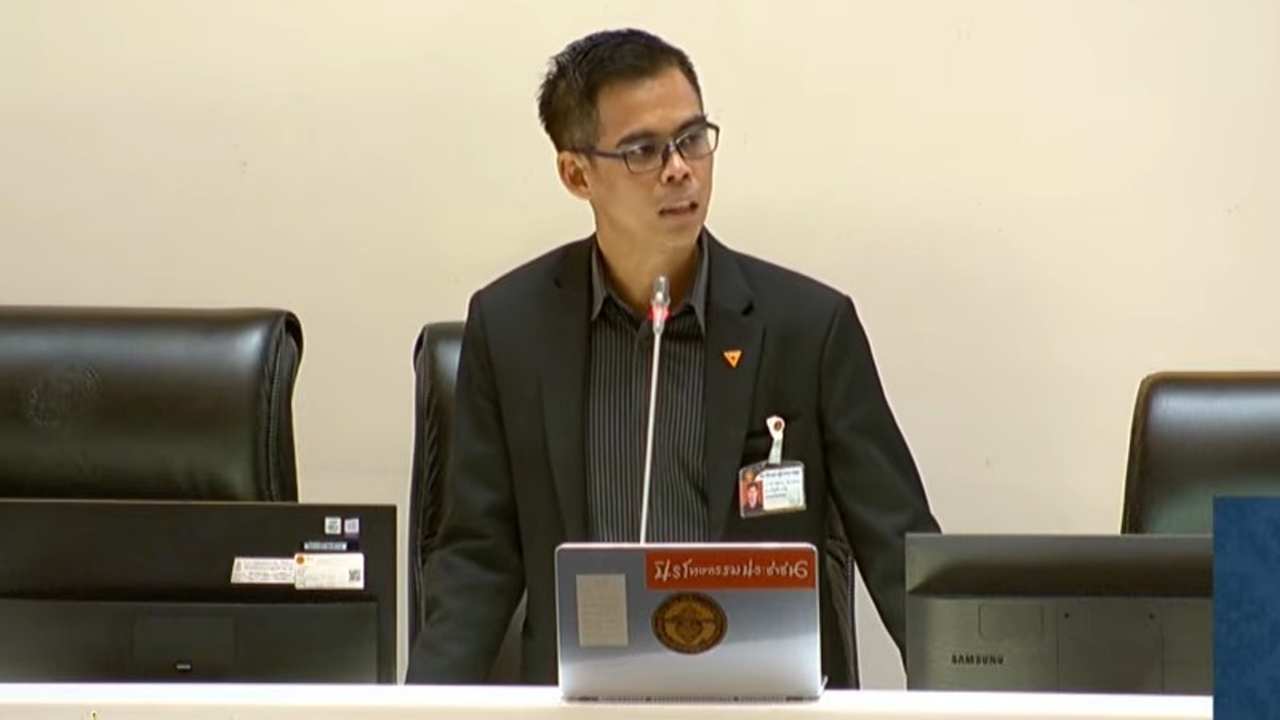
The House approved the 2nd and 3rd readings of the Cabinet’s draft Defense Ministry Act. Representatives Chayaphol and Kittipong reserved their opinions, emphasizing that military reform must have a single clear direction, armament procurement should follow the plan, and the civilian government must have authority over the military.
On 2 Sep 2026, during the House of Representatives session, the draft Defense Ministry Administration Act was considered in its 2nd and 3rd readings. The special committee had completed its review. Bangkok MP Chayaphol Sathondee of the Prachachon Party, along with party list MP Kittipong Piyawanono, both special committee members who reserved their opinions, debated several sections, noting the committee had mostly adhered to the Cabinet’s original draft content.
Mr. Chayaphol debated Section 3, amending Section 13, proposing to include the 'armament procurement plan' as part of the military reform plan or the Defense Ministry efficiency development plan, or the 'White Book' to ensure that annual armament procurement aligns with the overall strategy, including capabilities, system compatibility, and joint operations among military branches. He proposed the Defense Council provide military opinions before submission for approval by the Defense Minister.
Mr. Chayaphol stated that if the White Book lacks an armament procurement plan, it could allow purchases inconsistent with the big picture, such as each branch using different communication systems or armament standards that cannot interconnect, causing logistical, spare parts, and maintenance issues, or acquisitions not supporting the national defense plan. For example, the Navy plans to acquire frigates but procured submarines first.
He added that approval authority for the White Book should rest with the Defense Minister, not the Defense Council, because military development plans and armament procurement span longer than individual branch commanders’ terms. Thus, these must be linked to political leadership, government policy, national and global situations to provide long-term military development direction.
Mr. Kittipong further argued that military reform plans should not be rigidly tied to the 20-year National Strategy, which stems from the 2017 Constitution and the NCPO coup. While the military needs a strategy, it must be adaptable to rapidly changing security conditions and technologies, such as unmanned aerial vehicles and artificial intelligence, since a 20-year timeframe may be too long for security planning.
He also emphasized including the armament procurement plan in the White Book. Military development should comprise at least three parts: armaments, personnel, and military plans. Having a strategy without an armament procurement plan would prevent effective military development in practice.
Mr. Kittipong added that to enable true joint military operations, a Joint Capability Command (JCC) must be established. Armament procurement must be planned jointly; otherwise, joint operations will be difficult. Furthermore, a long-term procurement plan helps save budget costs in acquisition and maintenance.
Regarding Section 5, amending Section 24 paragraph five, Mr. Chayaphol proposed removing 'Defense Council resolutions' from the powers that the Defense Minister may delegate to others. He noted the Defense Ministry Administration Act originally grants the Defense Council significant authority, especially Section 43, which requires the minister to act according to Defense Council resolutions on military policy, mobilization, command, budget, and related legislation.
"The Defense Council consists of many generals by position who can outvote the minister. Then what is the point of having a Defense Minister if they lack authority over their own ministry? Such power should reside with civilian political leadership, not have the minister act as a puppet controlled by a council of generals," said Mr. Chayaphol. .
Mr. Kittipong also debated this section, reaffirming the principle that civilians must control the military. Elected ministers must have authority over the military. The Defense Council should only be advisory and not have power over the minister. Command, approval, and administrative powers belong to the minister and should not be tied to Defense Council resolutions.
Toward the end, Mr. Chayaphol supported a 90-day timeframe to develop the military reform or efficiency development plan, describing the plan as the backbone and compass of military reform. He said the data needed is already available from routine military administration, so there is no reason to delay up to six months as proposed by the Cabinet draft.
He questioned the explanation that the new approach would be top-down planning. If so, previously, each military branch planned upward before a comprehensive plan was created. Does this mean the branches had not been developing in a unified direction?
The voting result on the Defense Ministry Administration Act in its 2nd and 3rd readings showed 435 total votes: 434 in favor, 0 against, and 1 abstention.