

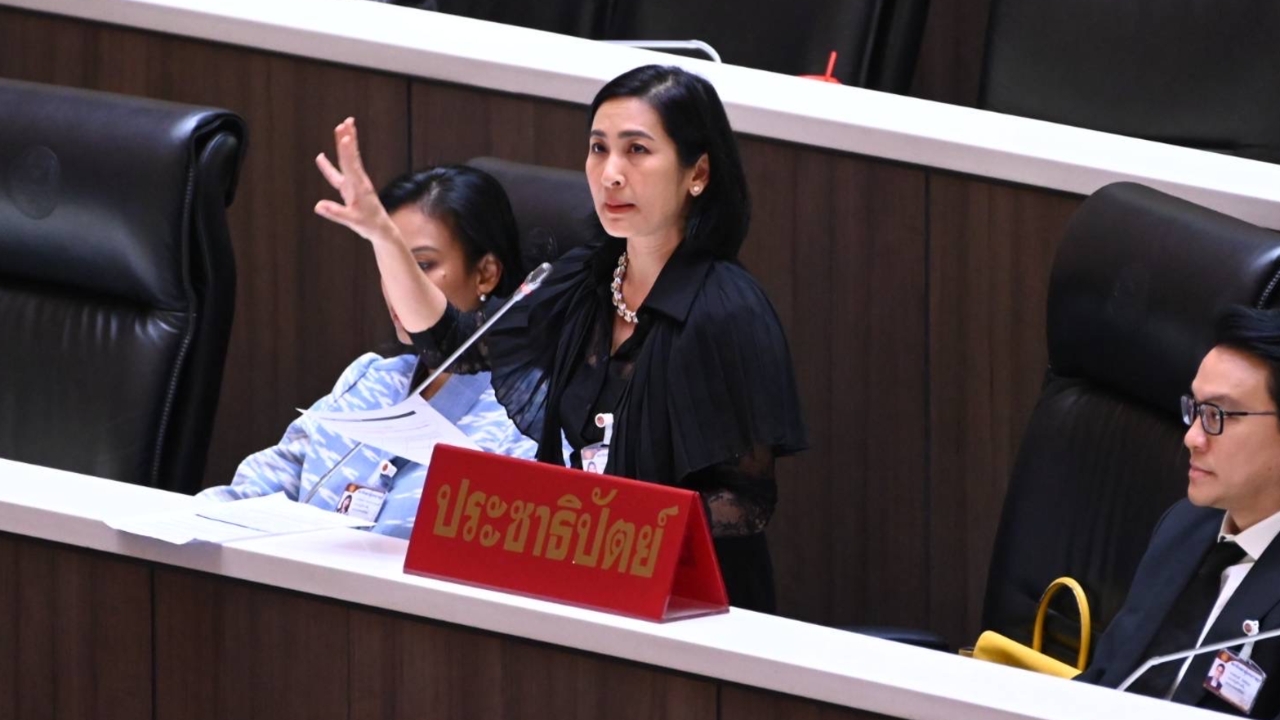
"Kardee and Sakolthee" jointly object after the Senate amended nearly 90 articles of the Clean Air Act draft, warning of risks to good governance. They point out the removal of the PRTR system, opening the door to conflicts of interest, and potential power centralization, urging the formation of a joint parliamentary committee.
2 Sep 2026 GMT+7 Mrs. Kardee Liao Phairoj Kardee Liao Phairoj, a party-list Member of Parliament (MP) from the Democrat Party, joined the debate to object to the Senate's amendments to the Clean Air Management Act draft. She revealed four key concerns for the House of Representatives to reconsider and to establish a joint special committee from both houses as follows.
1. The removal of the PRTR system definition by deleting the phrase “Pollutant Release and Transfer Register” from Section 4, resulting in waste transfers or off-site disposal escaping legal oversight and continuing to pollute the environment. The definition should be revised to be comprehensive and aligned with other laws.
2. Lack of centralized data (Big Data). She proposed establishing a single pollution database (Single Data Source) to resolve scattered data issues and incompatible architectures, and requested transparency in data sharing with the public, private sector, and academics.
3. A focus on toxic substances rather than just dust size. She supports the law emphasizing control and prevention of harm from toxic chemicals affecting health directly, rather than focusing solely on PM2.5 dust levels.
4. Risks to governance and conflicts of interest. Concerns were raised about adding representatives from the Chamber of Commerce, Federation of Industries, and Bankers Association to the national and provincial policy committees. These groups are the same ones subject to regulation, potentially causing conflicts of interest in budget allocation and economic measures. Additionally, adding discretion conditions in Section 148 could reduce transparency.
"Amid a governance trust crisis in Thai society, allowing stakeholders to set policies and exercise discretion themselves is highly worrying. Therefore, I propose that the parliament establish a joint special committee from both houses to review the content transparently, using real data and figures for decisions that best serve the public."

. . . Mr. Sakolthee Pattiyakul Sakolthee Pattiyakul, party-list MP from the Democrat Party, objected to the Senate's amended Clean Air Act draft returned to the House under Article 137 of the Constitution. He said this law is important and long-awaited to address the toxic dust crisis, but the Senate's revisions, cutting and modifying nearly 90 articles, do not merely streamline language but fundamentally change the law's principles. He highlighted five main concerns from the Senate's amendments as follows.
1. Removal of public rights by abolishing the PRTR system, which allows citizens to monitor local pollution, as well as eliminating class-action lawsuit rights and emergency court injunctions.
2. Removing financial institution responsibility by lifting sustainable finance frameworks for lending to pollution-causing projects.
3. Centralizing power from local to regional by transferring clean air committee authority at the provincial level from the Provincial Administrative Organization president back to the provincial governor.
4. Conflicts of interest by adding business and industry representatives to self-regulatory and supervisory committees.
5. Cutting economic tools, effectively canceling incentive measures and upstream pollution controls, such as the deposit-return system.
In closing, Sakolthee said, "The Senate's amendments move toward stripping citizens' rights, relieving capital groups, centralizing power, and allowing industries to self-regulate. I therefore urge the parliament to reject these amendments and establish a joint special committee from both houses to refine the law so that it truly belongs to the people."