

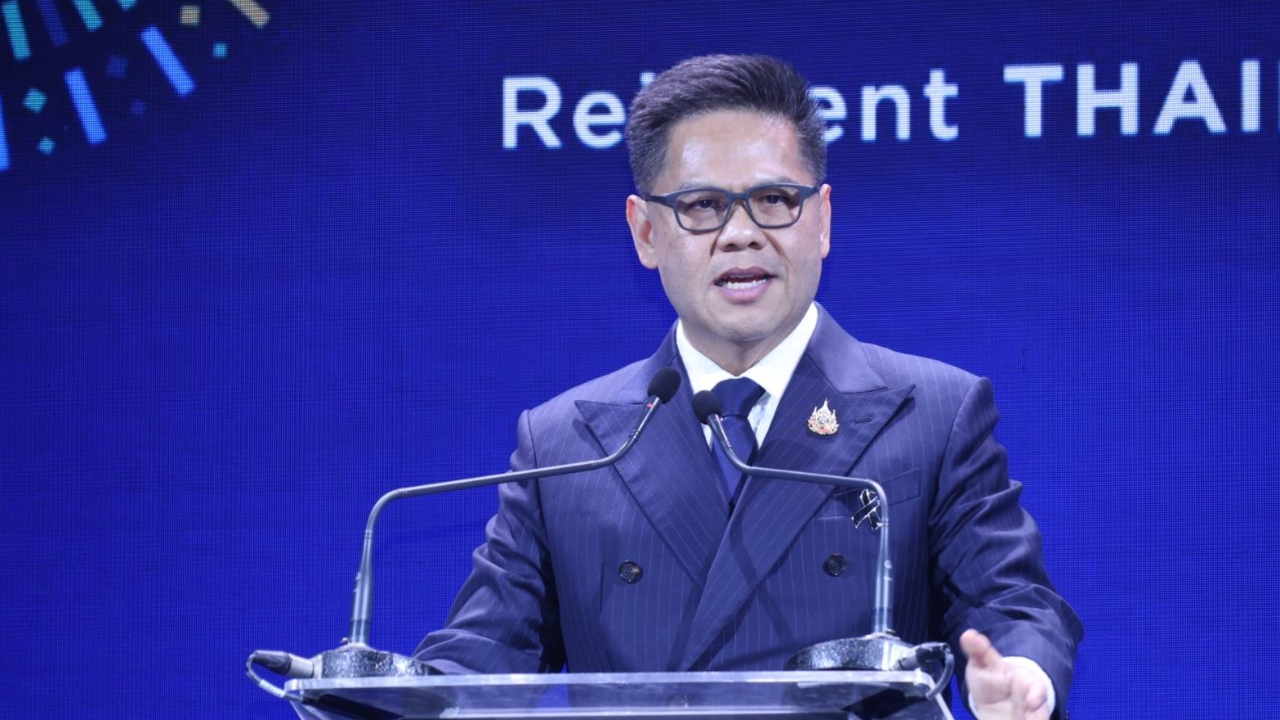
Warawut promotes the SEP philosophy paired with AI² to propel Thai industry through the K-Shaped economy, attracting foreign investment in technology. He aims for a modern Thai industry that enables all Thai people to grow together.
3 Sep 2026 GMT+7 Mr. Warawut Silpa-archa, Minister of Industry, delivered a keynote speech at the event The Bangkok Business Summit: Reinvent Thailand, Resilient ASEAN, stating that the world is facing structural volatility including geopolitical shifts, technology, climate change, demographic changes, and supply chain fragility, resulting in both the global and Thai economies experiencing a K-Shaped recovery.
The upper arm of the K represents modern industries focused on advanced technology, mostly invested in by multinational companies, showing rapid growth in the digital economy. Meanwhile, the lower arm includes SMEs, local supply chains, farmers, and a large vulnerable workforce lagging behind. If the gap between the two arms widens, it will become a systemic risk rather than sustainable growth.
“Growth that leaves behind more than half of our Thai brothers and sisters is not true progress but a systemic risk,” he said.
Minister Warawut added that the Ministry of Industry has adopted the Sufficiency Economy Philosophy (SEP) as a compass to restructure Thailand’s industry, applying moderation, reasonableness, and resilience principles to businesses to shift from unchecked growth toward balanced, competitive, and volatility-resistant development.
One key tool is the TIS 9999 standard, which applies SEP principles to organizational management, aiming to build businesses focused on long-term survival, stable value creation, governance, and resilience. This aligns with global ESG (Environmental, Social, and Governance) business principles, now a competitive factor in international trade. The Ministry promotes TIS 9999 among SMEs to enhance their capabilities and elevate them into the global supply chain.

Regarding Thailand’s industrial direction, Minister Warawut proposed the “AI²” strategic framework with two new engines: Advanced Industry and Modern Agriculture Industry, to drive both economic growth and opportunity distribution.
The first AI is Advanced Industry, covering AI, automation, robotics, data infrastructure, advanced semiconductors, and digital technology. Thailand must leverage foreign investment and global partnerships to upgrade its industries. However, the goal is not just attracting capital. “The true measure of industrial development is not how much investment flows into Thailand but how much it enhances Thailand’s capabilities.” Therefore, new investments must bring knowledge transfer, technology diffusion, development of Thai engineers and personnel, integration of Thai parts producers into global supply chains, and foster Thai companies to develop their own technologies, intellectual property, and markets.
, The second AI is Agriculture Industry, which serves as a bridge to elevate the grassroots economy and the lower arm of the K by transforming traditional agriculture into high-value Agri-Food and Agri-Tech industries through biotechnology, future foods, medicinal substances, precision agriculture, advanced food processing, and smart manufacturing. It will incorporate technologies from Advanced Industry such as IoT, AI, automation, and advanced data systems to increase productivity, reduce waste and energy use, enhance traceability, and create high-value products to boost income from Thai agricultural lands.

The Minister further stated that driving AI² aligns with the World Bank’s recommendation for Thailand to accelerate its transition from low-cost, low-value production to a knowledge and innovation economy, especially in green industries, smart electronics, advanced technologies, and the digital economy, alongside workforce skill development. This will enable Thai people to keep pace with technological changes. Thailand’s future cannot be built by leaving many citizens behind; thus, workforce upgrading and skill development are not merely labor policies but economic necessities.
He emphasized that the goal of modern Thai industry is not only national growth but ensuring all Thai people have opportunities to grow together. The government cannot drive this alone; cooperation is needed from investors, industry leaders, entrepreneurs, and international partners to invest in people, develop skills, transfer knowledge, and integrate Thai SMEs into global supply chains.
“Do not merely chase growth; build resilience. Do not only attract investment; build capability. Do not measure success only by how far Thailand advances, but by how many people we elevate along with us.”