

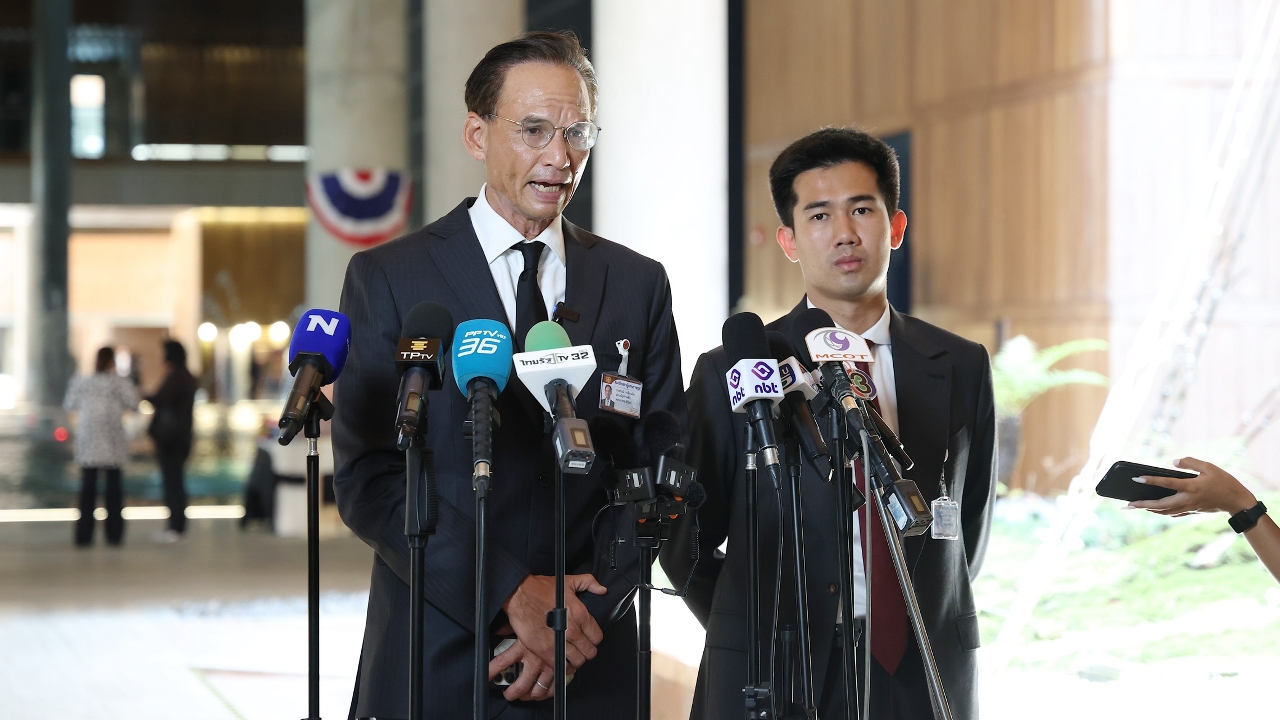
Korn urges the government to clarify seven concerns over Data Centers, fearing repeated pollution issues, impacts on electricity and water, and the risk of US bans on AI chips.
On 3 Sep 2026 GMT+7 at the Parliament, Korn Chatikavanij, Deputy Leader of the Democrat Party, revealed after raising a live question to the government about policies and stances on accepting global Data Center investments that the public is deeply worried about the proliferation of Data Centers in areas like Rama 9 Road and the unauthorized accumulation of large amounts of oil. This reflects slow and outdated government management, posing risks of harm to the country both short- and long-term.
Although the government began to take notice by forming a committee to oversee Data Center policies in August, the Democrat Party believes there are still more questions than answers. They summarize seven main concerns for the government to urgently clarify as follows.
1. Lack of a dedicated authority and governance to oversee Data Centers.
Currently, no single agency is responsible for regulating Data Centers specifically, allowing operators to circumvent laws by claiming to be warehouses. Permits are scattered across multiple agencies without coordination, and there is no requirement to conduct Environmental Impact Assessments (EIA). Moreover, the government committee lacks full authority, and the recently issued BOI regulations remain unclear on whether they apply retroactively to approved but not yet constructed projects.
2. Contradictory impacts on energy structure and electricity costs.
Promoting foreigners to use Thailand’s "backup power" conflicts with policies to reduce fossil fuel reliance since backup power mainly comes from natural gas. This increases LNG imports, making electricity tariffs and the FT rate vulnerable to gas price fluctuations, directly affecting citizens’ electricity bills. If backup power runs out, the government may need to build more fossil fuel plants, undermining the country’s renewable energy strategy.
3. Water resource competition crisis.
Over half of Data Center projects propose locations in the EEC, where medium-sized Data Centers consume water amounts equivalent to that used by 50,000–60,000 people annually. Allowing private companies to contract water sales directly may affect local residents’ and farmers’ water access rights.
4. Uncontrolled pollution problems.
Exempting Data Centers from EIAs means no measures exist to manage or regulate ensuing pollution issues such as noise, heat, and wastewater.
5. Risks to technological sovereignty and Thai AI language development.
Thailand is opening its territory to foreign Data Center investments but does not support advancing Thai AI models, which currently run on outdated GPU chips numbering only around 700. This may harm the country’s competitiveness and data security over the long term.
6. Uncertainty about benefits for Thai people (Local Content).
No clear measures or agreements require that Thai operators, startups, or SMEs receive shared access to processing capacity from foreign Data Centers benefiting from tax incentives while using Thailand’s resources.
7. International accusations risk US chip import restrictions.
Recently, the US government named Thailand as a possible shortcut for China to access high-level chips under US control. If the US imposes sanctions or export restrictions on GPUs to Thailand, it will severely impact Thailand’s technology industry and digital economy development.
Korn emphasized that these seven concerns are not overthinking but reflect global issues being addressed worldwide. He urged the policy committee chaired by Ekkanit Nitithanprapas to carefully plan their work to ensure Data Center investments maximize benefits for Thailand’s economy while minimizing impacts on citizens.