

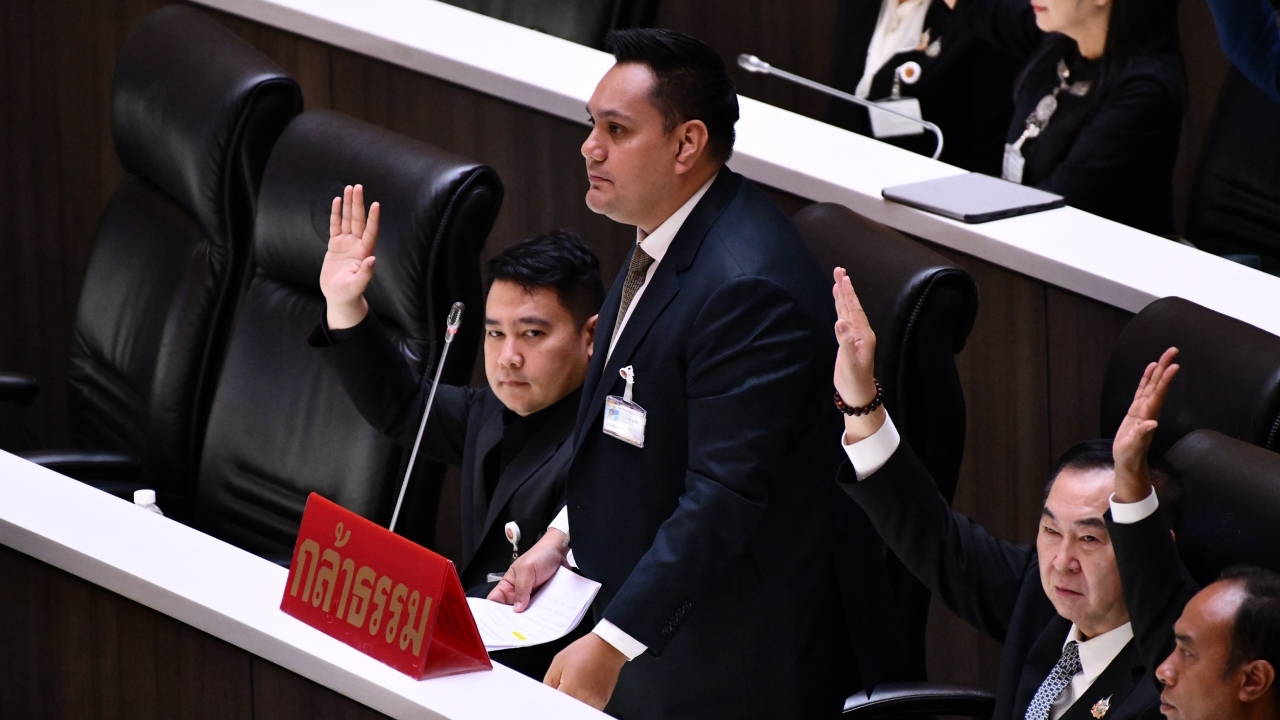
Amin, MP from the Kla Tham Party, urgently proposed a verbal motion, expressing deep frustration over the recurring suffering in the southern border provinces for more than 20 years. He questioned the government on where 3,000 people would go if the border is closed, demanding swift action to combat drugs and informal debt, while pressing for the recovery of 18 million baht owed to Narathiwat farmers.
At 18:00 on 3 September 2026 GMT+7. Mr. Amin Mayuso. Member of Parliament for Narathiwat province from the Kla Tham Party. He proposed an urgent verbal motion requesting the House of Representatives to establish a special committee to study ways to strengthen the peace process and sustainably resolve all types of complex issues in the southern border provinces. He stated that the unrest in the southern border provinces has continued for more than 20 years, representing a complex political conflict and one of Thailand's major challenges.
Despite several governments implementing multifaceted measures—including administrative reforms, law enforcement, security operations, and creating specialized agencies and mechanisms—these efforts have yet to resolve the conflict or produce an accepted conclusion, especially concerning governance legitimacy. Meanwhile, residents still face insecurity in life and property, limited access to justice, restricted development opportunities, and lack respect for their identity and cultural diversity.
Mr. Amin emphasized that the problems in the three southern border provinces are not merely local but national political issues affecting security, national development, and the unity of Thai society. Therefore, a systematic study for solutions is necessary, especially addressing the complex issues accompanying the unrest.
He then addressed the drug problem, highlighting it as a major complex issue, particularly in Narathiwat province, which shares a border with Malaysia across districts such as Tak Bai, Su-ngai Kolok, Waeng, and Sukhirin, with a long border stretch. He observed that current government approaches focus more on suppression than prevention, proposing greater emphasis on early prevention and interdiction.
“I propose developing the security checkpoint at Ko Mo Kang in Pattani province with modern technology to enhance efficiency in intercepting drug trafficking from the northern region into the south. I urge the Ministry of Defense and security agencies to take this matter seriously and sincerely.”
Additionally, Mr. Amin expressed concern over plans to build electronic fences or border walls along the entire border. While acknowledging the importance of border security, he stressed that the government must consider the impact on border residents’ livelihoods. Many locals cross into Malaysia for work, some through unofficial channels, with about 2,000 to 3,000 people crossing daily as laborers, traders, and restaurant workers.
“If the government closes checkpoints, ports, and natural crossings completely, what measures are in place for these people? If they lose their jobs, it could lead to crime and social problems. Therefore, the government should prepare supportive measures alongside security operations.”

Mr. Amin also called on the government to expedite resolving compensation payments to farmers, especially over 4,000 households in Narathiwat who have yet to receive last year’s 1,000 baht per rai aid, totaling about 18 million baht. He noted that this amount is modest compared to the people's hardships and believed that presenting this issue to the Cabinet would lead to approval. With the new planting season approaching next month, swift action is needed.
He emphasized informal debt as a significant economic problem affecting many locals, especially merchants and those lacking access to formal credit, who resort to high-interest loans, harming families, relationships, and youth development opportunities.
“I urge the Internal Security Operations Command (ISOC), military, police, and relevant agencies to concretely tackle informal debt. I also propose the government extend low-interest loans or soft loans to startups and new entrepreneurs unable to access state funds, with amounts around 50,000 to 100,000 baht per person, enabling people to start businesses and generate income independently.”
Regarding Thailand-Malaysia cooperation, Mr. Amin believes it should not be limited to national leaders’ discussions but should increase coordination at agency and local levels, especially among security and border control units of both countries, to enhance problem-solving effectiveness. He referred to incidents from 22–24 August involving suspects possibly fleeing to Malaysia, noting that current local-level coordination between the two countries is insufficient. Over the past 20 years, such grassroots cooperation has effectively helped address local issues and should be restored and upgraded.
Mr. Amin also mentioned the Prime Minister's appointment of Mr. Wan Muhamad Noor Matha as chairman of the advisory committee, urging him to use his experience and understanding of the three southern border provinces’ issues to advise and propose solutions to the Prime Minister, helping the government grasp the problems comprehensively and formulate effective responses.
“Resolving the southern border problems requires a comprehensive approach, including the peace process, security, addressing complex issues, creating economic opportunities, tackling debt problems, and supporting residents’ livelihoods to build lasting peace and development in the region.”