

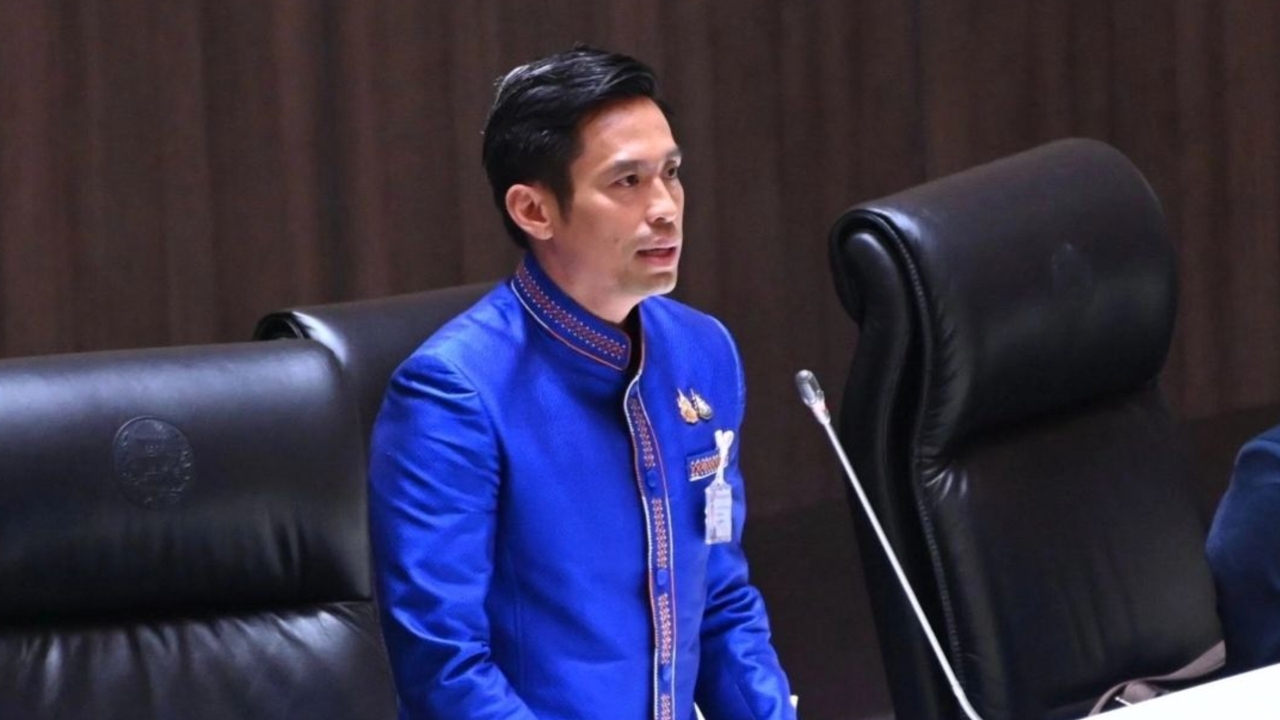
Krawi hit back at the opposition, asserting that the lives and safety of residents in the southern border provinces are not political tools or excuses for any party. He insisted that there is no obstruction of the Election Commission's agenda and no reason for the government to avoid scrutiny.
5 Sep 2026 GMT+7 Mr. Krawi Prissanantakul Member of Parliament (MP) for Ang Thong, representing the Bhumjaithai Party, and Government Whip, posted a message viaFacebookregarding the controversy over scheduling the parliamentary agenda between debating the unrest in the southern border provinces and the Election Commission's (EC) annual report, affirming that the lives and safety of the people in the southern border area are not political tools or excuses of any side.
Krawi said that over the past two days, there has been an attempt to turn the parliamentary issue into a political game by accusing the government of using the southern unrest as a cover to avoid debating the EC's report. He viewed this as an overly politicized interpretation, while the facts are straightforward.
The Government Whip further stated, the southern border problem is an issue pending discussion and has been talked about since last week. Everyone agrees on the urgency due to its direct impact on security, peace in the area, and the lives of residents. Therefore, MPs from the three southern border provinces submitted an urgent verbal motion to bring the matter up for swift parliamentary consideration. When there is an urgent issue, Parliament should provide space to find solutions.
Before voting, there was hours of debate. The opposition argued that the EC report should be discussed first according to the agenda, then the southern border issue. Meanwhile, the other side argued that the southern border issue had been postponed since last week and should be addressed first, followed by the EC report.
Krawi emphasized the matter is simple with no complexity. The fact to understand is that prioritizing the southern border motion does not remove the EC report from the agenda, does not block debate, and does not strip any MP of the right to question. The EC's annual report remains on Parliament's agenda, and the government is ready to proceed, allowing members to debate, examine, and question fully according to rules.
The acknowledgment of the EC's annual report is a review of the independent agency's work under the constitution, not a no-confidence debate against the government, nor a review of the executive branch's work. It provides members the opportunity to debate, question, and express opinions on the agency's performance.
"Therefore, the government has no reason to avoid scrutiny of the EC. Parliament provides full space according to rules; no one is prohibited. It's not only the opposition that wants to debate; members from all parties have the right to question the EC's work," he said.
Towards the end, Krawi said the government also has questions and seeks answers from the EC. The key principle is that every agency, including the EC and other independent bodies, must be accountable to Parliament. He viewed that it is inappropriate to politicize the urgent unrest in the south, which affects people's lives, as a tactic to silence or avoid political issues. "Such actions are what truly exploit the hardship of southern border residents as political tools," he concluded.