

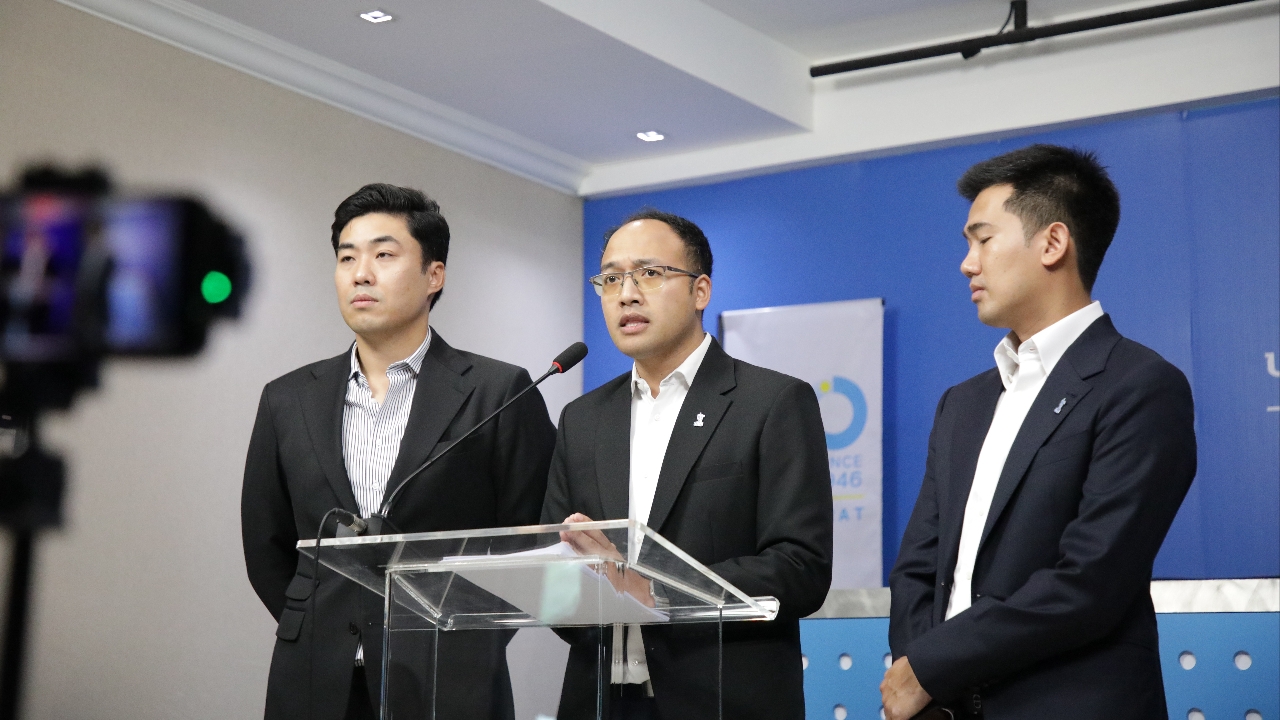
The Deputy Spokesperson of the Democrat Party urged the government to urgently resolve the EEC crisis, fearing contract cancellations for the high-speed rail linking three airports, which would affect the Airport Rail Link and U-Tapao Aviation City. He warned that without prompt solutions to the shortage of trains and personnel, the projects risk becoming mere “double-track monuments.”
On 6 Sep 2026 GMT+7, Mr. Jirawat Changwat, Deputy Spokesperson of the Democrat Party, held a press conference on the overall development of the country's infrastructure and transportation. He called on the government and relevant agencies to urgently address critical issues in the Eastern Economic Corridor (EEC) development project and nationwide dual-track railway projects before investor confidence and public services are adversely affected.
Concerns arise over impact on the Airport Rail Link.
Mr. Jirawat revealed that the high-speed rail project connecting three airports (Don Mueang, Suvarnabhumi, U-Tapao)—the backbone of EEC development covering Bangkok, Chachoengsao, Chonburi, and Rayong—faces rumors that private companies want to terminate contracts, deeming them unprofitable after more than seven years. This situation raises serious concerns, as the Thai government has conducted global roadshows to attract investment. Allowing contract cancellations would severely damage foreign investor confidence.
Furthermore, the high-speed rail linking the three airports directly connects to the U-Tapao Aviation City and airport development project. If any one project stalls, others cannot fully proceed.
The most worrying issue is the impact on the capital’s residents, especially in eastern Bangkok. Data indicates that if private companies end contracts, the Airport Rail Link service might cease on 30 September, currently serving 60,000–80,000 daily passengers traveling to Suvarnabhumi Airport. A sudden service halt without government contingency plans would cause significant hardship.
“I urge the Prime Minister, as chair of the EEC board, to promptly step in to resolve this issue. Do not let a project worth 130–150 billion baht be reset or abandoned simply because the focus is on launching new projects like the Southern Seaboard or Landbridge while neglecting the existing foundation with proven potential,” he said. Mr. Jirawat added,
He advocates electrification for the southern dual-track line.
Regarding the recent cabinet meeting approving the southern dual-track railway project spanning over 500 kilometers (Chumphon to Padang Besar), Mr. Jirawat expressed congratulations but highlighted a lack of continuity, especially for the Hat Yai–Padang Besar segment, which was approved only as a conventional diesel rail system despite prior studies since 2015 considering electrification (EV/Electrified Train).
Mr. Jirawat noted that Malaysia’s railway system is electrified up to the Padang Besar border. If Thailand invests in electrification connecting to Hat Yai city, it would facilitate Malaysian tourists traveling directly to Hat Yai without changing trains. The Office of Transport and Traffic Policy and Planning (OTP) study clearly shows electrification is more cost-effective than diesel trains. He urged the Ministry of Transport and OTP to reconsider plans to make a one-time investment and avoid future redundant expenses.
He warns the government risks creating mere “double-track monuments.”
The Democrat Party deputy spokesperson also pointed out that nationwide dual-track railway investments, including new lines to Nakhon Phanom and Chiang Rai totaling thousands of kilometers, focus solely on track infrastructure while neglecting the trains themselves. Currently, completed dual-track lines still operate with original train sets aged 30 to 60 years, maintaining the same number of third-class carriages despite doubling track length. This fails to generate the economic value the government claims, as insufficient train sets limit service capacity. The government should plan to procure new trains aligned with service timelines and passenger volumes.
Additionally, there is a shortage of over 2,000 railway personnel at the State Railway of Thailand (SRT), including drivers, attendants, and mechanics, causing driver fatigue and insufficient rest, as seen in incidents around Asoke. He called on the government to expedite approval for recruitment according to SRT’s development plan to prevent the country’s multi-billion baht investments from becoming mere “double-track monuments.” These would be projects with tracks but no trains or operators, failing to deliver real benefits to the public.