

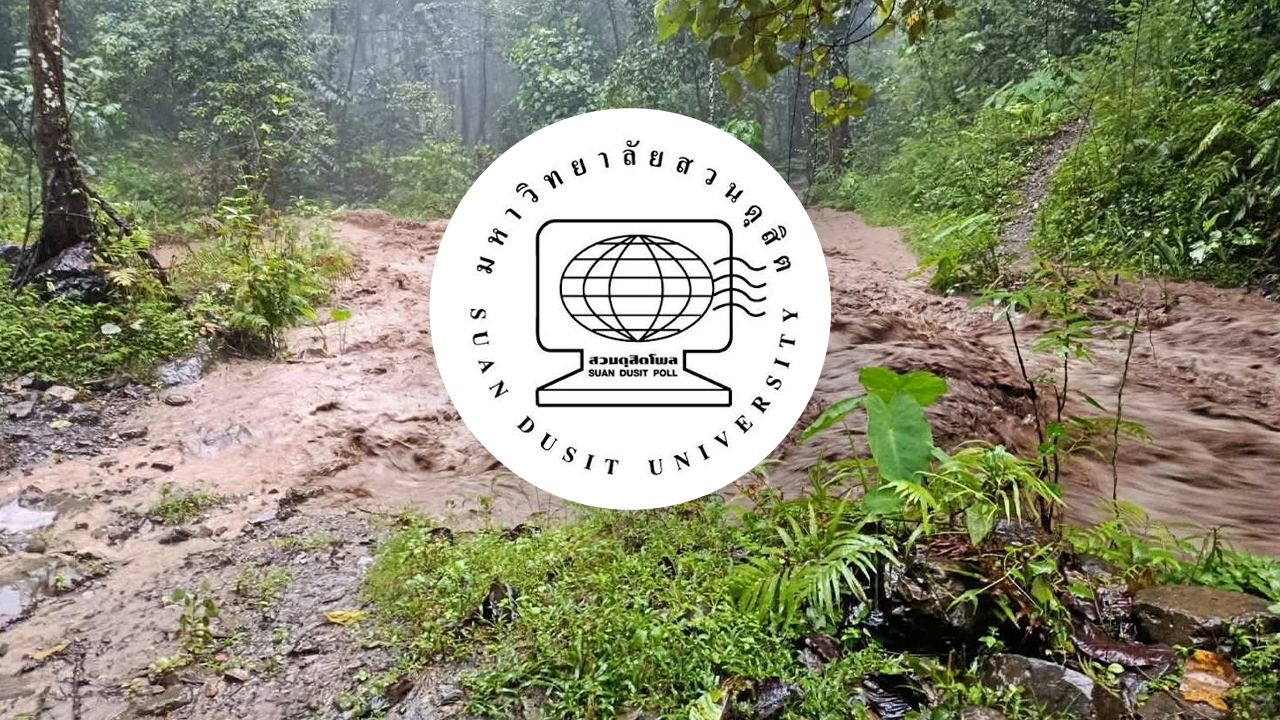
Dusit Poll reveals that over 84% of Thais fear "floods and landslides," hoping the government will urgently address the problem before it becomes too late, but many remain doubtful of its handling capabilities, with more than half lacking confidence in the government's disaster response.
On 6 Sep 2026, Dusit Poll of Suan Dusit University released a nationwide survey titled "Thais and Disaster Preparedness." Among 1,241 respondents surveyed from 1-4 Sep 2026, 84.29% expressed the greatest concern about disasters such as floods, flash floods, and landslides. They viewed climate change and global warming as the main causes for the increasing frequency and severity of disasters, with 69.70% holding this view.
Regarding disaster preparedness, 64.46% of respondents said they regularly follow news and warnings, while 53.19% remain skeptical about the government's capability to manage potential disasters in Thailand. They want the government to urgently solve environmental problems and reduce the factors that worsen disasters, a view shared by 68.65%.
Dr. Pornpan Buathong, Chairperson of Dusit Poll, stated that the survey reflects Thai people's concern about nearby disasters, partly due to climate change. Although individuals prepare themselves, confidence in the government's response remains quite low. The government must accelerate readiness through early warning systems, emergency aid, and post-disaster recovery to build public confidence and safety.
Dr. Monthon Suwanprapha, Chair of Environmental Health and Public Disaster Program, Faculty of Science and Technology, Suan Dusit University, explained that reviewing disaster frequency in Thailand over the past decade shows flooding remains a significant national crisis. It is fair to say flooding has long been a persistent issue for Thais, but repeated incidents may cause society to become accustomed and accept it, even though many losses could be prevented.
The survey also shows increasing public awareness that disasters are not solely natural but linked to human actions, with global warming accelerating and complicating the situation. Nonetheless, people still hope the government will intervene, despite underlying distrust. The government must shift from waiting to solve problems after they occur to actively preventing and managing risks at their roots, while also educating and equipping citizens to prepare and respond independently. Effective disaster management cannot rely on government alone; it requires cooperation from the public, communities, and all societal sectors.
