

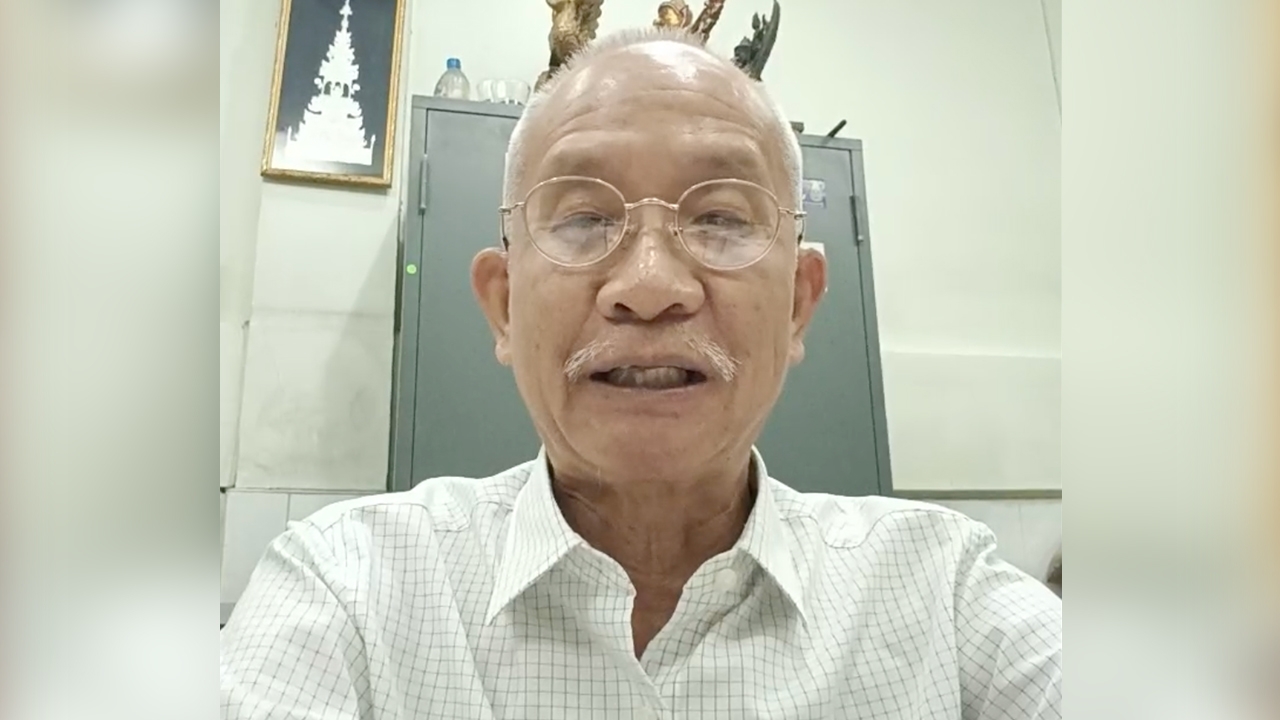
Veera Somkhumkit revealed documents on the Senate rigging case, threatening to disclose the names of all involved if the Election Commission (EC) does not vote by 14 September, while also suggesting the EC may postpone the case hearing until after 28 September.
On 6 September 2026 at 20:00, Veera Somkhumkit, head of the People's Network Against Corruption, live-streamed on his Facebook after posting about exposing the Senate rigging case with photos of documents including investigation file 4, secretary-general's opinion report, and meeting report of committee 36. He said he received the information from a well-wisher within the Election Commission (EC), as he had been a student of the EC's Political and Election Development course (PETS) class 9, thus knowing several EC officials. For example, Somchai Srisuthiyakorn is a classmate from Suankularb, the same as Buriram United chairman Newin Chidchob and Deputy Prime Minister Songsak Thongsri. Veera emphasized that upon receiving such information, he must investigate and work straightforwardly with no intention to favor any side.
Veera then read the report from committee 36's meeting and the secretary-general's opinion stating the Senate rigging case, with Kanchit Charoenin, EC deputy secretary-general, as one of the investigators. On 15 September 2025, the opinion recommended the EC file a complaint with the Supreme Court to prosecute 136 individuals named on the list and revealed corrupt money connections across 17 provinces nationwide linked to politicians and the Bhumjaithai Party.
The evidence found, if deemed sufficient by the EC, could be forwarded to investigation committee 26, the case owner, for the EC secretary-general to summarize and submit to the EC for further action.
On 17 July 2025, committee 26 resolved the Senate rigging case, recommending the EC prosecute 229 accused: 138 senators, 50 network members, 21 MPs and executives of the Bhumjaithai Party, and 20 involved team members, with a requirement to complete the process within 60 days.
Regarding corrupt money in 17 provinces, it was found that current senators had paid other candidates unfairly, but the EC secretary-general dismissed the complaint due to insufficient evidence, especially acquitting the Bhumjaithai Party leaders and executives, thus forwarding the matter to Veera for review.
Kanchit opined that the case should be submitted to the Supreme Court to revoke voting and candidacy rights and pursue criminal charges, except for witnesses who should be exempted.
Veera said having committee 36 review the Senate election case after committee 26 was not unusual, as it provided additional scrutiny. However, committee 36 dismissed all 229 complaints collectively without individual consideration, a first-time occurrence. He believes this blanket dismissal aims to protect nearly 20 Bhumjaithai Party executives implicated, as prosecuting them in the Supreme Court and Criminal Court could lead to party dissolution, which he believes must be prevented. Meanwhile, the 138 senators facing election and criminal charges would lose their seats.
Veera also mentioned a complaint involving person number 205 who handed a candidate list to Mr. T, a member of a political party, discussing how to make the party a government leader and secure over 120 Senate seats in the June 2024 election. The party assigned young members to study laws and used offline methods, requiring candidates from every district and occupational group. The party spent cash at the district level to gauge MPs' enthusiasm by region, with possible candidate changes as directed by party leaders. Candidates needed to be flexible, communicative, not stubborn or self-willed, and willing to compromise, as the party aimed to control independent organizations.
The selection process involved placing candidates in all groups, guaranteeing about 60 votes. The party provided varying cash expenses depending on each province's capability and occupational group. For instance, the science and technology group 13 had higher expenses due to difficulty finding candidates. Priority provinces included Phichit, Buriram, Ayutthaya, and Satun, with candidates collecting money at the party's Bangkok office.
A witness coded 16, considered key eyewitness, personally met with leaders of a political party but later reversed their testimony.
Veera said he actually has the full list of those involved but will only disclose codes for now. He warned that if the seven EC commissioners do not vote on the Senate rigging case by 14 September, he will reveal all names. He also recently learned that the case hearing might be postponed because one side wants to wait for the Constitutional Court's decision after 28 September 2026.