

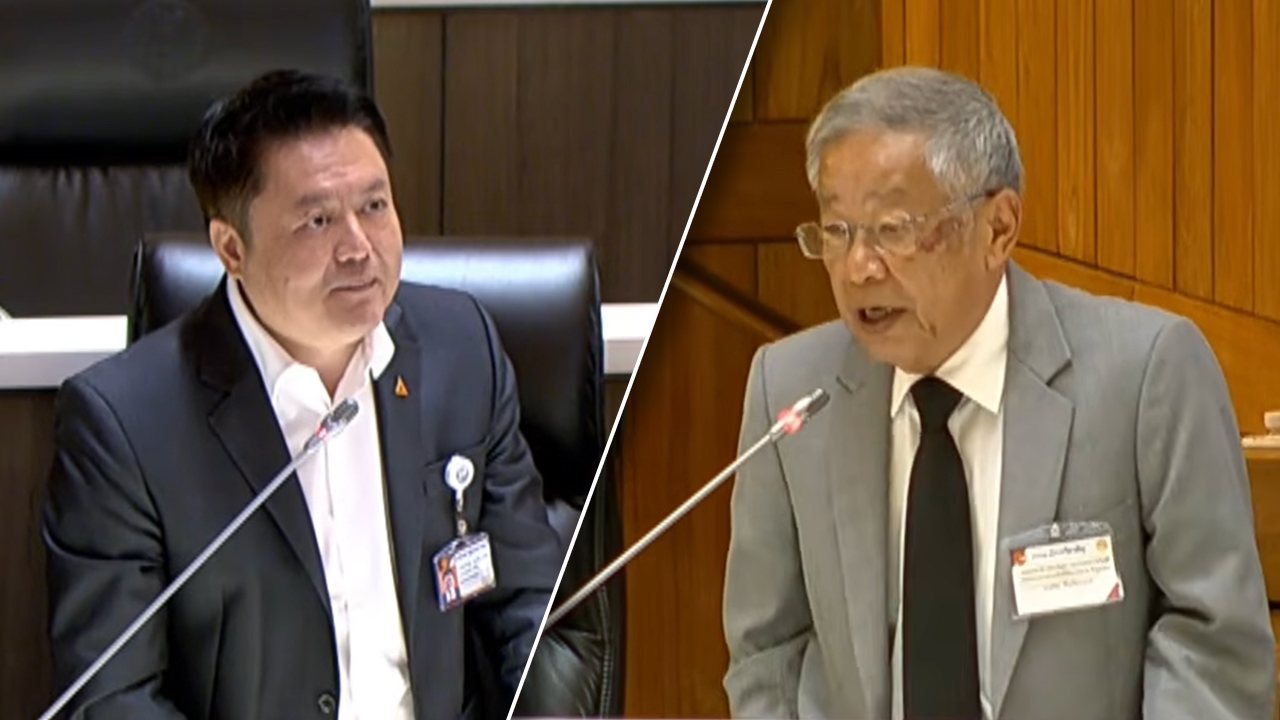
Ekkaniti led the team to explain the 2570 budget bill in sessions 2-3. Surachet criticized the budget allocation as distorted and deliberately avoiding financial discipline laws, while Veera recommended escaping the economic trap by utilizing over 4 trillion baht of off-budget funds to stimulate the economy. Tags: [budget bill, financial discipline, economic policy, People's Party, off-budget funds]
On 7 Sep 2026 at 09:30 at the Parliament, a special session of the House of Representatives was held, chaired by Sopon Sarum, Speaker of the House. The session considered the 2570 fiscal year budget bill totaling 3.78 trillion baht in sessions 2-3, following completion of the joint committee's review. Ekkaniti Nitithanprapas, Deputy Prime Minister and Finance Minister, explained that the committee examined details of 3,286 budget-receiving units, aligning with government policies, national strategies, and master plans, considering the country's fiscal status and economic conditions. The committee cut the budget by 11.162 billion baht based on current conditions, goals, actual performance, cost-effectiveness, readiness, and spending capacity—such as projects delayed beyond deadlines, payments unfeasible within the fiscal year, items inconsistent with the current situation, items that could be postponed without affecting public services, canceled projects, or those funded from sources outside the budget. The committee welcomed further questions from members.Tags: [Parliament session, budget review, fiscal policy, government spending, Finance Minister]
The session proceeded to clause-by-clause consideration. Clause 4 set the 2570 fiscal year expenditure budget at 3.78 trillion baht. Many committee members and MPs debated, urging further budget cuts due to unnecessary items. Surachet Praveenwongwut, party-list MP of the People's Party and minority committee member, argued that the 2570 budget was distorted to deliberately evade financial discipline laws requiring at least 20% investment budget. The government manipulated terminology, using phrases like “investment expenditure” or “expenditure for investment” instead of the clear definition of investment budget, resulting in only 13% actual investment, below the threshold. They played with terms to pass the minimum legal requirement, following a style dubbed “Sritanyachai” (a reference to crafty manipulation). Most investment funds were allocated to road and water projects without foresight, benefiting favored contractors through bid rigging. Politicians and officials created projects to allocate funds to these special contractors, while ordinary contractors were excluded. For example, the Department of Highways received an investment budget of 100 billion baht intentionally sized to facilitate collusion—69 projects in 2569 (2026) and 70 projects in 2570 (2027) despite an overall 13% decrease in investment budget. The allocation resembled a zero-sum game favoring the longest arms in the pot.Tags: [budget manipulation, investment budget, People's Party criticism, corruption, bid rigging]
Veera Theeraphatranont, minority committee member, proposed cutting 7.4 billion baht from the budget and insisted that future budgets must not increase expenditures further, aligning with the country's fiscal capacity that cannot raise more revenue and must endure chronic deficits and an annual 400 billion baht interest burden. The 2570 budget was made under duress, limiting more appropriate allocations without breaking the law. Thailand is trapped by the budget and public debt, facing an inevitable fiscal trap leading to economic crisis if within 2–3 years economic growth does not exceed 2% toward 5%. The way out is to utilize the over 4 trillion baht of off-budget funds to inject liquidity into the economy. Shockingly, only 95 billion baht of these off-budget funds have been used. Ministries such as Interior, Public Health, Defense, and Transport hold large off-budget funds but have not contributed to easing the fiscal burden.Tags: [economic policy, budget deficit, off-budget funds, fiscal crisis, liquidity injection]