

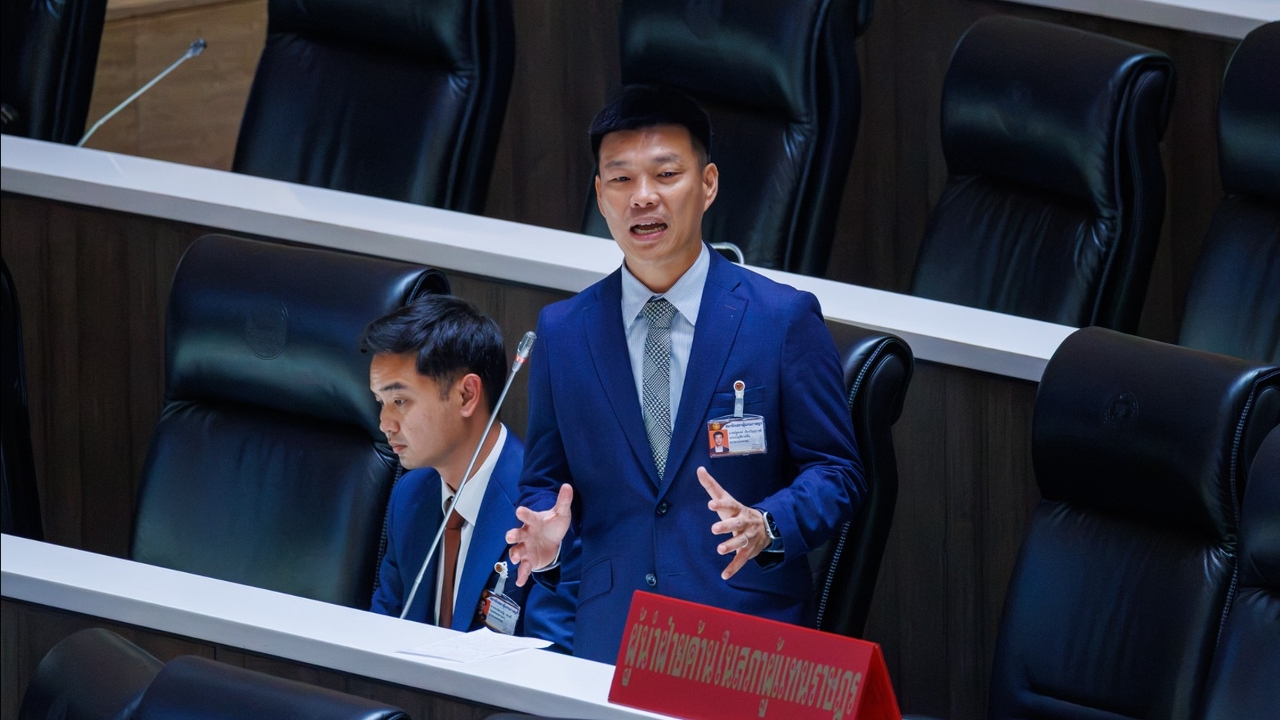
Nattapong urges the government to reform the 2570 budget process, proposing three approaches: transparency, efficiency, and public participation. He suggests using Section 165 to open parliamentary sessions to hear MPs’ voices before budget requests, to prevent TOR specification locking issues.
On 7 Sep 2026 GMT+7, during the second and third readings of the 2570 fiscal year budget bill, Section 7 concerning the Prime Minister’s Office budget, Nattapong Ruangpanyawut, party-list MP and opposition leader of the People’s Party, spoke about the Budget Bureau’s budget, the main agency drafting the budget bill. He questioned whether the 2570 budget process could truly reflect government policies with transparency and efficiency as measured by the bureau’s own indicators.
Nattapong stated that the Budget Bureau proposed its own budget framework of about 1.05 billion baht, but the special committee reduced it by only 240,000 baht. He noted that besides disbursement efficiency, budget cuts should also consider outcomes and performance indicators. If results fall short of targets, budget reductions should be considered the following year.
Regarding the Budget Bureau’s performance indicators, Nattapong pointed out they include alignment with government policies and transparency. However, several parliamentary debates have raised doubts that various projects do not meet the needs of the public or country.
Nattapong cited the zero-based budgeting concept that Finance Minister Akeniti Nitithanprapas announced in the first reading. Yet, over 90%, possibly 95%, of projects in the 2570 budget draft are carryover projects from previous years. He questioned whether the government can truly confirm that the 2570 budget reflects its policies.
On transparency, Nattapong discussed price inquiry processes, issuance of comparative quotations, and concerns about TOR specification locking. He cited the TH-AI Passport project under the Digital Economy and Society Development Fund of the DE Ministry, where questions arose about possible TOR specification locking.
Nattapong proposed that pre-disclosure of price inquiry data and meeting records of TOR drafting committees and other committees would help deter corruption and enhance transparency in the budget process.
The People’s Party has already submitted a draft Public Information Act to parliament, proposing to change the principle from "presumption of secrecy with disclosure as exception" . To "presumption of disclosure with secrecy as exception." They questioned whether the government agrees with this approach and is ready to push the law through parliament within this fiscal year to increase transparency and reduce corruption in preparing the 2569 budget.
Second, on budget efficiency, Nattapong referred to the special committee’s observation 1.15, urging the Budget Bureau and government to set a clear pre-ceiling framework early in the process. The government should set budget direction at the start of the year, such as prioritizing future industries or disaster prevention, so each agency’s budget requests align with these frameworks and missions.
Nattapong said this aligns with the OECD’s top-down budgeting approach and asked whether the government is ready to improve the budget process accordingly for the next fiscal year. The People’s Party has proposed a Budget Procedure Act draft to address this, which is already on the agenda, calling on the government to support it to enhance efficiency for the 2571 budget.
Third, on public and representative participation, Nattapong discussed the idea of budget consultations noted in the special committee’s observations, suggesting the government consult the public and MPs early in the budget-making process.
He proposed that when the new fiscal year begins on 1 October, the government could open parliamentary debates to hear MPs’ views from each region and party-list MPs on desired directions and features of the next year’s budget. The government would then use these proposals as guidelines for each agency’s budget requests.
Nattapong said that with this process, when the budget bill enters parliament, the government could explain that projects have already undergone public representative consultation, reducing repetitive parliamentary debates because members would understand the projects’ origins.
He noted the government already has authority under Section 165 of the Constitution, allowing the Prime Minister to request parliament sessions to discuss key administrative issues without a vote. He added that if the government cannot commit to these three proposals, there is concern that the 2571 budget process, if conducted as before, will yield results similar to the 2570 budget.