

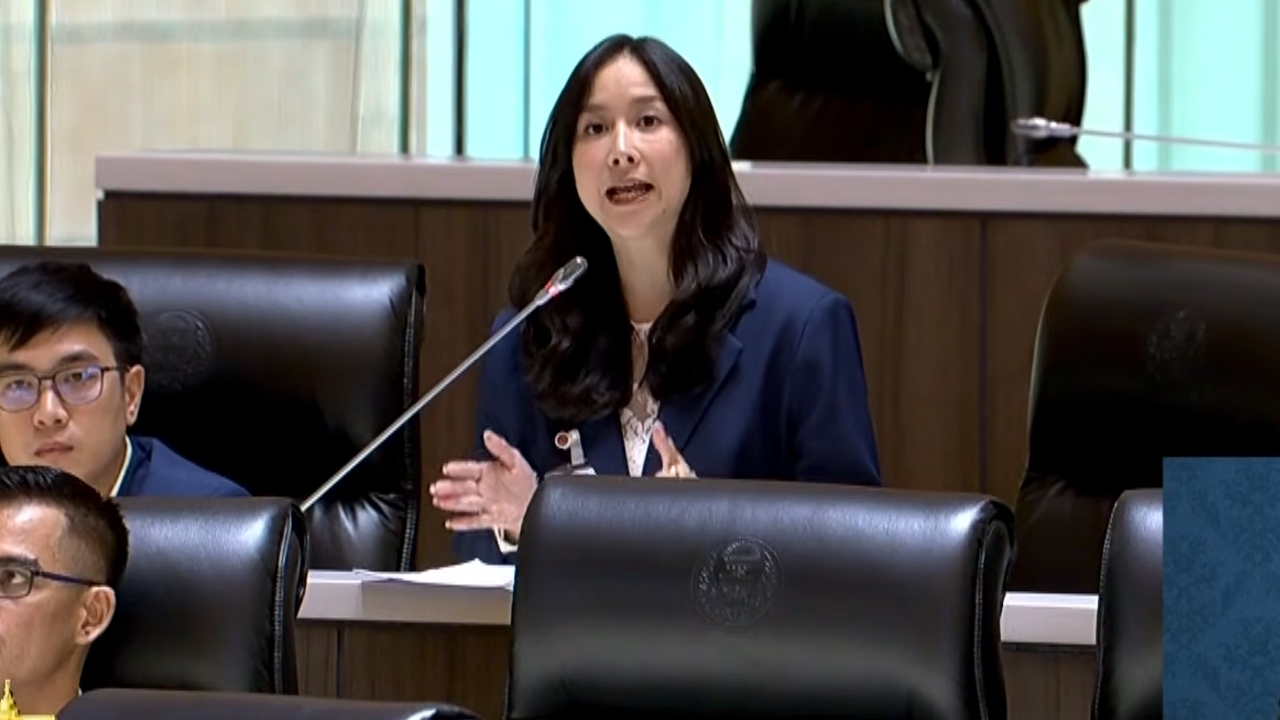
Cholnat proposed a 5% budget cut for the Internal Security Operations Command (ISOC), revealing an 89-million-baht OSINT project lacking detailed explanation and with outdated specifications, which risks infringing citizens' rights.
On 7 Sep 2026, during the 2027 fiscal year budget bill consideration, in session 2–3, Article 7 concerning the Prime Minister's Office budget, Ms. Cholnat Koykul, Member of Parliament for Bangkok (Bang Bon, Chom Thong, Nong Khaem districts) from the People's Party and minority committee member, debated to propose a 5% budget reduction citing multiple concerns over ISOC's procurement project.
Ms. Cholnat explained that ISOC requested a budget of 89 million baht to procure an Open Source Intelligence (OSINT) system, which collects and analyzes behavior and relationships of individuals from public spaces and social media. Simply put, it systematically collects, analyzes, and monitors what people say and do publicly—without hacking or wiretapping—by analyzing publicly available online data. Naturally, such a system has costs, including commercial software licenses, API fees, servers, system development, and personnel expenses.
"I am not saying Open Source Intelligence should be free, but the question is: what exactly are we paying for with taxpayers' 89 million baht?" Ms. Cholnat further stated,
During committee review, three main issues of unreasonableness and lack of transparency were found:
1. Budget details unclear: There was no breakdown of actual costs, including the number of personnel, salaries, or hardware and software infrastructure, making it impossible for parliament to verify whether the 89 million baht is justified or reasonable under public tax use principles.
2. Outdated information in the TOR: Examination of the Terms of Reference (TOR) obtained from the ICT subcommittee showed that the project specified platforms to be used, such as “Skype,” which Microsoft discontinued for general users as of 5 May 2025. This raises questions about whether the 2027 budget request underwent proper technological updates and verification before submission to parliament.
3. Risks of rights violations and personal tracking: According to ISOC's explanation, the system can determine geolocation and link relationships of “target individuals” in real time, potentially involving severe surveillance and processing of personal data without clear criteria on who designates targets or safeguards fundamental rights of citizens.
"Although each piece of data may come from public spaces, the state's collection, analysis of locations, relationships, and profiling of individuals profoundly impacts citizens' fundamental rights," Ms. Cholnat noted.
The minority committee member from the People's Party concluded that this project exemplifies ISOC's budgeting failures, unable to demonstrate cost-effectiveness, transparency, or necessity to parliament, thus proposing a budget cut to protect public interest and state funds.