

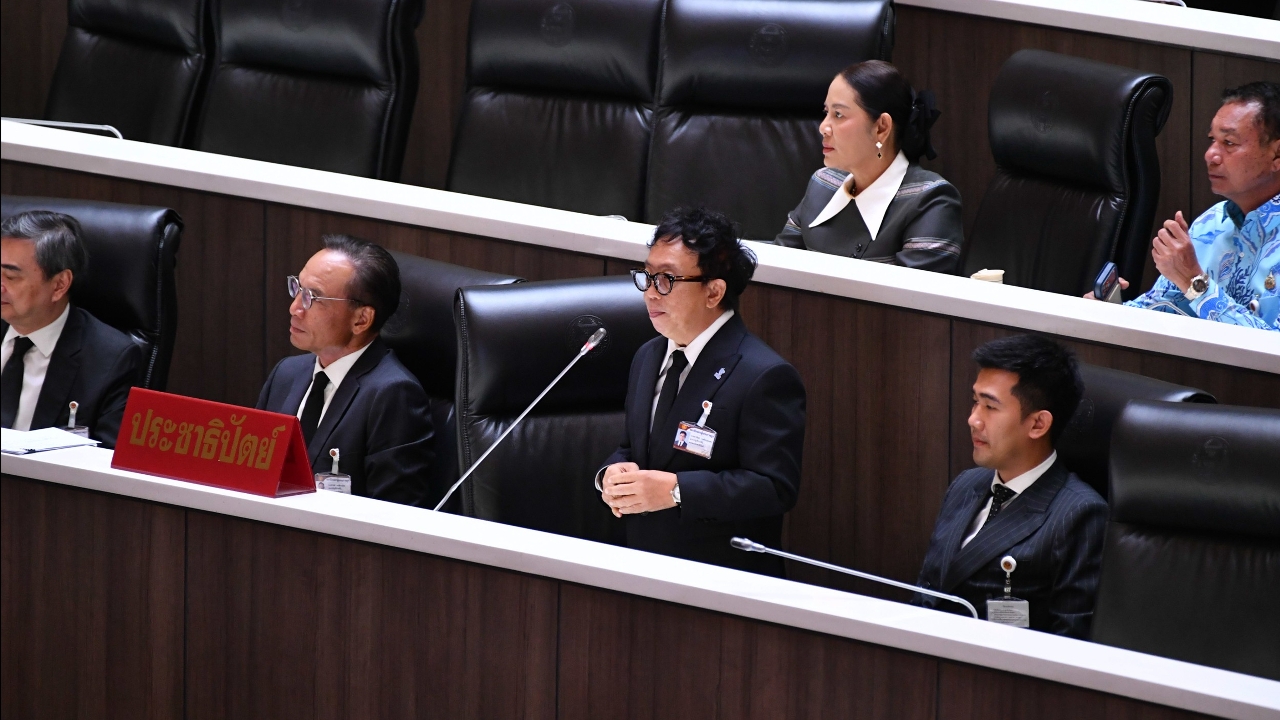
Satit highlights issues affecting the poor, condemns the Prime Minister's Office budget for wasteful spending, and neglecting to solve land and community title deed problems. He stressed that the One Map proposal submitted to the Cabinet is merely an opinion, not law, and that the annexed maps in ministerial regulations must be corrected to be effective.
On 7 September 2026 at the Parliament, during a House of Representatives session to consider the draft Budget Act for fiscal year 2027, Satit Wongnongtoey, a party-list MP from the Democrat Party, debated the Prime Minister's Office budget. He questioned the credibility of the parliamentary committee’s work and the government’s budget allocation policies, arguing they fail to address the people's problems.
Satit pointed out that the Prime Minister's Office budget was only slightly reduced, and cuts were made in areas that should not have been reduced. Meanwhile, the government neglected to dissolve redundant agencies with large budgets, such as the Office for Driving National Reform Strategy for the National Strategy. This office remains despite a Deputy Prime Minister responsible for public sector reform having proposed its dissolution. Satit suggested political motives behind retaining this office, possibly related to appointing a new director.
Conversely, the government decided to dissolve two key agencies that address land use problems for the poor: the Community Title Deeds Office and the Land Bank. These agencies were recently dissolved before the budget draft was submitted to Parliament. This action abandons many citizens who benefit from community title deeds and the Land Bank project, with no measures prepared to address the resulting impacts.
Satit added that the government shifted all responsibility to the National Land Policy Committee (NLPC), despite their clearly different mandates. Recently, the National Human Rights Commission had to send a letter to the Prime Minister opposing the Land Bank’s dissolution, noting that those at risk of losing land under the Land Bank project are being neglected. This is not the NLPC’s burden, and when responsibility was passed to the Bank for Agriculture and Agricultural Cooperatives, no supporting programs were in place either.
These issues led mass groups like P-Move to protest by blocking the Government House alongside opponents of the Land Bridge project. Instead of listening and solving the problems, a Deputy Prime Minister sarcastically remarked, “If you want to come and stand in the sun in Bangkok, then come.”
Satit also highlighted issues with the NLPC's One Map project, saying that the subcommittee's resolution submitted to the Cabinet is only an opinion, not law. Actual map corrections require amending the annexed maps in ministerial regulations, of which there are many, casting doubt on whether the project will succeed in two years. He also noted that the Agricultural Land Reform Office (ALRO) stipulates that if land overlaps with forest areas, ALRO land titles will be revoked and returned to the forest department, leaving villagers who obtained titles legitimately without legal protection.
“You do not listen to the voices of the poor, but you have shared meals several times with the tycoons. Therefore, this issue must be raised here in Parliament to show that this problem is just waiting to erupt: the problem of land rights for the poor,” Satit said. . Satit concluded.