

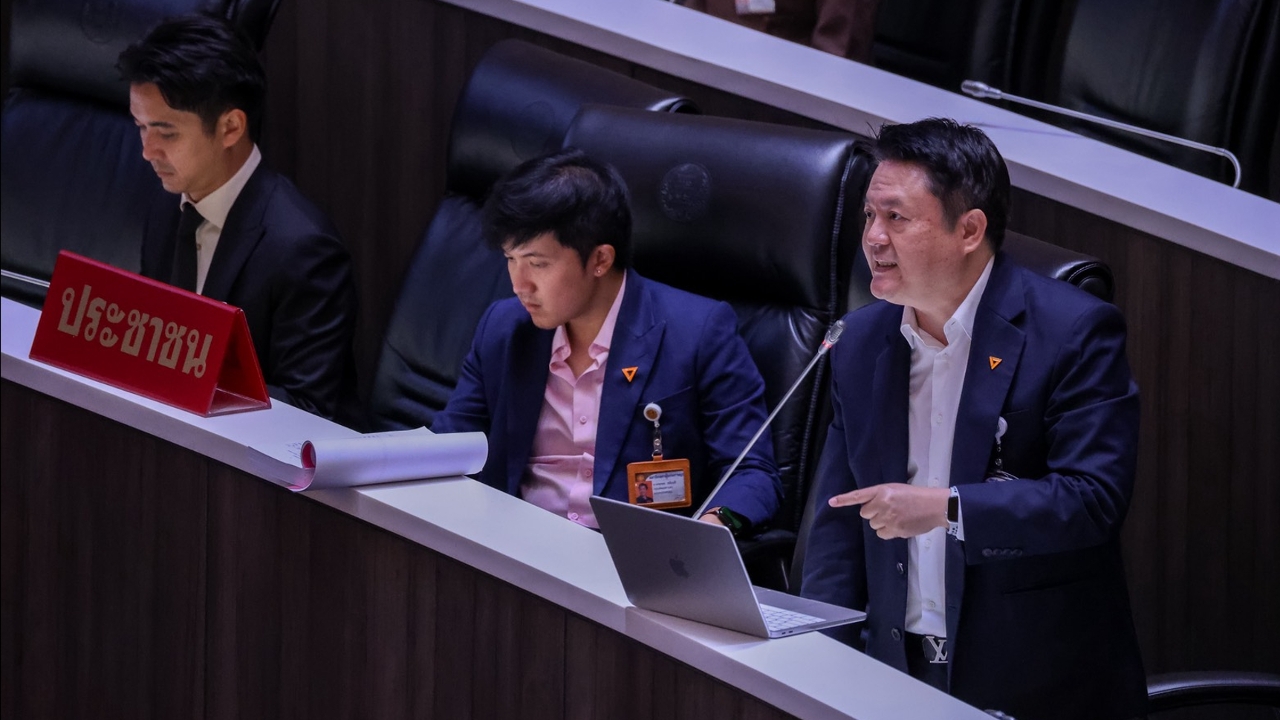
Surachet criticized the Department of Highways for crafting projects to hand over to VIPs and complained that the Land and Construction Subcommittee lacks the courage to reduce budgets for major projects. Meanwhile, Mark expressed doubts about the leftover budget for the Land Bridge project.
At 13:15 on 8 Sep 2026 GMT+7, the House of Representatives began considering Section 15 of the Ministry of Transport’s budget totaling 166.014 billion baht. Opposition MPs criticized the budget allocation focusing mainly on road construction and repair, alleging profit-sharing with contractors, while the committee hesitated to cut budget items. Surachet Praweenwongwut, party-list MP from the People’s Party and minority committee member, proposed a 3% reduction in the Ministry of Transport’s budget, saying it was allocated without clear purpose, mainly targeting road repair and construction. He particularly criticized the Department of Highways for favoring special-class contractors with mid-sized projects worth 600–2,000 million baht, which serve as political and bureaucratic cash cows through kickbacks. These projects are deliberately crafted to ensure enough special-class contractors to share the benefits. The number of special-class projects increased from 69 in 2026 to 70 this year. Yet, the Land and Construction Subcommittee dared not cut major projects despite a total budget of 265 billion baht, only trimming 312 million baht. All special-class projects remained intact, untouched. The Department of Highways’ investment projects worth hundreds of billions were quickly approved with defenders and supporters rallying. Attention must be paid to preparations for Cabinet approval that violate the state construction project guideline, which requires at least 15% of the project value to be allocated in the first year; this has been lowered to 10% to leave budget room for additional projects and collusion. This, he said, is the Blue regime where wrongdoing can be made right.
Mark questions the leftover Land Bridge budget.
Abhisit Vejjajiva, party-list MP and leader of the Democrat Party, expressed doubts about the Ministry of Transport’s operations, which constantly announce policies and projects that do not align with budget allocations. He questioned whether the committee had examined this. He cited the Land Bridge project as an example: although the study committee, chaired by Deputy Prime Minister and Finance Minister Aeknithi Nitithanprapas, had delayed the project after much public objection, the study budget for the Land Bridge still appeared in the budget, albeit a small amount. He wondered why this was left unresolved—whether the committee failed to cut it in time or intentionally left it to keep the project alive for future progress.
Abhisit added that government ministers often advertise projects in various areas, implying political parties in those regions have caused harm, even though the current government is continuing projects approved by previous administrations. The government announces projects but provides no budget, focusing only on road construction. They approve projects to keep them alive and create huge future fiscal obligations, appearing to benefit certain capital groups or contractors. Transport and logistics are key to competitiveness; he urged the government to have a clear plan and allocate budgets accordingly, not to favor vested interests or merely use logistics projects as election campaign tools. He remarked that vote-buying is already bad, but there is also a phenomenon of vote extortion, where officials say voters must elect all MPs from a province to secure certain projects.