

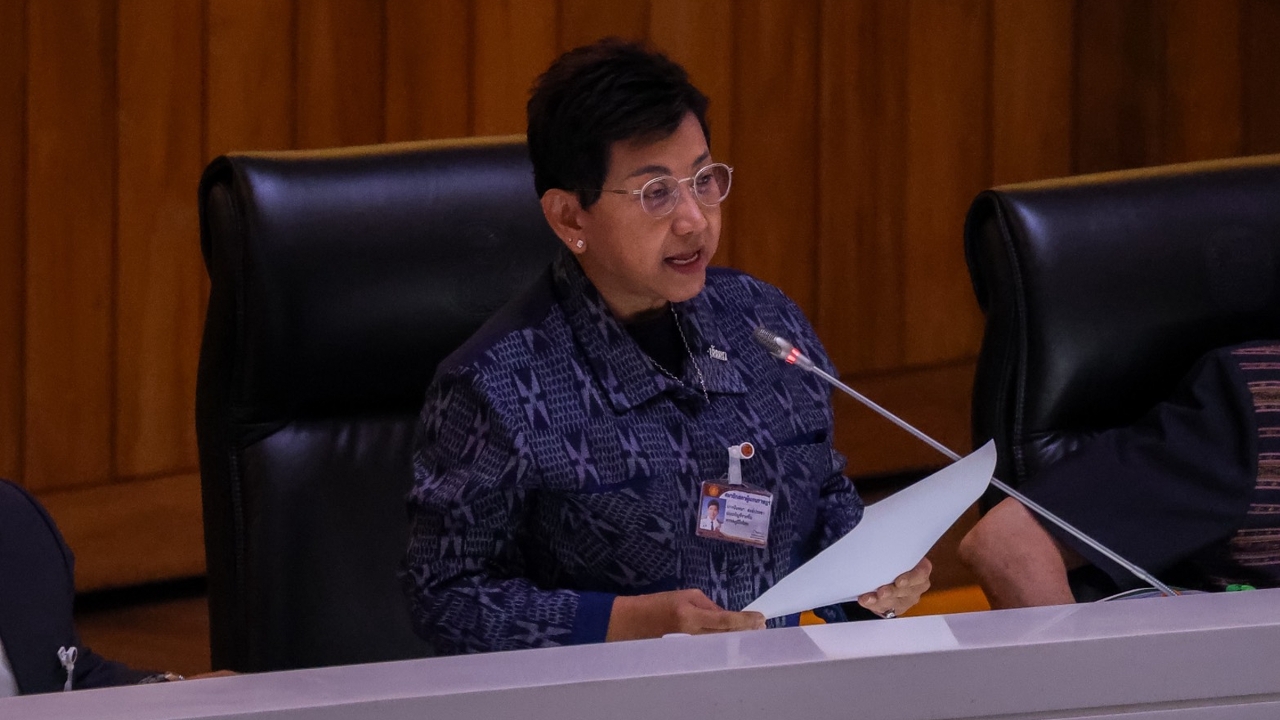
“Nantana” explains the Ministry of Transport's 2027 budget prioritization by delaying a new building project worth 3.552 billion baht, setting the highway budget based on actual disbursement, and confirming procurement follows criteria without favoring special contractors.
At 15:50 on 8 Sep 2026 GMT+7, Ms. Nantana Songpracha, party-list MP of Bhumjaithai Party, serving as commissioner and chair of the subcommittee on land and construction, explained the Ministry of Transport's 2027 budget in response to parliamentary questions point by point. She affirmed that budget consideration is based on actual readiness, cost-effectiveness, and regulations—not advancing large projects without regard to budget burdens.
First, Ms. Nantana clarified the new Ministry of Transport office building project with a budget commitment of about 3.552 billion baht for 2026-2028. In 2026, the construction and supervision budget was 530.28 million baht. However, in 2027, the government policy urges agencies to delay construction of non-urgent government buildings. Therefore, the ministry's permanent secretary agreed to postpone the project, not proceeding with construction in 2027, and instead rent space in the existing tourism building, budgeting 6 million baht for rent and 20 million baht for building improvements. This reduces large upfront investment during a period requiring prioritized public spending.
Ms. Nantana said regarding concerns about the Department of Highways setting the first-year budget commitment below 15%: highway projects worth over 1 billion baht typically have a 1,080-day (36-month) timeline and require careful procurement. Data show large projects disburse only 4.44% on average in the first year. Thus, allocating 10% of the project budget for the first year is sufficient to meet actual spending, avoiding excessive reservation that could delay projects or limit investments elsewhere.
Ms. Nantana added that once the 2027 Budget Act is promulgated, the Budget Bureau will compile budget items requiring multi-year commitments and amounts to be committed in future years, submitting them to the Cabinet within 10 days under Section 41 of the Budget Procedures Act B.E.2561 (2018), including items requesting exemptions per the Cabinet resolution dated 11 March 2026.
Regarding the Ministry of Transport budget reduction of over 492 million baht by the construction subcommittee, Ms. Nantana said this was not a blanket cut but based on the readiness of designs, cost estimates, operational areas, and delayed progress indicating expected underspending within the fiscal year.
Ms. Nantana said the 2026 transfer act moved over 2.779 billion baht, while the Ministry of Transport's 2027 budget decreased by about 23.961 billion baht or 9.43% compared to 2026. Therefore, adjustments were made to align with overall conditions and actual operational capacity.
Addressing concerns from MPs about budget allocations favoring special contractors, Ms. Nantana said the Budget Bureau evaluates readiness of location, construction site, standard designs, standard construction cost lists, and current cost estimates (Pror.4 and Pror.5). Ministry of Transport construction project bidding follows criteria set by the Comptroller General’s Department regarding project size, value, and contractor class with bidding rights—not conditions tailored to benefit any particular party.
Ms. Nantana responded to concerns that setting the first-year budget commitment below 15% might cause future budget burdens. She said new 2027 commitments consider future liabilities and comply with state fiscal discipline. According to the 2018 State Fiscal Policy Committee announcement, new commitments must not exceed 10% of total expenditure budget. For 2027, new commitment items total 8.01% of the budget, thus remaining within legal limits.
Ms. Nantana mentioned the 11 million baht budget for the Land Bridge project under the Office of Transport and Traffic Policy and Planning (OTP) is the final year of the 2024-2027 study contract and will be paid according to the original contract amount.
However, after Deputy Prime Minister Ekniti Nitithanprapas announced that the Land Bridge study indicates low business feasibility, potential budget burdens, and high impact risks, and amid public disagreement, OTP will audit the work per contract scope. OTP will categorize completed work, work in progress, and unfeasible work before considering contract amendments and budget reductions per regulations and laws.
Ms. Nantana explained that equipment for the Marine Department, such as jet skis, flat-bottom boats, and fast water surface vehicles, cannot be compared to commercial product prices because government equipment must meet specific features and include additional mission-related equipment. These items include trailers for towing, capacity for at least three operators, stable balance systems, six-display indicators, emergency lights, life jackets, helmets, and both theoretical and practical training for use and maintenance. The equipment subcommittee has already adjusted budgets downward appropriately.