

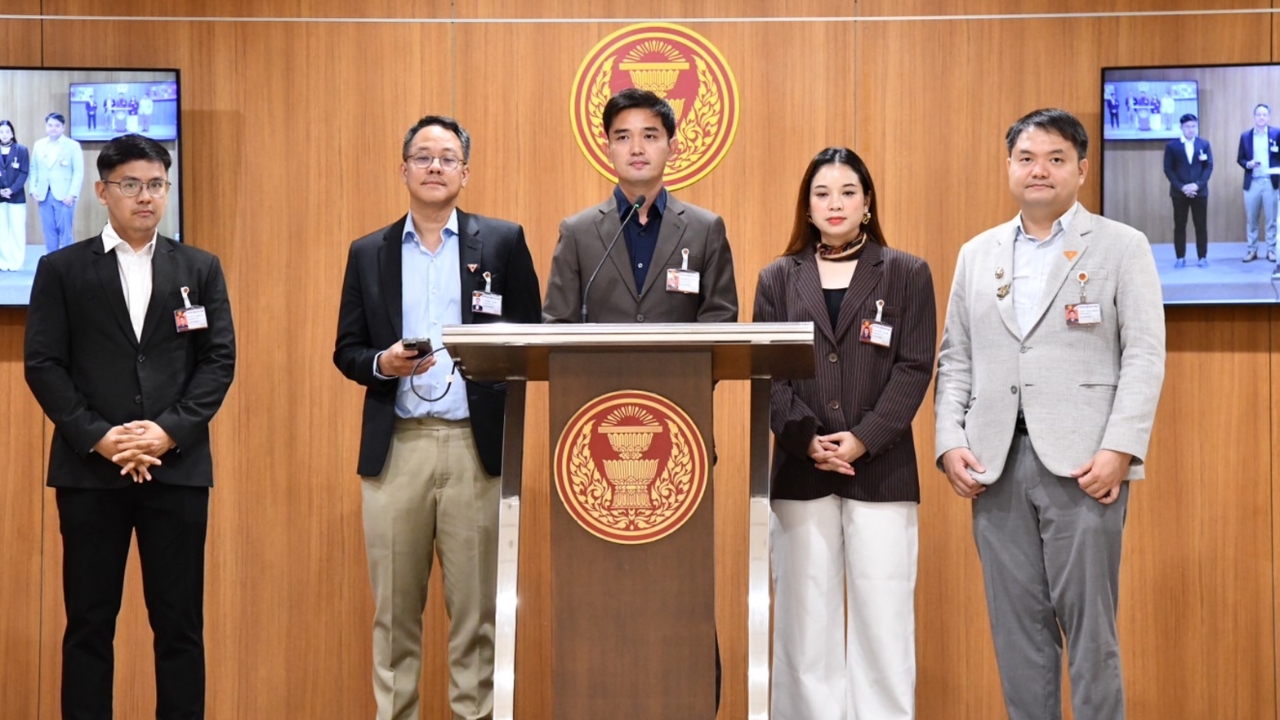
Pongsornat, an MP from the Prachachon Party, announced submitting a motion to review the duties of the Speaker and Deputy Speaker of the House, pointing out that their discretionary control over meetings affects MPs' rights. Phandil emphasized that the issue is not about free meals but about establishing a system to support late-night meetings.
8 Sep 2026 GMT+7 Mr. Pongsornat Thonglee Mr. Pongsornat Thonglee, Member of Parliament for Bangkok from the Prachachon Party, along with the party's MP team, held a press conference regarding submitting a motion to review the performance of the Speaker and Deputy Speaker of the House of Representatives, concerning both meeting oversight and parliamentary administration, following ongoing issues affecting MPs' duties in the 27th session.
"Since the House opened, problems have persisted, differing from the previous session. Before, each meeting allowed full debates where MPs could freely present facts and issues affecting their constituents, sharing all relevant information."
Mr. Pongsornat further stated that the current meeting control and discretion exercised in the House have become limitations impacting MPs' rights to debate, particularly the Speaker's and Deputy Speaker’s discretionary powers in managing meetings. Today, such controls and discretion act as constraints, affecting MPs' ability to debate. The problems extend beyond meeting control to include the effects of parliamentary administration.
"We have received numerous complaints stemming from meeting controls by the Speaker and Deputy Speaker, as well as impacts from parliamentary administration. Today, we submit this motion to the House to consider these problems and propose recommendations, so the Speaker and Deputy Speaker can take them into account to improve oversight of meeting controls and administration."
The House of Representatives plays a critical role in legislating, budget consideration, and government oversight. Therefore, MPs must be able to debate, present facts, and highlight public problems fully, under the constitution and meeting rules. Past issues with meeting control and discretion have impaired MPs' duties, including limits or cuts to debate time, information presentation, time management, and agenda setting, raising doubts about impartiality and preventing MPs from fulfilling their roles effectively.
These issues should not be confined to members merely complaining among themselves but must be formally examined in the House. This will allow consideration of problems and recommendations for the Speaker and Deputy Speaker to improve meeting oversight and parliamentary management. Article 119 of the Constitution mandates that the Speaker conduct parliamentary affairs according to rules and remain neutral. The Speaker’s duties also involve overseeing operations and administration to support MPs' effective performance.
, Mr. Phandil Nuamjeum Mr. Phandil Nuamjeum, MP for Bangkok from the Prachachon Party, also highlighted problems with the review and concealment of debate slides that sometimes disrupt debates, as well as internal parliamentary management issues affecting MPs and staff. He pointed out problems from the screening and hiding of debate slides to insufficient support for late-night meetings, where MPs and staff sometimes must continue until 9 or 10 p.m., after building shops have closed. He affirmed that the request is not for free meals and that he is willing to pay for his food personally.
"I am willing to pay 300–500 baht and am not asking for free meals, but I believe the Speaker, as the official in charge of parliamentary affairs, should establish appropriate systems to ensure meetings proceed smoothly without interruption. This issue is not about MPs' meals but about whether the parliamentary administration is adequately prepared to support work during late hours. The Speaker’s role is not only to keep meetings running but to enable the House to fulfill its constitutional duties efficiently."
Mr. Phandil added that problems in meetings and parliamentary administration affect government oversight, lawmaking, and bringing public concerns into the House. Currently, the House meets only twice a week, so the available time should be used fully to allow MPs to debate and raise issues effectively, ensuring meetings proceed appropriately.
Mr. Pongsornat concluded that the motion aims for the House to seriously consider these issues and jointly find recommendations so the Speaker and Deputy Speaker’s duties, meeting control, and parliamentary management fully support MPs’ work. Ultimately, the House must be a place where representatives chosen by the people can effectively work and voice the public's concerns.