

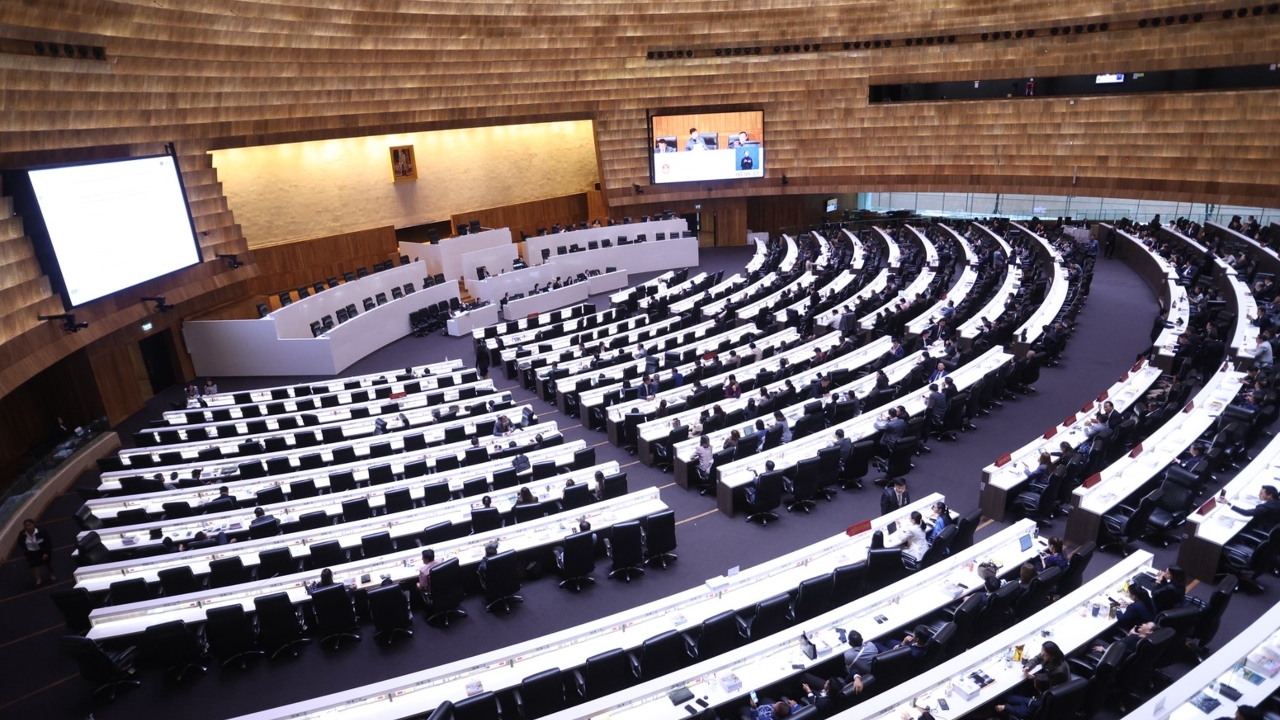
The parliament heated up late at night again as the Prachachon and Bhumjaithai parties fiercely contested the groundwater budget. MP Nattha pressed questions about fund concentration and misallocation, while Pimpattara responded by advising to focus on substance rather than content. Meanwhile, Rakchanok became extremely angry, almost sparking a heated verbal clash.
At 21:29 on 8 September 2026, Mr. Boonlue Prasertsopha, MP for Ratchaburi from the Bhumjaithai Party (BJT) and chairman of the subcommittee on training, seminars, public relations, contracted services, consultancy fees, and work system development within the majority special committee reviewing the 2027 fiscal year budget bill, rose to explain during the House of Representatives session on the budget bill, Article 17, Ministry of Natural Resources and Environment, in the second reading. He clarified the reason for budget cuts after discussions about the committee reducing the Pollution Control Department's budget by 3 billion baht. The cut aimed to compensate a company involved as a party in a 20-year-long Klong Dan landfill lawsuit. The Pollution Control Department had requested the budget to cover compensation to the opposing party.
Mr. Boonlue continued that since the case remains unresolved, with asset seizures ongoing and under administrative court review, the committee decided to cut this budget item and return the funds to the state budget. He affirmed that this subcommittee decision was historic, careful, and prudent, primarily intended as a behind-the-scenes measure.

At 21:45, during the House session chaired by Second Deputy Speaker Lertsak Patanachayakul, while considering Article 17 concerning the Ministry of Natural Resources and Environment, Mr. Boonjong Wongtrairat, MP for Nakhon Ratchasima from Bhumjaithai and a majority committee member, explained that he had to respond to questions raised by the minority committee member, Mr. Nattha Boonchaiinsawat, a party-list MP from Prachachon. This question was previously addressed in the budget committee meeting and was thought to be understood. The issue concerned the groundwater budget for fiscal year 2027, set at 1.5 billion baht to drill groundwater wells for the public. However, most wells are located in Bhumjaithai's constituencies rather than Prachachon's, with about 281 drilling projects—141 in Bhumjaithai areas.
Mr. Boonjong added that as MPs, they understand that water issues are major public concerns, especially for MPs in their constituencies who often hear complaints about insufficient groundwater for consumption and agriculture. The question was why these groundwater projects, under the Department of Groundwater Resources, were mostly in Bhumjaithai MPs’ areas rather than Prachachon’s. He noted that Bhumjaithai has 172 constituency MPs, while Prachachon has less than half that number. Moreover, Bhumjaithai’s MPs represent rural areas across all regions, where water shortages are acute, and MPs coordinate with government agencies regarding drilling feasibility.
“I ask the minority committee member, Mr. Nattha, to understand this fact: rural areas fall mostly within Bhumjaithai’s constituencies, while Prachachon’s MPs represent Bangkok and its vicinity. Where would Prachachon drill? This is not about favoritism but addressing people’s hardships. The Bhumjaithai Party leader always instructs members that we serve the people. When we find problems in the field, we coordinate with government agencies. MPs don’t have the power to allocate budgets arbitrarily. I hope this clarifies why groundwater projects are mostly in Bhumjaithai areas rather than Prachachon’s,” he said.

Mr. Nattha invoked his right to respond, noting that although this issue was discussed in the committee, his question referred to the mid-year 2026 budget of over 5 billion baht, of which more than 3 billion baht was allocated to Bhumjaithai areas. The Department of Groundwater Resources provided documents with new information indicating this was a new budget, unrelated to the previous 5 billion baht, which was a past mistake.
However, his question in this session concerned the new issue: the 1.5 billion baht budget, of which 861 million baht went to Bhumjaithai’s 141 projects out of 281 total. He said the claim that this had been explained before was incorrect. The maps provided by the department showed allocations in Bhumjaithai constituencies that did not match drought risk maps from 2017 to 2024. Some wells were drilled in non-drought areas, while drought areas received little attention. He questioned how this could happen.
“Second, regarding the claim that Bhumjaithai MPs have more members, thus more drilling projects in underserved areas—this method of argument is often used. While Bhumjaithai has more MPs, what about coalition partners? They have to endure receiving only 57 wells despite supporting the government. I see members raising hands to make the prime minister; now they are sidelined. Mr. Speaker, I speak for all parties, including yours. How can you watch this happen? Letting them take 141 projects while coalition partners get only 57?”

Mr. Lertsak then cautioned Mr. Nattha that he was implicating other political parties, to which Mr. Nattha replied, “I am asserting rights for coalition partners. Otherwise, you just vote them into government, and they sweep everything. This is the so-called 'blue regime' that sweeps everything clean, leaving nothing.”
This triggered protests from Bhumjaithai MPs, with Mr. Yosawat Maphaisan, MP for Kanchanaburi, standing to object: “You know well the reason you were elected fewer times, and your areas are Bangkok, Nonthaburi, and Samut Prakan. Where else do you have constituencies? You’re a party-list MP who doesn’t endure fieldwork like us. So you’re slandering us. I am also a committee member. You claim mistakes—what evidence do you have? You don’t understand the rules. Mr. Speaker, please control this.”
Mr. Wichai Sudsawat, MP for Chumphon from Bhumjaithai, also protested, “I raised my hand long ago, since the 'black-chinned snakehead' era. I want to know what kind of idol that is. That snakehead is everywhere and still not eradicated. We don’t want just anyone.” He then reproached the chair, “You allow continuous taunts and accusations against Bhumjaithai, from areas to everything else. Don’t think loud voices mean truth. I’m loud too. All MPs have equal dignity. You can’t insult one colleague alone. Please rule whether this speech is right or wrong.”
Mr. Nattha retorted, “What did I taunt? Please specify exactly what I said to provoke the protest.” The debate escalated until Mr. Lertsak had to mute all microphones, though some voices leaked through. He acknowledged Mr. Wichai’s protest and asked for calm, but Mr. Wichai asked what the two colors represented, suggesting they were the same, both dark.


Later, Mr. Akkaradet Wongpitakrot, MP for Ratchaburi from Bhumjaithai, protested, urging the chair to maintain order and to withdraw the term 'blue regime,' which he said was a mocking term with no real existence—just the Bhumjaithai party's color. He objected to being slandered as part of a so-called blue regime. “You falsely claim we disadvantage coalition partners. We have over 190 MPs and received 141 wells, compared to 57 for them. Are you multiplying numbers incorrectly? What degree do you hold?”
Mr. Nattha interrupted, saying this would not end. The chair again muted all microphones and ruled that explanations and references had been made and that the term 'blue regime' was considered nonexistent, thus closing the matter and proceeding to the vote.
However, Mr. Rangsiman Rome, party-list MP from Prachachon, protested the insult about education and arithmetic skills. He asked if the chair would allow such remarks. Mr. Lertsak explained that Mr. Akkaradet’s comments questioned calculations, not insulted. Mr. Rangsiman protested again, asking if debate in parliament requires qualifications. Mr. Akkaradet insisted, “I asked what degree you hold. Please answer. Where is the taunt?” Mr. Lertsak warned that such speech could be seen as taunting and asked for withdrawal. Mr. Akkaradet then withdrew the statement.

Ms. Pimpattara Wichaikul, MP for Nakhon Si Thammarat from Bhumjaithai and a majority committee member, explained to Mr. Nattha that regarding which party received what, consider the composition of members: Prachachon has 88 constituency MPs, including 33 in Bangkok, 32 in surrounding provinces, and 9 in other cities, totaling 74. They use metropolitan or regional waterworks, unaware that people in mountainous or border areas rely on village or mountain water supplies, needing groundwater budget support. She asked if he understood why Prachachon did not get such budget because they are urban and use metropolitan waterworks, but they could request funds if needed.
She noted the imbalance in member distribution across parties and explained that this issue did not end in the committee meeting but has been ongoing since budget meetings with repetitive questions and answers. She urged not to focus on content but on facts.
“Each party’s MPs differ in numbers, so budget shares vary. For example, the Kla Party received the most central budget relative to their MPs. We don’t complain because benefits go to citizens awaiting clean, safe, and standard drinking and usage water.”

Meanwhile, Ms. Rakchanok Srinok, party-list MP from Prachachon and chair of the budget monitoring committee, invoked her right of interpellation, prompting protests from MPs. Mr. Lertsak stated that protests during interpellation rights are not allowed and that protests against the chair must have a basis, which he ruled was not the case and disallowed discussion. He emphasized that the chair’s ruling stands and that she would have an opportunity to speak later.
Ms. Rakchanok urged members to maintain decorum amid frequent interruptions. Mr. Lertsak asked not to protest yet, reaffirming his ruling and asking her to trust the chair’s decision. However, several MPs continued protesting and said discussions would be allowed on Thursday, while Ms. Rakchanok insisted the chair had allowed multiple members to speak excessively.
Mr. Lertsak muted microphones again and warned that he had ruled to stop protests. He asked Ms. Rakchanok to withdraw the word 'babble.' She complied and protested, as did Mr. Thanayot Timsuwan, MP for Loei from Bhumjaithai, who stood and requested the voting process proceed.

Mr. Natthapong Ruangpanyawut, party-list MP and leader of Prachachon as opposition leader, said although no party was directly named, the reference to urban parties not receiving groundwater drilling budgets in their constituencies was normal. Mr. Lertsak allowed Mr. Natthapong to speak but muted Ms. Rakchanok and asked her to sit down. She protested that the chair could not infringe on her right to stand, prompting cheers from the chamber.
Mr. Natthapong continued, interpreting earlier explanations as distortions. He noted that Mr. Nattha never compared budget allocations between Bhumjaithai and Prachachon but highlighted concerns about fund concentration and misallocation to areas without need, questioning whether some areas received disproportionate allocations.
“I urge the chair to remind all members explaining distorted facts to accept the truth straightforwardly. It is normal for budgets to be allocated to certain areas. Remember, the Constitutional Court's ruling under Article 144 applies here. Your words are recorded and may violate Article 144 of the constitution.”
After Mr. Natthapong finished, Mr. Lertsak opened the floor for voting on the article and proceeded immediately. Reporters noted that Ms. Rakchanok was so angry she trembled, requiring fellow Prachachon MPs to help calm her.
After continuous debate and voting on various articles up to Article 19 concerning the Commerce Ministry and affiliated agencies' budget, the chair adjourned the session at 00:40. Proceedings will resume on the morning of 9 September 2026.