

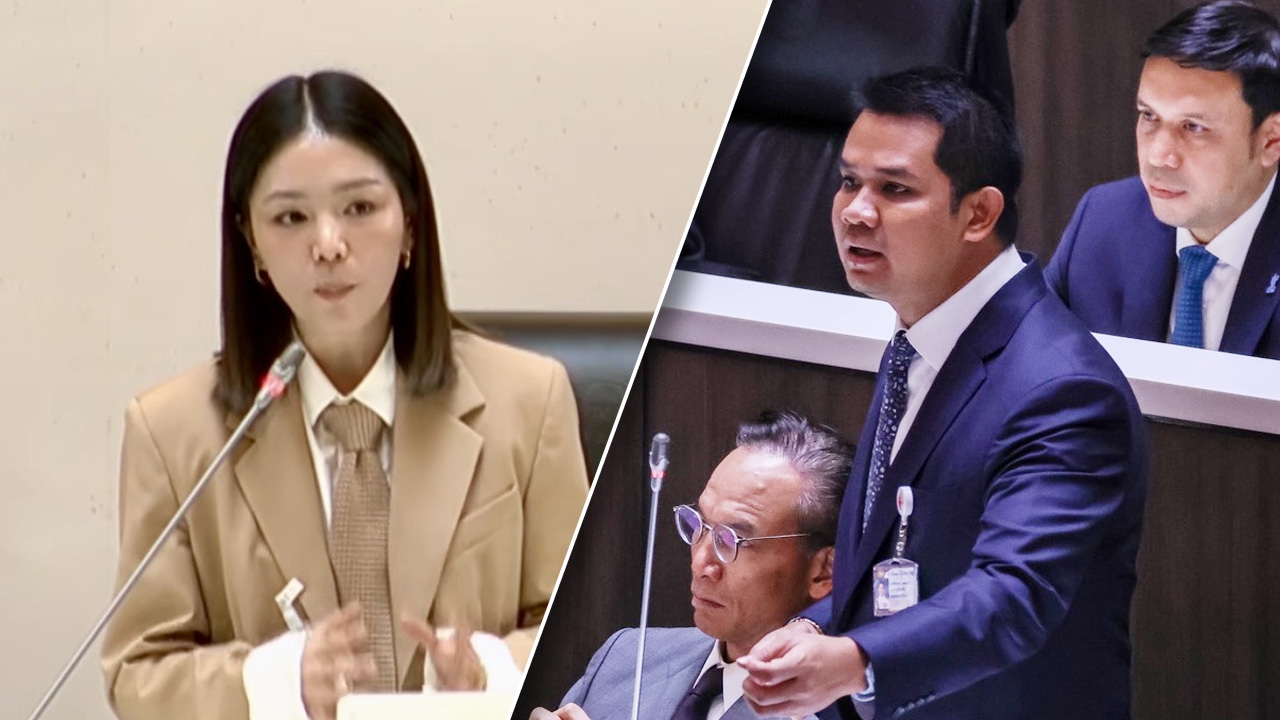
"Madame Dear" urges the government to clarify the community nurse volunteer project, which overlaps with Village Health Volunteers (VHVs), involves a two-year commitment, and raises fears of creating political networks. Meanwhile, "Chaiyachana" reiterates demands for proper budget allocation, opposes establishing nurse volunteers, and criticizes neglect of one million VHVs.
On 10 Sep 2026, reporters reported that during the budget bill debate on 9 Sep, Ms. Watanya Bunnag, a special committee member, discussed Section 25 regarding the Ministry of Public Health's budget and related agencies, reserving judgment on the 1.14768 billion baht budget for the community nurse volunteer project under the Department of Health Service Support (DHSS).
Ms. Watanya said her main reason for reservation was concern over the community nurse volunteer (CNS) project, which plans to hire 7,256 personnel—one per subdistrict—at a monthly salary of 15,000 baht, working full-time under two-year contracts. She did not oppose increasing staff to care for people, recognizing Thailand's aging society and the need for sufficient primary healthcare workers.
"What I want the parliament and public to consider is not just adding personnel to care for people, which sounds good, but to see whether the government is really adding staff where the system lacks them or just creating new positions without solving existing problems," Ms. Watanya said.
Ms. Watanya pointed out five irregularities. First, these new roles duplicate existing functions, since VHVs, caregivers, community hospital staff, and professional nurses already work in these areas. The VHV budget alone for 2027 exceeds 25.68 billion baht. Thus, the government must clarify how CNS differs from existing personnel and how it will avoid overlapping duties with professional nurses supervising the new staff.
Second, Thailand lacks nurses, but the response is not to increase them. Over 17,000 professional nurses work in the system but are not yet appointed as civil servants, with proposals to add about 25,000 civil servant positions to address this. Yet the government pushes ahead with the CNS project. There are concerns about using the term "nurse volunteer," which may confuse the public between licensed nurses and short-term trained personnel. Thailand lacks professional nurses, not just the title.
Third, the government reduces staff through early retirement and agency mergers to control personnel costs but simultaneously allocates subsidies to pay 7,256 full-time CNS staff with supervisors, KPIs, and two-year contracts. This raises questions about why a full-time parallel workforce is being created outside existing personnel frameworks and budgets.
Fourth, the budget is for one year, but contracts last two years with plans to expand. Ms. Watanya noted that the 1.121 billion baht salary budget covers only about 10.3 months for 7,256 staff at 15,000 baht monthly, not a full year. The government must clarify the budget for the second year.
Additionally, there are plans to increase CNS numbers to 28,000 in 2028 and 75,668 in 2029. Assuming the same pay rate, budget burdens could rise to approximately 5.04 billion baht and 13.62 billion baht respectively, but these costs are not clearly reflected in forward budget estimates.
Fifth, concerns exist about the CNS personnel selection process and the risk it may be perceived as building political networks, since hiring occurs in every subdistrict nationwide, with plans to extend to village levels. Selection must be standardized and transparent to avoid suspicions that health funds are used to create politically linked networks.
Ms. Watanya also noted the selection process reportedly relies mainly on interviews without standard exams or records, with scoring by provincial committees. Complaints about committee member lists in some provinces have arisen, prompting calls for the government to clarify the process transparently.
"The government must prove that these personnel are chosen for public health benefits, not political interests," Ms. Watanya said.
Ms. Watanya emphasized she does not oppose increasing personnel to care for people, but parliament should not approve new positions without knowing if duties overlap, approve two-year contracts without second-year budgets, or commit to over 13 billion baht annually before proving project effectiveness. People need enough professional nurses, competent caregivers, and a system with fully accountable spending, not just new titles with "nurse" in them. She reserved judgment on the 1.14768 billion baht until the government fully explains task overlaps, legal status, selection impartiality, and future budget commitments.
"Chaiyachana" Opposes Establishing "Nurse Volunteers," Criticizes Neglect of One Million VHVs
Meanwhile, Mr. Chaiyachana Deddecho, a party-list MP from the Democrat Party, proposed reducing the Ministry of Public Health's budget, stating that while he does not want to cut this vital ministry's budget that cares for citizens throughout life, budget allocation is misdirected—especially the 1.1 billion baht set aside for nurse volunteer projects this year, tied for three years totaling over 15 billion baht.
Mr. Chaiyachana said Thailand has about one million Village Health Volunteers (VHVs), who have long selflessly served society. They first received 600 baht compensation under former Prime Minister Abhisit Vejjajiva, later increased to 800 baht, then further raised during General Prayut Chan-o-cha's tenure. During the 2019–2020 COVID-19 crisis, VHVs were frontline caregivers nationwide, yet the government seems to prioritize new projects while forgetting these volunteers.
"If the 1.1 billion baht budget for nurse volunteers were used to increase VHV compensation by 1,000 baht each for one million volunteers, it would cost only 1 billion baht. Considering the three-year 15 billion baht commitment, raising VHV compensation by 2,000 baht per person would cost just 2 billion baht annually. The remaining 13 billion baht could fund the 12 health regions nationwide with 1 billion baht each for medical equipment and supplies," he said.
Mr. Chaiyachana also questioned the Ministry's management direction, asking why other areas like mental health and drug addiction centers, which lack budgets for community hospital facilities, are overlooked. He highlighted opportunities to generate national revenue through proper regulation and taxation of Thai traditional medicine, alternative medicine, and the over 10,000 beauty clinics nationwide, which could bring in billions annually if properly managed.
He concluded that the new nurse volunteer roles duplicate the existing VHVs, who already care for one person per 10–20 families. He urged the government to consider whether the project aims to build political support networks. The Democrat Party plans to push for reducing this budget to increase support for VHVs nationwide and health regions, affirming that citizens' lives are too valuable to be exploited.
"The Democrat Party was the first to support VHVs and provide compensation. We firmly intend to reduce the nurse volunteer budget and reallocate those funds to VHVs and the 12 health regions nationwide. People's lives are precious and must be cared for properly. Let's not exploit those who have always cared for the public," he said.