

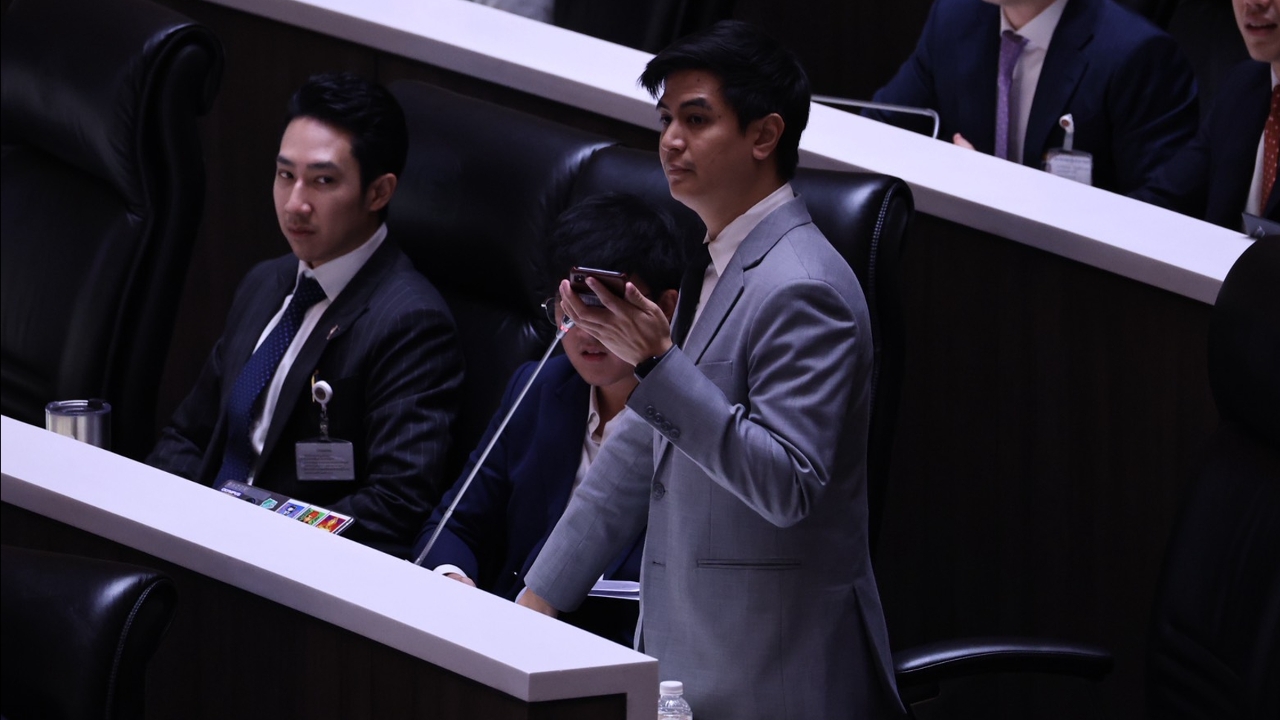
Parit dissects the Election Commission's 2.7 billion baht budget, fearing it might be used to support "democratic crimes." He exposes irregularities in 'Subcommittee 36' that whitewashed the collusion operation by dismissing all complaints against the accused and demands a full cut of the investigative budget.
On 10 Sep 2026, during the second reading of the 2027 fiscal year budget bill, Parit Watthanasin, a party-list MP from the Prachachon Party, debated the budget of independent organizations (Section 32), proposing a reduction in the Election Commission's budget while questioning the value and purpose of how the agency uses its funds.
Parit began his debate by stating that parliamentary approval of any agency's budget depends on confidence that the funds will be used efficiently and for their intended purpose. The 2027 budget documents show the Election Commission requested 2.7 billion baht, claiming it would ensure credible, honest, and fair elections. However, based on observations of the Election Commission's past performance, he expressed deep doubts whether the funds approved by this parliament would be used to protect democracy or to support democratic crimes.
He cited the Election Commission's role over the past two years regarding the openly blatant Senate election fraud scheme occurring under its watch. Society is concerned that within four days, the Election Commission might vote to dismiss the matter before it reaches the courts. He noted that his assumption about the Election Commission had shifted from questioning whether it was negligent to worrying that some officials might have been complicit from the start in the Senate fraud scheme.
Parit outlined the abnormalities in the Senate collusion scheme starting from the planning phase to control the Senate. Teams and budgets were allocated in a political party's meeting room. The Election Commission, instead of preventing this, issued election regulations favoring the plan—especially by requiring candidates to use the same number in both morning and afternoon sessions, facilitating the production of ballot slips.
During the candidate registration phase, many candidates were organized and hired to vote for insiders. The Election Commission, however, turned a blind eye, allowing ineligible candidates to advance. This included cases involving familial relationships, such as parent-child or spouses, which could have been quickly verified.
At the national election stage, ballot slips prepared at various hotels one to two days before the election were used. The Election Commission allowed this to proceed until the afternoon, when it issued a warning. When candidates ignored the warning and ballot slips were seized, no further action was taken. Some individuals whose ballot slips were confiscated later became senators or even the current Senate president.
Parit said that comparing the Senate collusion scheme's course with the Election Commission's actions shows seamless, suspicious connections, like Rama IV Road and Sukhumvit Road linked by alleys continuously and converging at Phra Khanong intersection. Unfortunately, that intersection lacks a court or prison to detain those involved.
He also referenced an audio clip from the B2 Hotel in Rangsit, Pathum Thani Province, one day before the national election. The voice in the clip, acknowledged by him as his own, spoke to a Senate candidate: "Issues considered problematic will be handled by insiders because what we are doing is not for business but for the higher-ups." This statement raised questions about the Election Commission's budget requests related to anti-corruption efforts, such as 11.9 million baht for basic investigation and hearing training and 4.8 million baht for enhancing election offense prevention, questioning whether these should be approved.
Parit then analyzed the effectiveness of the Election Commission's investigation into Senate election fraud, which involves three steps. The first is the examination by the Central Investigation and Hearing Committee No. 26, a joint effort between the Election Commission and the Department of Special Investigation (DSI). This team worked thoroughly, interviewing over 700 witnesses, compiling more than 90,000 pages of documents, and concluding with indictments against all 229 accused persons, including 138 senators and 21 ministers, MPs, and executives of the Bhumjaithai Party. The investigation clearly indicated that the party's executives and MPs had helped candidates get elected in violation of Section 76 of the Organic Act on the Election of Senators.
The second step, at the Election Commission Secretary-General's level, also recommended indictment of hundreds of accused individuals, including at least 136 senators on the list and at least three ministers or MPs from the Bhumjaithai Party with direct evidence.
The third step involves review by 'Subcommittee 36 on Adjudicating Contested Issues.' Parit questioned three main irregularities: first, the suspicious establishment of this special subcommittee by the Election Commission, despite normally having 35 rotating subcommittees to avoid prior knowledge of case assignments. Subcommittee 36 was specially created, staffed with qualified members seemingly to assist certain parties. Even though the Election Commission claimed the existing 35 subcommittees were overloaded, four of the seven members in Subcommittee 36 also sat on those original subcommittees, undermining that explanation.
Second, Subcommittee 36's work aligned with political agendas, acting like a court to dismiss evidence citing unresolved doubts, although legally the Election Commission's role is merely to file charges when there is reasonable belief of fraud. When evidence implicated politicians close to power centers, the subcommittee tried to interpret laws to protect them or deny that the fraud was systematic.
Third, the subcommittee's conclusions starkly contradicted evidence, ruling that the Senate collusion scheme did not exist and that no accused individuals should be charged, not a single one.
Parit highlighted the peculiarity that Subcommittee 36 received meeting allowances totaling hundreds of thousands of baht but accepted unreasonable explanations. For example, they accepted that ballot numbers matching exactly between slips and official ballots were mere coincidences done in good faith. Cases such as a Surat Thani MP's assistant transferring money to 10 Senate candidates one day before the election were dismissed as coincidental debts, coincidental Buddha amulet purchases, or coincidental fertilizer purchases on the same day. Even cases like a Nakhon Phanom senator offering money and positions, flight ticket payments to seven candidates, and witnesses confirming meetings with a former deputy parliament speaker at a hotel were believed to be honest actions unrelated to political parties.
In conclusion, Parit stated that if the Election Commission's investigative standards remain as such, even if the investigation team produces clear evidence, the adjudicating subcommittees will politically dismiss the cases. Therefore, the investigative budget and subcommittee meeting allowances should be entirely cut to zero. If this is the desired outcome, even a minimal telephone budget to Buriram could yield the same results.
“On 14 Sep, if all seven Election Commission members vote in line with Subcommittee 36’s conclusions, which contradict evidence, this parliament should not approve any budgets for the Election Commission. Doing so would mean using taxpayers’ money to fund an organization that protects networks of democratic criminals,” Parit said. Parit concluded his remarks.