

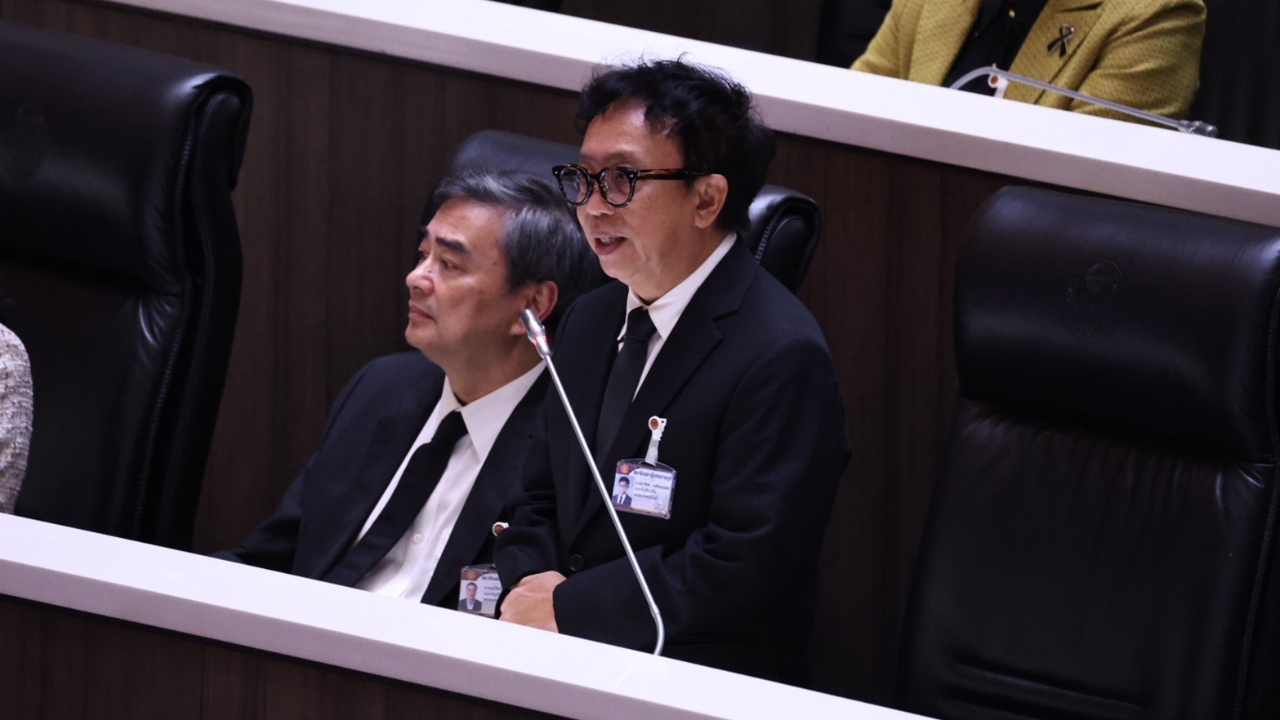
Satit sharply criticized the chair of the 2570 budget committee for protecting the Election Commission (EC) and blocking questioning on the Senate vote-rigging case. He emphasized that 14 September is the last chance to submit the case to court. Meanwhile, Pongsakorn revealed the Democrat MPs' decision to vote against the 2570 budget bill, calling it lacking future prospects, concealed, and legally evasive.
At 17:05 on 10 September 2026 at the Parliament. Mr. Satit Wongnongtoey, party-list MP of the Democrat Party. He spoke during the debate on Section 32 of the budget for independent organizations in the consideration of the draft annual budget act for fiscal year 2570 (2027), stating that the Section 32 budget review was highly irregular, especially during the budget committee's majority hearing. He said he received information that when the EC secretary came to explain and was questioned about the significant reduction in investigation budget related to the Senate vote-rigging case, questions about the case progress were ignored. The EC secretary did not answer, and the budget committee chair abruptly ended the session and left without allowing a second round of questioning as is customary, claiming not to see other committee members waiting to ask questions.
This behavior suggests an attempt to protect the EC from questions that could impact certain political parties. The EC is an independent organization that has spent over 70 billion baht of public funds in 23 years. If the EC, as the first gatekeeper of Thai politics, becomes compromised, it undermines democratic principles. He further pointed out three failures of the EC in fulfilling its duties.
1. Issuing dishonest and unfair regulations: The EC's regulations for certifying Senate candidate qualifications were too lax, allowing false declarations, such as claiming work experience as 'housework.' Also, appointing district chiefs under the Ministry of Interior as election directors risked political interference from parties overseeing the ministry.
2. Inefficient election management: The EC received budgets for rapid response and intelligence units but allowed vote-buying and collusion for Senate seats to occur openly in hotels near election sites nationwide without investigation.
3. Exercising semi-judicial power improperly: The EC did not follow previous precedent of referring vote-trading Senate cases to the Supreme Court. Although this case qualifies as 'super collusion,' it was not referred. He warned that independent organizations face a severe trust crisis, and if political parties or power groups dominate the House, Senate, and independent bodies, it will lead to national disaster.
. 14 September is a crucial and final opportunity for the EC to regain public trust by adhering to the law and submitting the Senate vote-rigging fraud case to court for judgment. He urged EC members, numbering 2-3 thousand, that this trust crisis may stem from a few top officials causing daily erosion of confidence. The 14 September deadline is the chance to restore trust by following the law, constitution, honesty, fairness, and national correctness through submitting the Senate vote-rigging case to court — the sole path to regain EC's credibility.

Later, at 19:00. Mr. Pongsakorn Kwanmuang, spokesperson for the Democrat Party. Announced the outcome of the party MPs meeting: The Democrat Party MPs resolved to oppose the draft annual budget act for fiscal year 2570 (2027). They identified three main problems in the 2570 budget structure:
1. A budget lacking future vision, focusing on recurrent expenses, commitments, and populist policies, cutting future development funds, allocating actual investment budgets below appropriate levels, and neglecting to reduce unnecessary spending.
2. Risking violation of financial discipline laws, which require at least 20% investment budget. The government used accounting tricks, like classifying over 6 billion baht of cloud system rentals—which are normally operational expenses—as investment to meet legal thresholds.
3. A concealed and duplicated budget, with over 10 billion baht allocated for energy transition in the recurrent budget, despite a 400 billion baht loan decree already providing 200 billion baht for energy transition. The party proposed reallocating this 10 billion baht to support the student loan fund to enhance educational opportunities for youth.
The Democrat Party explained that they abstained in the first reading to allow the government to address concerns in committee. However, the government ignored suggestions and insisted on the same futureless, concealed, and legally questionable budget structure. Therefore, the Democrat Party voted to oppose the bill to protect the country's and people's interests.