

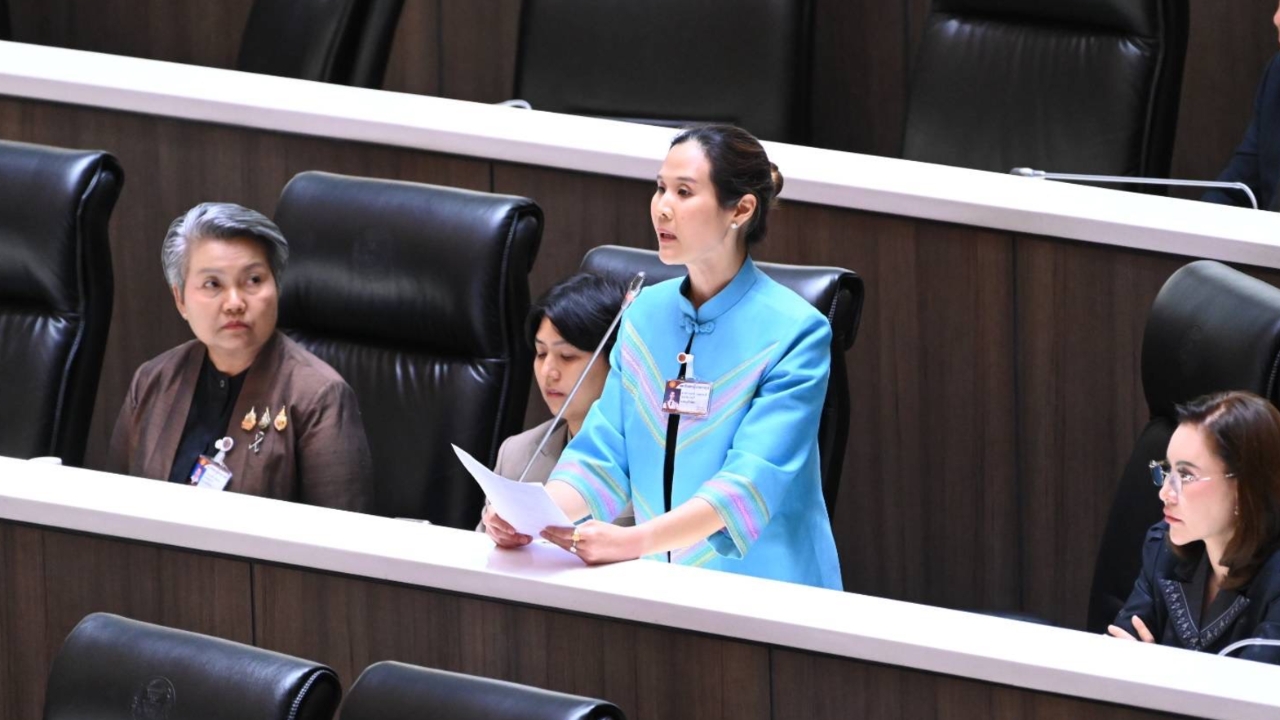
Kulwalee debated the 2027 budget, revealing that 40 million baht in villagers' compensation funds went missing, over 478 million baht was cut from the forest elephant monitoring team budget, while all funding for heavy metal testing at 11 Kok River sites and new equipment was eliminated.
On 10 September 2026, Ms. Kulwalee Nopamornbodi, Chair of the Land, Natural Resources, and Environment Committee of the House of Representatives, participated in debating the 2027 annual expenditure bill, second reading, specifically Article 17 concerning the Ministry of Natural Resources and Environment, while commending the special committee and subcommittees for reviewing and reducing over 3.278 billion baht in unnecessary ministry expenses.
However, Ms. Kulwalee stated that budget reductions should be carefully considered, especially those related to people's lives, safety, health, and property. She raised two key points to the Budget Bureau for consideration.
The first issue concerns the escalating conflict between wild elephants and people. Ms. Kulwalee explained that, as chair of the land committee assigned by the parliament to study and monitor this problem, the committee is preparing a report to propose systematic solutions.
For the 2027 budget, the Department of National Parks, Wildlife and Plant Conservation requested funds to assist people affected by wild elephants, but these were significantly reduced.
Regarding compensation and relief for people harmed by wild elephants—including deaths, agricultural damage, homes, and property—the department requested 50 million baht based on damage surveys but was allocated only 10 million baht, leaving a 40 million baht shortfall.
"Villagers are not demanding more than necessary; these are real, surveyed damages, and they are awaiting government compensation. If the budget is insufficient, it is the people who must wait," Ms. Kulwalee said.
Meanwhile, the budget for forest elephant monitoring and deterrence teams, which employs locals to monitor, alert, and prevent elephants from entering communities, was requested at 776 million baht but allocated only 298 million baht, a cut of over 478 million baht. Ms. Kulwalee emphasized that resolving the elephant problem requires more than just chasing elephants away; it demands training, network building, and cultivating new local workers continuously, as some current personnel are aging or leaving.
"If we do not build new monitoring teams, who will ensure the safety of villagers in these areas?" Ms. Kulwalee asked.
Ms. Kulwalee also highlighted cross-border pollution issues in the Kok, Sai, Ruak, and Mekong Rivers—concerns of local residents that the committee has been continuously monitoring.
The Pollution Control Department planned to establish 11 automatic water quality monitoring stations to continuously track heavy metal levels across risky areas, enabling rapid detection and pinpointing pollution sources for investigation.
However, the budget for all 11 monitoring stations was entirely cut.
Moreover, the department's existing heavy metal testing devices—five units over 10 years old—are now reduced to two functional units after three became defective, despite processing tens of thousands of samples annually.
The Pollution Control Department requested funds to purchase three new devices but had this request entirely eliminated.
"I urge the Budget Bureau to carefully distinguish between unnecessary expenses and essential tools. Without adequate heavy metal detection equipment and warning stations, how will we identify and address pollution sources to protect the public?" she said.
Ms. Kulwalee expressed support for the special committee’s budget review approach and agreed with cost-effective spending but urged that budget cuts consider their impacts on the people.
"Every baht of the budget comes from the people, so any cuts must answer how they will affect the public. Ultimately, the ones impacted by budget decisions are not just agencies but the local communities," Ms. Kulwalee said.