

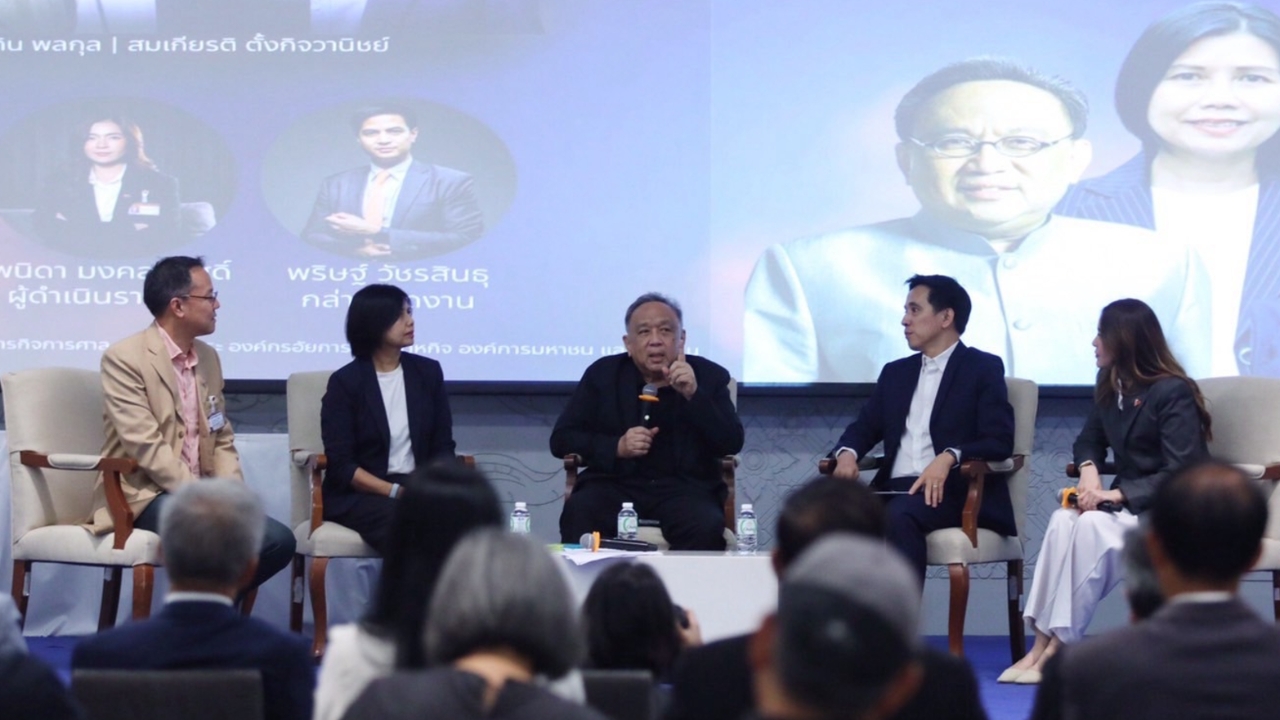
A panel discussion highlighted that independent agencies are undergoing "institutional decay," urging the Election Commission (EC) to open the way for the courts to rule on the senator election fraud case as a measure of democratic confidence in Thailand's democracy.
On 12 Sep 2026 GMT+7, the Parliamentary Committee on Courts, Independent Agencies, Prosecutors, State Enterprises, Public Organizations, and Funds held a seminar titled "Monitoring the Role of Independent Agencies Amid Thailand's Political Crisis," featuring academics reflecting on Thailand's structural political issues.
Thongthong Chandransu, a former 1997 constitution drafter, described the original intent to establish the EC and Senate as neutral bodies to balance power from elections managed by the Ministry of Interior. However, the current structure has created a vicious cycle where the EC participates in selecting senators, while senators approve the EC, resulting in a reversed situation of "a non-neutral EC producing a non-neutral Senate," likened to escaping a tiger only to encounter a crocodile, making independent agencies increasingly difficult to scrutinize.
Meanwhile, Prof. Dr. Siriphan Noksuan Sawasdee, a political science lecturer at Chulalongkorn University, highlighted weaknesses in the 2017 constitution that removed mechanisms to remove independent agency members. Furthermore, in recent Senate elections, the EC delegated duties to administrative officials, leading to collusion. Evidence of irregular group behavior, such as identical voting patterns, financial trails, and coordinated arrangements for accommodation and clothing, suggests centralized orchestration. She called on the EC to exercise its authority by referring the case to the Supreme Court for transparent public clarification.
Assoc. Prof. Dr. Prajak Kongkirati, a political science lecturer at Thammasat University, warned that independent agencies are facing "institutional decay" due to excessive power without oversight, having been seized by political groups and used as instruments to destroy opponents rather than protect citizens as originally intended. The EC's decision on the senator election fraud case represents a critical crossroads with high stakes for restoring or undermining confidence in Thailand's democratic system and rule of law.