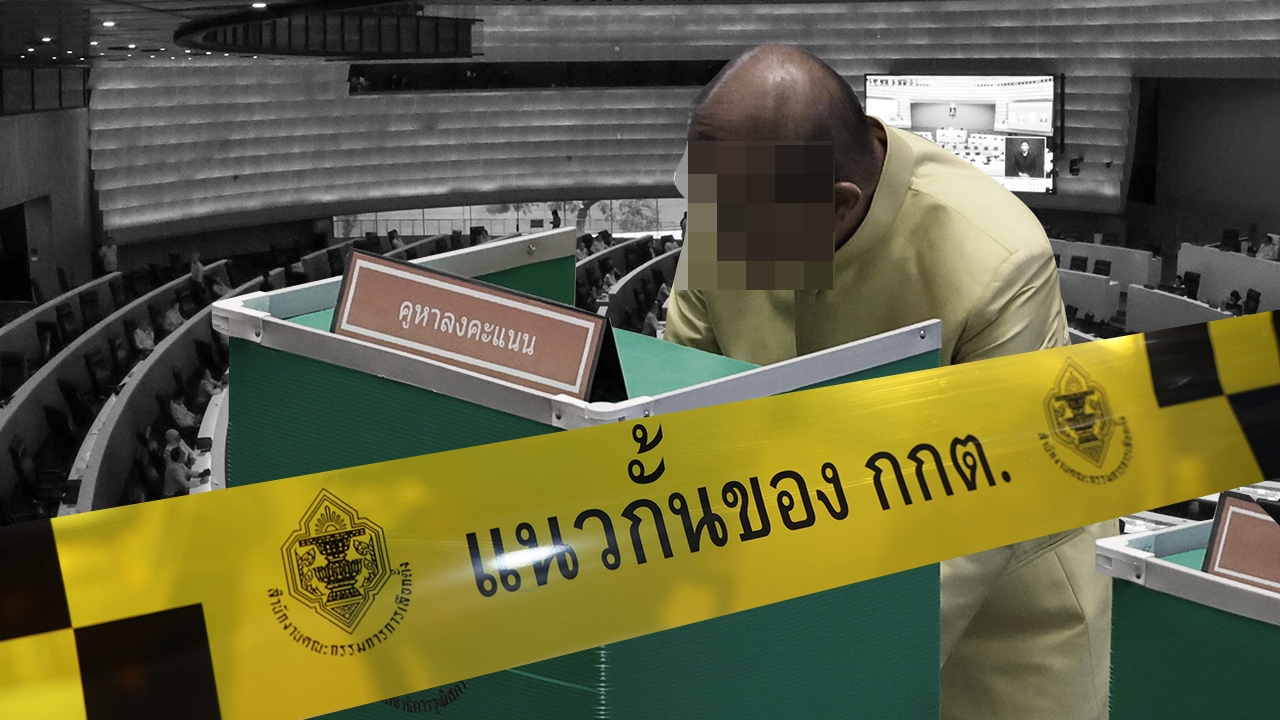
Attention turns to tomorrow's crucial decision by the Election Commission (EC) on the senator rigging case. The 26th committee ordered charges against 229 people, but the 36th committee recommended dismissing all complaints due to insufficient evidence, amid societal doubts.
The origin of the senator rigging case.
- Going back to 26 June 2024 at IMPACT Forum, Muang Thong Thani, the date of the nationwide senatorial election conducted using the "Self & Cross Selection" system. Involving 20 professional groups with at least 10 years of knowledge, expertise, or experience, candidates must pass selections at the district level in two rounds (self-selection and cross-group selection). Those who pass proceed to provincial rounds with the same two-step process, then to national rounds also with two phases, to select 200 genuine senators—10 from each group. The general public does not vote directly. This was seen as the world's most complex self-selection system, lasting across days and nights.
Origin of the case and abnormalities.
- Civil society groups such as the iLaw network and We Watch, along with Somchai Srisutthiyakorn, a former Election Commissioner, warned and revealed information about "rigging slips." From hiring candidates at the district level, compiling slips for distribution, to voting according to the slips on the national election day, including irregularities in the cross-group voting system.
- The whistleblower in Buriram province (after district-level voting): Phattharapong Supaksorn, also known as Lawyer Aun, came forward immediately after failing the district round on 9 June 2024, presenting evidence such as voter lists, meeting photos, and traces of network formation in Buriram, repeatedly complaining to the EC and media.
- 10 February 2025: The Department of Special Investigation (DSI) began accepting complaints from senatorial candidates to examine whether the case involved complex criminal offenses.
- 5 March 2025: The Special Case Committee (Board of KCP) chaired by then-Deputy Prime Minister Phumtham Wechayachai voted 11 to 4 to accept it as a "special case" involving criminal conspiracy and money laundering, exercising investigation powers parallel to the EC, which handles election law matters directly.
- 18 March 2025: The EC resolved to appoint officials from the EC office together with DSI officers as the 26th Central Investigation and Inquiry Committee to collect evidence, examine documents, and interview more than 700 witnesses nationwide.
- 25 April 2025: DSI officially charged "senator election rigging conspiracy." They started reenactments at the IMPACT Muang Thong Thani building (the national senator election venue) as part of evidence, with Police Colonel Tawee Sodsong, then Minister of Justice, approving the operational framework and authorizing the DSI to set up the investigative team.
- 17 July 2025: The 26th working group summarized the case, recommending prosecution and submitting to the EC for filing in the Supreme Court against 229 people as follows:
Current senators: 138 individuals.
Ministers, MPs, and executive committee members of the Bhumjaithai Party: 21 individuals.
Individuals connected to the Bhumjaithai Party network: 20 individuals.
Reserve senators and other senatorial candidates: 50 individuals.
After the 26th working group finalized the case, the file was forwarded to the 36th Adjudication Subcommittee.
- August 2025: The 36th committee reviewed the case and resolved to dismiss the complaint/do not prosecute. They found the evidence insufficient for criminal prosecution or senator disqualification.
- Senators and opposition political groups viewed the DSI's involvement as "interference with the EC's authority." They filed a petition to the Constitutional Court to determine whether Phumtham and Police Colonel Tawee violated serious ethical standards by ordering the DSI's actions. However, on 21 January 2026, the Constitutional Court ruled that both Phumtham and Police Colonel Tawee were "not guilty." The court stated there was no evidence of unlawful interference, and the DSI's work complied with special case authority.
Opening the confidential files: the 26th working group's investigation data.
- The origin of the Offline program and secret third-floor meetings: According to witnesses in the senator rigging case, around April 2024, three young members of a major political party were assigned to study the law and regulations on senator selection, later developing an "Offline operating system program" to calculate scores specifically for cross-selection rounds. Regardless of which group or profession candidates were assigned to, they encountered network individuals planted across all professional groups.
- This planning occurred in secret meetings: Held in the executive meeting room on the third floor of a major party's headquarters, where all attendees had to "surrender their mobile phones" to prevent information leaks. Then, slides were shown from a flash drive, explaining vote-blocking mechanisms and candidate distribution nationwide.
- Strategies included preparing accommodation and voter holding points in advance before the national election day on 26 June 2024, with locations pinned within 30–100 kilometers radius around IMPACT Forum, covering Ayutthaya, Nakhon Nayok, Pathum Thani, and private venues. Candidate groups acted as voters and teams were responsible for all travel, food, and accommodation expenses.
- Nationwide budgets reportedly circulated as high as 400–500 million baht. Expenses ranged from district to provincial to national levels, with cash payments made on the party's fourth floor. Through Mrs. R.
- District level: voter compensation of 10,000–50,000 baht (rare professional groups like scientists received higher pay).
- Provincial level: about 50,000 baht compensation.
- National level: compensation up to 200,000 baht per person.
Tutors threatened: “If you don’t comply, who knows what will happen.”
- Besides phone confiscation and cutting off outside contact, local tutor teams emphasized threats during slip copying, warning the system could verify who voted according to the slips, concluding with the threat: “Follow the slips, or else who knows what will happen.”
- Bound by digital forensic evidence: The 26th Central Investigation and Inquiry Committee found the key evidence that firmly tied the operation was "digital evidence." Cell site verification showed significant use of phones by accused persons and national-level voters at the same locations, such as safe houses, during 24–25 June 2024.
- Google Maps travel history from witness phones confirmed real travel in and out of meeting points, consistent with physical evidence like secretly taken photos of rigging slips, plastic sheets with cutouts for marking, and torn pages from senator notebooks discarded before leaving meeting rooms.
- After the election concluded, selected senators gathered at a well-known hotel near Rang Nam Alley to receive directives and allocate positions such as Senate President, Deputy Senate President, and committee chairs. Crucial evidence included senators signing "undated advance resignation letters" with copies of ID cards attached, handed to the network leaders as guarantees and tools to control Senate conduct.
Serious legal charges violating the Organic Act on Senator Selection.
- The inquiry committee concluded that the actions of party executives, leaders, and affiliates constituted conspiracy and division of tasks, undermining the independence, secrecy, honesty, and fairness of senator elections, violating multiple sections of the Organic Act on Senator Selection B.E. 2561 (2018), including:
- Section 36 in conjunction with Section 70: Conduct not following procedures and conditions for candidate introduction, undermining secret and free elections.
- Section 62: Acts resulting in national senator elections not being honest or fair.
- Section 76: Party executives assisting candidates to be elected or not elected as senators by any means.
- Section 77(1): Offering, promising, or giving assets or other benefits to induce votes or abstentions.
Summary of the senator rigging case.
- The completely conflicting resolutions between the 26th committee recommending charges against 229 people and the 36th committee dismissing all complaints have sparked significant public and media attention, prompting iLaw and People's Party leaders to organize an 11-kilometer march to the Art Gallery on 13 September 2026, one day before the ruling, urging citizens to watch the EC's seven-member panel decision on whether to file charges on 14 September 2026.
Possible decision scenarios:
Submitting to the Supreme Court and Constitutional Court: If the EC agrees with the 26th committee, it will forward the case to the Supreme Court to revoke the election and candidacy rights of implicated senators. If the court accepts it, accused senators may have to suspend duties immediately, and the case could be sent to the Constitutional Court to consider related party dissolution issues.
Dismissing all complaints: Ending the case as per the 36th committee's approach.
Filing charges against some individuals only: Selecting cases with clear evidence for the Supreme Court and ending party dissolution debates.
Compiled by: Political News Team