

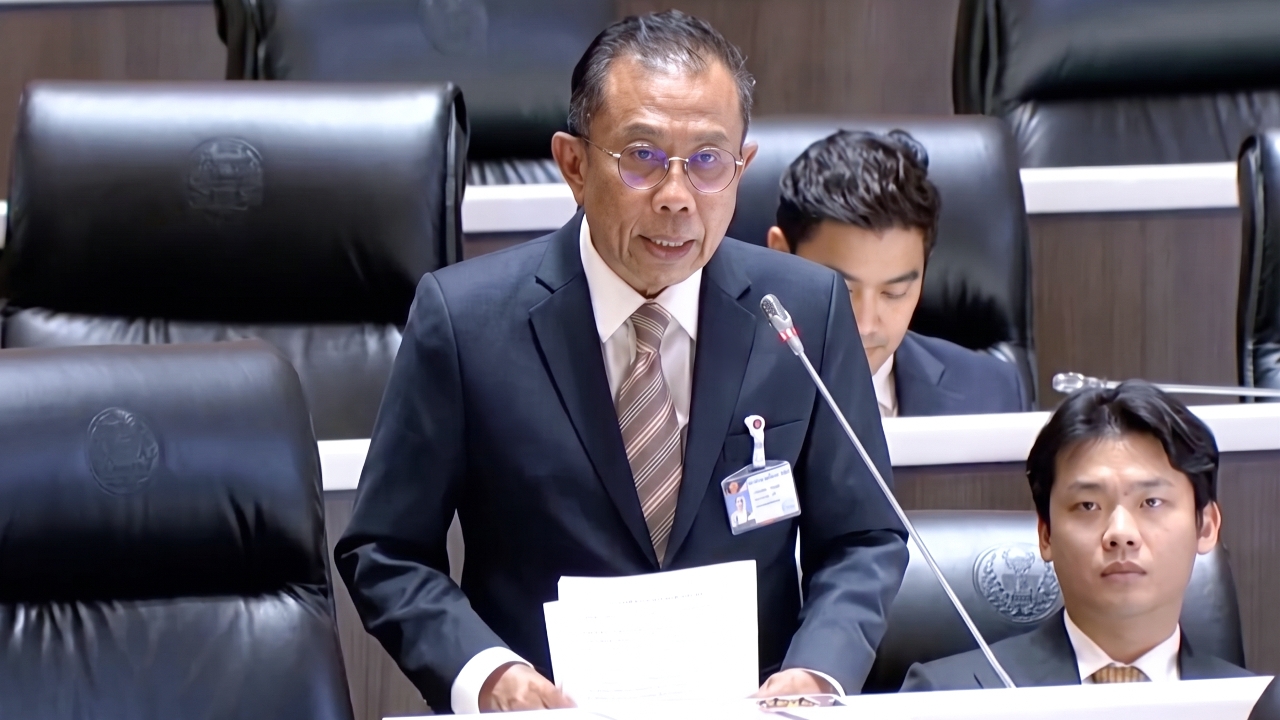
Supachai presents seven legal issues concerning the selection of senators, emphasizing that "public sentiment is not evidence." The Election Commission must assess based on "credible evidence." He asserts that if evidence is sufficient, the case should be sent to court; if not, it should be closed. He points out that on 14 September, the Election Commission must respond according to law, not pressure.
On 13 Sep 2026, Mr. Supachai Jaisamut, a party-list MP and legal chief of the Bhumjaithai Party, posted on social media his views on the senator selection process and debates about the credibility of the oversight system. He stated agreement with the key principle that "no one is above scrutiny" and that independent organizations must exercise power responsibly. However, legally, it is necessary to clearly distinguish between "concerns about system credibility" and the "legal conditions" required to bring cases to court.
Supachai stated that Article 226 of the Constitution does not mandate that when doubts arise or there is public demand, the Election Commission must automatically file a petition with the Supreme Court. Instead, it requires "credible evidence" that a candidate committed or was aware of electoral fraud.
Therefore, what the Election Commission must determine is not "how much public doubt exists" but whether the "evidence meets the constitutional standard."
Supachai outlined seven key points as follows:
1. Public concern does not equal "credible evidence." Article 226 does not require the Election Commission to file a petition with the Supreme Court simply because there is doubt or public demand for investigation. It clearly sets the standard of "credible evidence."
Thus, the Election Commission must consider whether the evidence meets the constitutional standard, not the level of public suspicion or pressure.
2. The Election Commission is not a "mailman" required to send all allegations to court. While filing first and letting the court decide may seem to allow scrutiny, the Constitution requires the Commission to have "credible evidence" before proceeding. If all allegations were sent automatically, there would be no need for this standard. The Commission must investigate, examine, and weigh evidence before deciding to file or dismiss.
3. The Commission’s investigation file directly influences the court’s consideration. Article 226, paragraph two, mandates that the Supreme Court base its judgment primarily on the Commission's investigation file, although the court may further investigate facts and evidence. This underscores the importance of the initial file’s quality and legality.
If there are doubts about evidence origin, key witnesses retract statements, testimonies conflict, or evidence cannot link to individual accused persons, the Commission must thoroughly verify before deciding, rather than deferring to the court with "let the court check further."
4. Responsibility must be proven individually. Cases involving senator elections cannot hold all mentioned persons responsible based on general irregularities. It must be proven who did what, when, how, and how the evidence links to each individual. Previous Supreme Court rulings reflect this principle, requiring proof both of acts and connection to accused candidates, not assumptions from the overall situation.
5. Witnesses who retract or have vested interests must be carefully weighed. When a witness changes testimony, legal questions concern which statement is supported by external evidence, why the retraction occurred, and whether the witness has interests or benefits, because being a "witness" does not automatically make their statements true.
6. Accountability does not mean "must send to court." Supachai agrees that independent organizations must be accountable, but under the Rule of Law, accountability means explaining why power is exercised or not according to law.
If evidence meets the threshold — the case must be sent to court.
If evidence does not meet the threshold — the case must be closed.
Both outcomes are lawful uses of authority. Closing a case due to insufficient evidence is not a failure of oversight. Conversely, sending a case to court without sufficient evidence simply to avoid accusations of opacity may be an abdication of legal discretion.
7. The Rule of Law must protect both society and the accused.
The Rule of Law should not be applied only to demand state scrutiny of authorities but must also protect the accused. All accused persons deserve a fair process, the opportunity to challenge evidence, and should not be held liable simply due to public sentiment or political pressure. Crucially, the principle that "the accuser must have evidence" must not be reversed to "send to court first and let the accused prove themselves."
Supachai said that on 14 September, the Election Commission’s responsibility is not to satisfy any party but to answer straightforwardly according to the Constitution whether the evidence in the investigation file, after checks for legality, credibility, and linkage to each accused, reaches the "credible evidence" level under Article 226 and related laws.
"If yes — send to court."
"If no — close the case." Either way, the decision must be legally justified.
Supachai emphasized this is true accountability because the credibility of the justice process is not measured by how many people are sent to court, but by whether the law proceeds when evidence is sufficient, and protects when it is not.
"No one is above the law, and at the same time, no one should be subjected to public pressure that renders the law meaningless."