

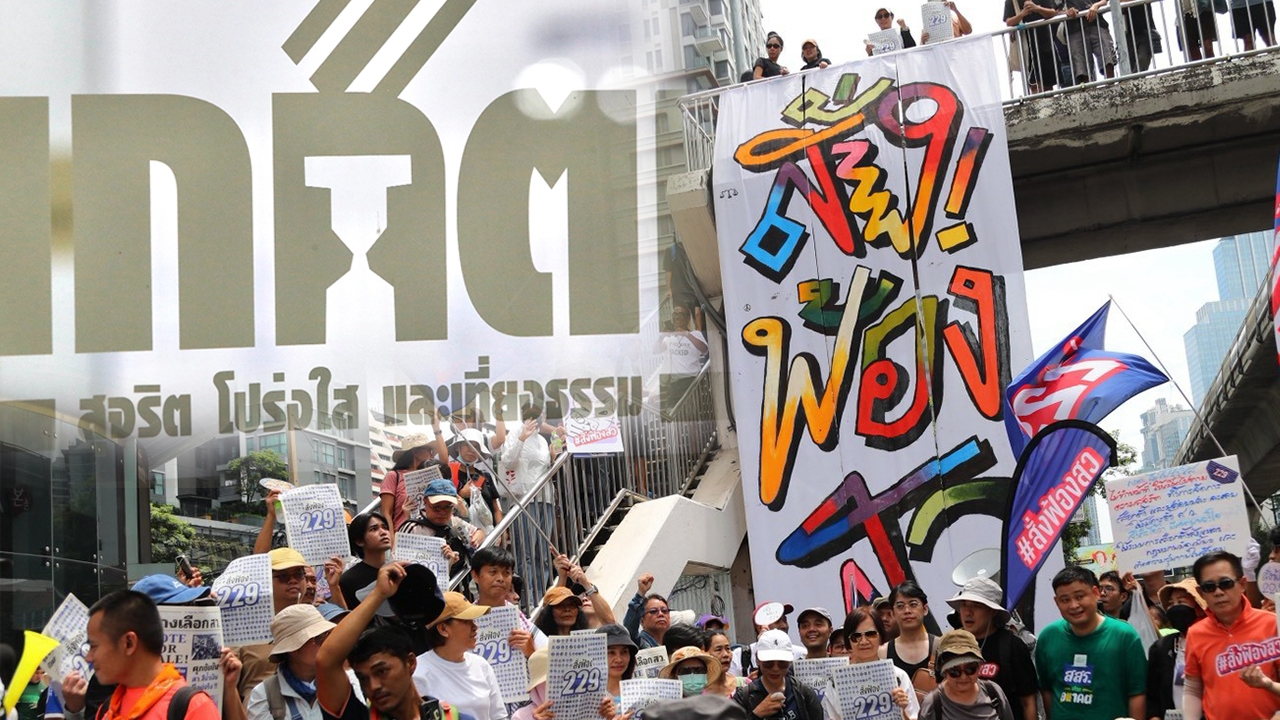
iLaw led a march on foot from Ladprao 25 to the Bangkok Art and Culture Centre, demanding that the Election Commission file petitions to the Supreme Court's Election Case Division against all individuals involved. They also declared that if the EC fails to file, they will release the evidence they have themselves. Meanwhile, the EC scheduled a press conference at 3 PM on Monday.
On the morning of Sunday, 13 Sep 2020 GMT+7, in front of the Internet for People's Law Project (iLaw) office in Ladprao 25, Yingcheep Atchanont, Executive Director of iLaw, spoke to reporters before starting the march.

Yingcheep began with a statement sounding more like a complaint than a rallying call, saying that if the justice process proceeds normally, no one would need to hold any activity today; everyone could just go home and wait for the results.
He stated that his demand is not to imprison anyone or judge guilt. What he requests is simply that the EC file petitions to the Supreme Court's Election Case Division against all 229 individuals and then let the impartial body decide who is guilty or not.
Yingcheep added that if the EC does not file against someone, they will release that person's evidence publicly. If the EC does not file against all, they will reveal all the evidence. He also said he would not be going to the EC office the next day.
The march departed from Ladprao Soi 25 around 10 AM following a planned route: from Ladprao Intersection 5, proceeding along Phahonyothin Road beside the BTS line, stopping at Saphan Khwai for about half an hour, then passing Victory Monument, turning onto Rangnam Road to Pratunam, entering Rama 1 Road, passing the Royal Thai Police Headquarters and Siam area, ending at the plaza in front of the Bangkok Art and Culture Centre at Pathumwan Intersection by 4 PM.
In addition to the march, there were also running and cycling groups that started from other locations and joined at the final destination in front of the Bangkok Art and Culture Centre.

Among the marchers were Natthapong Rueangpanyawut, leader of the People's Party, and Sirikanya Tansakul, deputy leader of the People's Party. Natthapong affirmed his desire for the EC to perform its duties straightforwardly.
At around 1:20 PM near Victory Monument, police negotiated with the march organizers, requesting they alter their route to avoid passing in front of the Sa Pathum Palace near the end of Rama 1 Road before Pathumwan Intersection. The organizers then changed plans to take the BTS from Phaya Thai Station to Siam Station and walk to the final destination.
The procession arrived at the plaza in front of the Bangkok Art and Culture Centre around 3:04 PM. During this time, musical performances by artists and speeches related to the Senate case took place.
At 5:45 PM, Yingcheep took the stage at the plaza in front of the Bangkok Art and Culture Centre, emphasizing that the danger lies in the case if no one is petitioned, as this Senate will remain in power. They will be responsible for approving the next EC, Constitutional Court judges, National Anti-Corruption Commission, State Audit Commission, Ombudsman, and Administrative Court, potentially paralyzing oversight of the country's powers.
He continued that the only solution he sees is amending the 2017 Constitution, but proposing amendments requires the Senate's votes. Currently, there are reportedly 140-150 senators aligned with the so-called 'Blue Senate,' making amendments difficult.
Yingcheep then presented options to the EC, stating that if they do not file petitions against anyone, this Senate will control drafting the new constitution. If that happens, civil society will have no choice but to vote against the referendum.
The second option is to file petitions, and once the court accepts them, most senators would suspend their duties temporarily. Those confident in their innocence can fight their case in court. Meanwhile, the door to a new constitution that allows all political colors to participate will open.

He also stressed that the Bhumjaithai Party still has the most MPs, remains in government, and the prime minister is the same person. The only change is that parliament will be more diverse. In other words, he publicly declared that their demand does not aim to topple the government.
Following this, Thairath Online interviewed Natchaporn Nammuang from the Constitution Campaign Network about what would happen if the EC does not file petitions.
Natchaporn said the key is the reasoning, not the numbers. There are three differing opinions: the 26th Investigation Committee recommended filing against all 229 accused, the EC office via the Deputy Secretary-General recommended filing against about a hundred or so, and the 36th Subcommittee held a different view.
He found the 36th Subcommittee's opinion unacceptable for two reasons: its formation appeared conflicted and compromised independence and neutrality, and its legal interpretations deviated from the law's text. Thus, if the EC does not file petitions at all based on this view, further scrutiny is needed.
If that occurs, he believes the existing door to justice will close, and civil society must seek new avenues, which include three options: suing the EC, pushing to amend the organic law on the selection of senators to allow victims or witnesses to file complaints directly without waiting for the EC, and advancing the pending constitutional amendment agenda to restore the right to recall the EC members.
When asked how quickly these options could happen, Natchaporn said filings could be made within this or next week, but passing them would take months. The immediate action is what Yingcheep announced in the morning: if no petitions are filed, the evidence will be publicly revealed. He sees this as urgent to show how the EC works.

Politically, Natchaporn assesses there could be three outcomes: filing against all 229 would reduce the political legitimacy of the 'Blue Regime,' accelerating drafting a new constitution; partial filing would lower legitimacy somewhat and open the way to amend specific articles, especially regarding senators and independent organizations; no filing would lead to political deadlock and increased pressure, with Bhumjaithai losing support, especially if it pushes its own constitutional amendment proposals.
He further noted that if it reaches that point, civil society will encourage people to reject the draft in a referendum. He observed that historically, no Thai government has ever lost a referendum.
Regarding whether partial filings are serious or just symbolic, he said if not complete, it is not serious. He acknowledged that the view not to file against some is understandable, but given the EC's status, the best course is to submit all evidence and accusations to the court for full consideration.
However, Natchaporn emphasized that the most critical point is not the number of individuals filed against but whether the accused are ordered to suspend their duties. Without suspension, cases could drag on for 4-5 years until terms end, leaving politics unchanged.

Meanwhile, Thairath Online consulted Associate Professor Dr. Pichai Rattanadilok Na Phuket, faculty at the National Institute of Development Administration (NIDA), who assessed that Monday's meeting could yield three possible outcomes, each with its own costs.
The first is filing against all 229, which he sees as the most principled and mission-aligned approach but would confront powerful networks behind the senators' appointments. In Thai society, moral courage to face such networks is rare, so the chance of filing all is slim.
The second is filing against no one, which he likens to 'cutting off the handle with the knee,' provoking public anger and escalating the situation. However, this remains possible if decision-makers disregard public sentiment, a mindset typical of old-school politicians who underestimate people's emotions.
The third is filing partially, which Dr. Pichai explained in detail. For example, filing against about 138 senators, including some lighter 'blue' network members and possibly some older 'blue' members, but excluding party executives, might somewhat ease public mood.
Dr. Pichai also mentioned a recent approach of filing some petitions initially and delaying the rest, which would prevent immediate prosecution under Article 157 but eventually would still be used, just postponed.
When asked who would scrutinize the EC if they do not file, he said it would be a dead end. Only direct victims, such as substitute senators or failed candidates, can file under Article 157, needing to prove loss of rights and opportunity. Acceptance depends on the court's discretion; if rejected, the matter ends.
However, Dr. Pichai called a major problem the group of accused linked to political parties and politicians: if the EC does not file, no one else can, as only the EC can submit such petitions.
After Yingcheep's speech ended around 6 PM, he invited attendees to show their strength by forming the number 229 before dispersing, symbolizing the Senate election collusion case involving 229 individuals.