

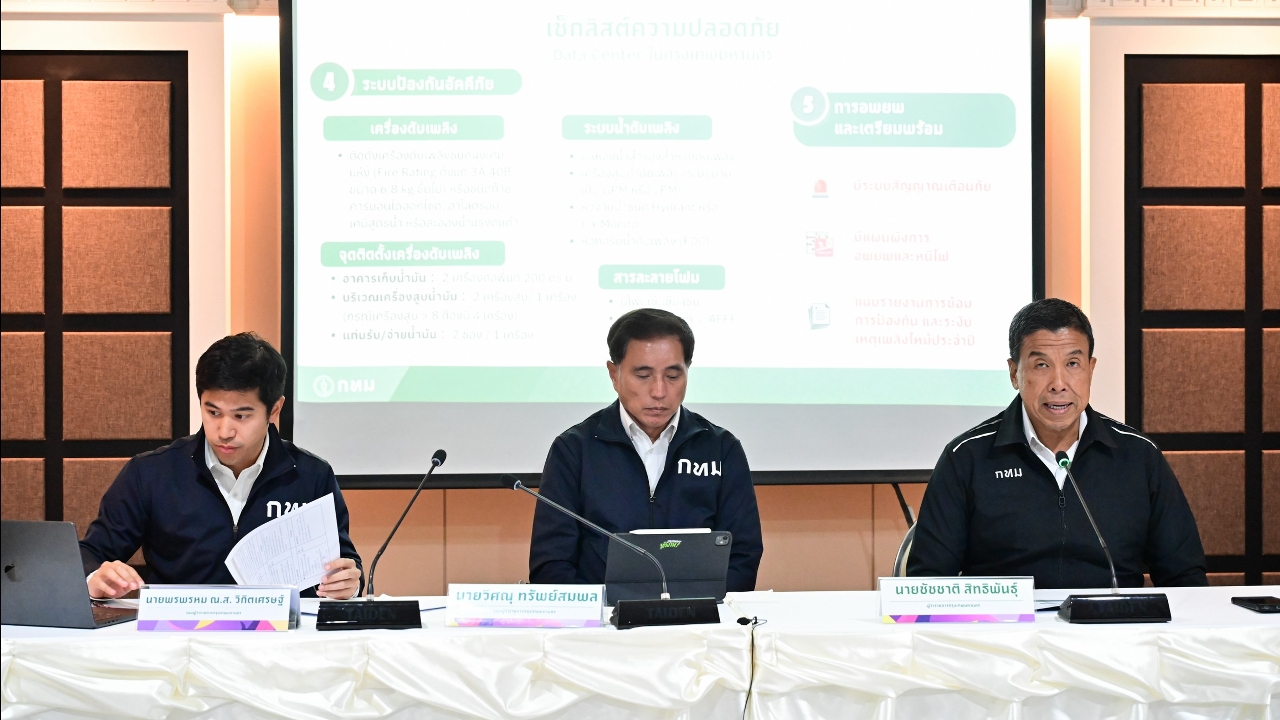
Bangkok scans Data Centers throughout the city, enforces strict 5-point safety checklist, and orders delay on new projects pending clear government criteria.
On 14 Sep 2026 GMT+7, Chatchart Sittipunt, Governor of Bangkok, along with Wisanu Subsompon and Pornprom Na S. Wikitset, Deputy Governors, held a press briefing on the progress of Data Center inspections in Bangkok at the Chao Phraya Room, Bangkok Metropolitan Administration (BMA) City Hall, Sao Chingcha, Phra Nakhon district.
Governor Chatchart stated that a preliminary survey found Bangkok has Data Centers divided into two groups: those located within general buildings such as offices, banks, and government agencies, totaling 43 sites, mostly small-scale using no more than 2 megawatts of power and operating for some time; and standalone Data Centers numbering six, with three operational and three under construction. The licensing for the latter three is currently paused. Among the 43, 31 use small generators and do not require fuel storage permits, while 12 store over 15,000 liters of fuel and have obtained proper permits from the Department of Energy Business.
The Data Centers in Bangkok are not hyper-scale facilities consuming 200–300 megawatts like those in other provinces. Currently, Data Centers in Bangkok use less than 3% of the city’s peak electricity demand. Their water consumption remains lower than that of large shopping malls.
The BMA’s main authority lies in supervision through building construction or modification permits, urban planning laws, and public health regulations. It collaborates with relevant agencies such as the Metropolitan Electricity Authority (MEA), Metropolitan Waterworks Authority (MWA), Department of Energy Business, Department of Industrial Works, and the Office of Natural Resources and Environmental Policy and Planning (ONEP) to ensure comprehensive control.
The BMA has developed a stringent 5-point checklist for ongoing random inspections: 1) Building standards must have international certification; 2) Resource usage—including fuel storage, water, and electricity—must comply with regulations from the Department of Energy Business, MEA, and MWA; 3) Impact on residents and environment, such as water and air pollution, health risks, heat effects, and noise pollution; 4) Fire prevention systems must meet standards; and 5) Preparedness and fire evacuation drills must be conducted.
The checklist details cover comprehensive aspects to protect nearby residents, including monthly random wastewater quality tests, real-time PM2.5 and PM10 dust measurements, and biannual bacterial testing for Legionella in cooling tower steam. Temperature and humidity are also measured at emission points and surrounding communities within a 500-meter radius, with a requirement that temperature differences over 24 hours do not exceed 2 degrees Celsius.
Regarding approvals for new projects, the BMA has ordered a pause on license consideration while awaiting clear definitions and operational guidelines from the Data Center Operations Policy Committee, expected within two weeks. District offices have inspected all Data Center sites and found no nuisance complaints so far. The BMA is also open to receiving public complaints 24/7 via the Traffy Fondue system.
“The BMA is not complacent. We are exerting full effort within our legal authority. If the public experiences problems or impacts, they can report immediately. The BMA is ready to intervene and resolve issues while awaiting additional operational guidelines,” said the Governor. Governor Chatchart concluded.