

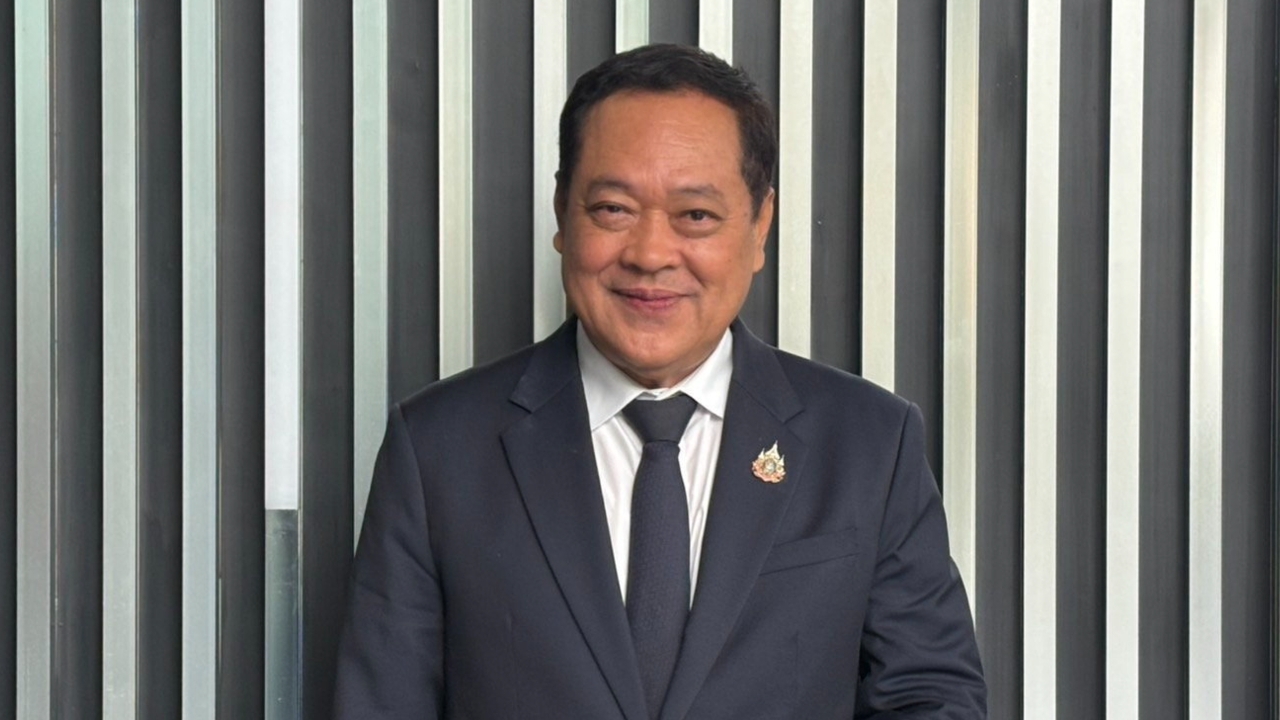
Pol. Col. Tawee emphasized that the acceptance of the "senator collusion" case as a special case was a resolution by the Special Case Committee (SCC), while the authority to protect witnesses lies solely with the Election Commission (EC). He also revealed the Constitutional Court's ruling affirming that during his tenure as Minister of Justice, he never interfered.
14 Sep 2026 GMT+7 Pol. Col. Tawee Sodsong, party-list MP and leader of the Prachachat Party as well as former Minister of Justice, addressed rumors implicating officials of the Department of Special Investigation (DSI) and the former Minister of Justice at the time, alleging they colluded to classify the senator collusion case as a special case and coerced witnesses to provide testimony in exchange for witness protection from prosecution.
Pol. Col. Tawee said that although he observed that most of the public does not believe these claims and sees them as distractions from the Election Commission’s (EC) upcoming announcement on the senator collusion case today, he felt compelled to clarify since the rumors also involve DSI officials’ work.
The first point is that the acceptance of the senator collusion case as a special case was not a decision made by him as Minister of Justice or by any individual DSI official, as some have tried to distort. Instead, it was a decision by the full Special Case Committee (SCC). The SCC consists of many experts and specialists, including the Deputy Prime Minister as chairperson, the Permanent Secretaries of the Ministry of Justice, Ministry of Finance, Ministry of Commerce, Ministry of Interior, the Attorney General, the National Police Chief, the Governor of the Bank of Thailand, as well as over 20 distinguished professors from various institutions.
The SCC’s resolution concluded that the case involves money laundering, with credible evidence of over 300 million baht involved, making it a special case under the DSI’s jurisdiction. It is not only impossible to collude to classify it as a special case under the law, but spreading rumors about such collusion disrespects all members of the Special Case Committee.
The second point concerns the distortion that DSI officials coerced witnesses into providing information to implicate others in exchange for witness protection, or that witnesses now want to retract their statements. Although he was not involved in DSI’s investigative process, he clarified that witness protection is exercised under the Senate Election Act B.E. 2561 (2018), Section 65, and EC regulations on witness protection without prosecution B.E. 2563 (2020).
In simple terms, witness protection is solely the authority and decision of the EC. The investigative committee number 26, which includes DSI officials, only has the power to submit opinions with reasons but is not empowered to grant witness protection, contrary to these distortions.
Furthermore, if you recall, in January 2026, the Constitutional Court ruled that he, as Minister of Justice at the time, did not order, dominate, or interfere with the EC or the investigative committee number 26’s duties. The court found no serious ethical violations that would cause his ministerial position to end. This ruling is final and binding on Parliament, the Cabinet, courts, independent organizations, and state agencies under Section 211, paragraph four of the Constitution. Therefore, no one should falsely accuse him on matters already decided by the court.
In closing, Pol. Col. Tawee emphasized the EC is an independent body that must perform its duties and exercise its authority with integrity, fairness, courage, and impartiality. The Constitution and relevant laws stipulate that if the EC has credible evidence, it shall file petitions with the Supreme Court. This does not mean the EC decides guilt; the court still must allow all parties to present evidence before making a verdict, rather than the EC proving the case on the court’s behalf.