

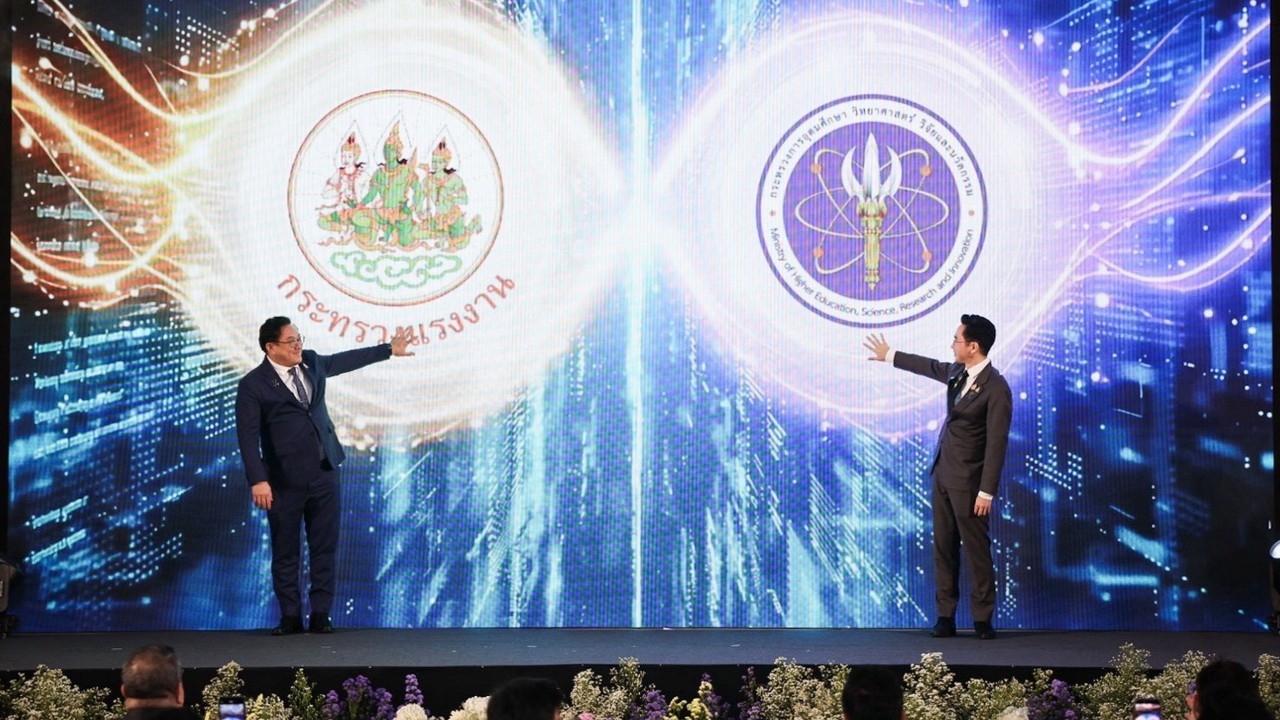
The Ministry of Labor has partnered with the Ministry of Higher Education to train personnel for the semiconductor industry, targeting 10,000 people within five years. Yotsanan pointed out this collaboration as a crucial piece in the country's workforce development.
Monday, 14 September 2026 GMT+7 Mr. Yotsanan Wongsawat, Deputy Prime Minister and Minister of Higher Education, Science, Research and Innovation, presided over the kickoff event for workforce development cooperation to support the semiconductor industry between the Ministry of Labor and the Ministry of Higher Education, Science, Research and Innovation, with Mr. Julpan Amornwiwat, Minister of Labor, reporting at the Rama Gardens Hotel, Talat Bangkhen Subdistrict, Laksi District, Bangkok.
Mr. Yotsanan said the semiconductor industry plays a vital role in modern technology, especially since nearly all electronic devices require semiconductor chips for data processing, device control, and signal transmission. These include smartphones, computers, smart devices, medical equipment, and electric vehicles, making the industry rapidly grow in recent years.


To develop a sustainable semiconductor industry, skilled labor with technical expertise and specialized skills is essential. The Ministry of Higher Education prioritizes semiconductor workforce development as a key sector for Thailand's future growth. The approach involves not only producing university graduates but also aligning training with real industry needs, covering technicians, engineers, scientists, experts, and researchers, including upskilling and reskilling current workers to acquire new skills.
Today's collaboration with the Ministry of Labor is a vital piece in national workforce development, combining the strengths of two ministries: the Ministry of Higher Education excels in producing and developing higher education personnel, research, technology, and innovation, while the Ministry of Labor plays a crucial role in skill development, workforce capacity enhancement, and linking to labor market needs. Together, they can integrate workforce production with labor demand into a unified system.


Mr. Julpan added that today's event launched a commitment and demonstrated the cooperation between the two ministries to actively advance semiconductor workforce development. This connects educational institutions, skill development agencies, and industry operators to develop personnel to support the semiconductor sector.
The second activity involved signing a memorandum of understanding on academic cooperation for skill development to support industry between the Ministry of Labor's Office of the Permanent Secretary, Department of Skill Development, and Department of Employment, and the Ministry of Higher Education, Science, Research and Innovation.
The third and most important activity was a seminar titled “Decoding the Needs to Drive the Future of Thailand’s Semiconductor Industry,” where participants exchanged views on labor market trends, technology forecasts, and strategic opportunities, and received feedback from government, private sector, education, and experts to inform the draft workforce development plan aligned with labor market demands.
The five-year goal is to develop 10,000 workers in the semiconductor and related industries. The Department of Skill Development will lead this effort. In fiscal year 2570 (2027 CE), a project will commence to enhance the capabilities of 1,000 workers to support smart electronic industry technology. Success depends on strong cooperation in technology, personnel, and facilities from the Ministry of Higher Education, Science, Research and Innovation, which underpins today's collaboration.


