

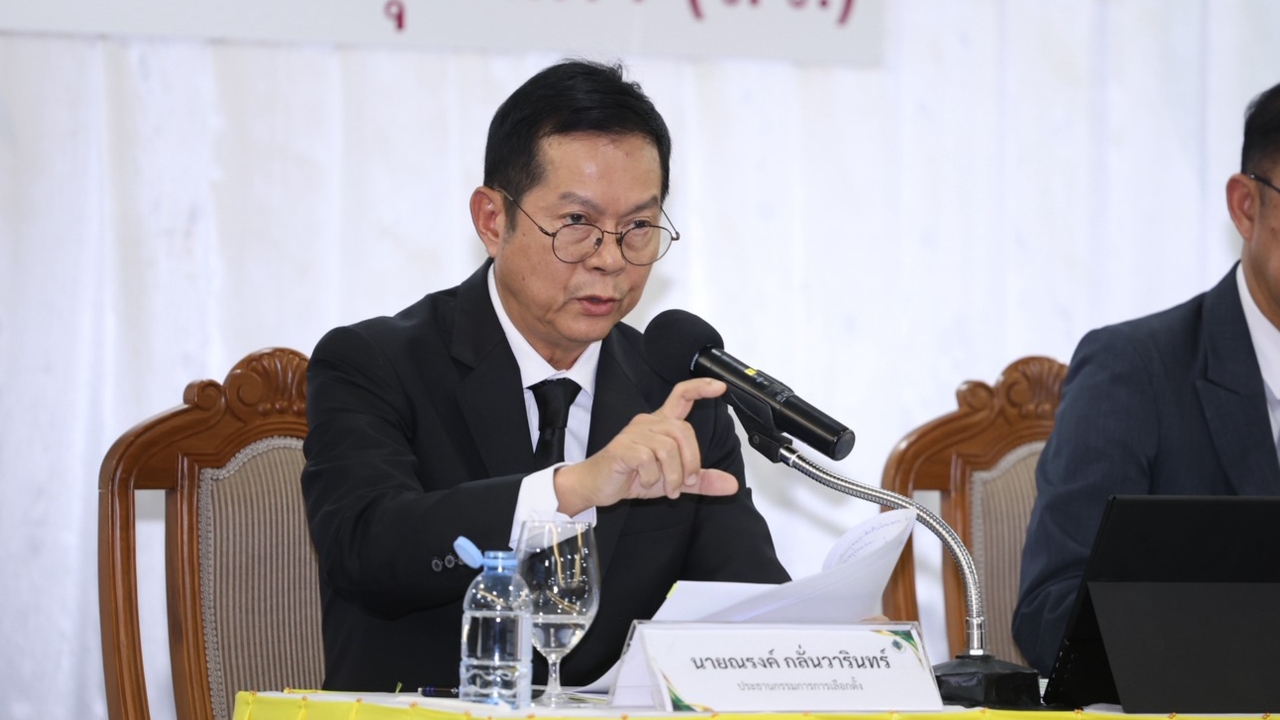
On 14 September, the Election Commission (EC) announced that Chairman Narong explained the reason for dismissing charges against Newin and the political party in the Senate vote-rigging case, citing insufficient evidence. He clarified that 26 senators and a total of 77 involved persons were prosecuted, revealing conduct of "hiring voters."','tags':['Election Commission','Senate','Vote Rigging','Political Case','Prosecution']
At 16:20 on 14 September 2026 GMT+7, the announcement was made. Mr. Narong Klanwarin, Chairman of the Election Commission (EC). He provided detailed responses to media inquiries regarding progress. He addressed the consideration of the corruption and vote-rigging case involving Senate members (senators). He explained the standards for examining evidence in filing charges with the Supreme Court's Election Division, including reasons why the majority vote dismissed complaints against politicians and party executives.
Mr. Narong stated that 26 senators and a total of 77 accused individuals under allegations 3 and 4-7 were charged. Most accused under each allegation belonged to overlapping groups. The key conduct prompting the EC's decision to prosecute at the Supreme Court to revoke candidacy rights and pursue criminal charges was presented via a PowerPoint slide, citing a case study in Nong Bua Lamphu Province (accused number 84, currently a senator). It found inducement and provision of assets—money and property—to eligible voters to vote for themselves, constituting "hiring voters." Investigation revealed links through financial trails, travel patterns, telephone contacts, and witness testimonies.


The EC Chairman emphasized that the EC applied the same standards and evidence weighing across all provinces, such as Nakhon Si Thammarat, Songkhla, and Surat Thani. The EC stated that any accused with clear evidence of wrongdoing under allegation 77 (vote inducement) would be prosecuted at the Supreme Court. Conversely, accused individuals who provided explanations, rebutted allegations, and whose evidence showed no inducement by assets had their complaints dismissed in many cases.
When asked about public doubts, including from the opposition and the Internet Law Project (iLaw), questioning why the investigation did not reach politicians, party executives, or political officeholders despite previously disclosed financial trails and connections,
the EC Chairman explained that allegations 1 and 2 are linked, involving cases where the EC accepted the complaints and set up an inquiry committee. The accused in this group are numbers 187-206 and number 228, being Newin Chidchob, totaling 21 persons. They are alleged to be party executives or political officeholders assisting over 140 Senate candidates named on the list to get elected.


Mr. Narong also explained the majority decision not to prosecute Newin and associates was based on evidence in the investigation files, including coded witnesses: witnesses 16/26, 21/26, 22/26, 25/26, and a key witness named Kusumalawatee Sirikomut. "The most crucial witness cited as direct evidence was witness code 16/26, who gave testimony claiming to have witnessed four events, the first occurring around April 2024."
Mr. Narong reiterated that the EC, which includes representatives from the judiciary, weighed all evidence, complaints, explanations, and surrounding evidence and found that the evidence was insufficiently weighty to accept that the said group of politicians committed the offenses. Therefore, by majority vote, the complaints in this part were dismissed.
The EC Chairman also affirmed that every case was considered carefully and with the same standards as the judicial process, reviewing case by case and individual by individual. When evidence (financial trails, phone records, witness testimonies) clearly connects, prosecution proceeds decisively. However, when evidence cannot rebut explanations, justice must be upheld according to facts presented in the files.