

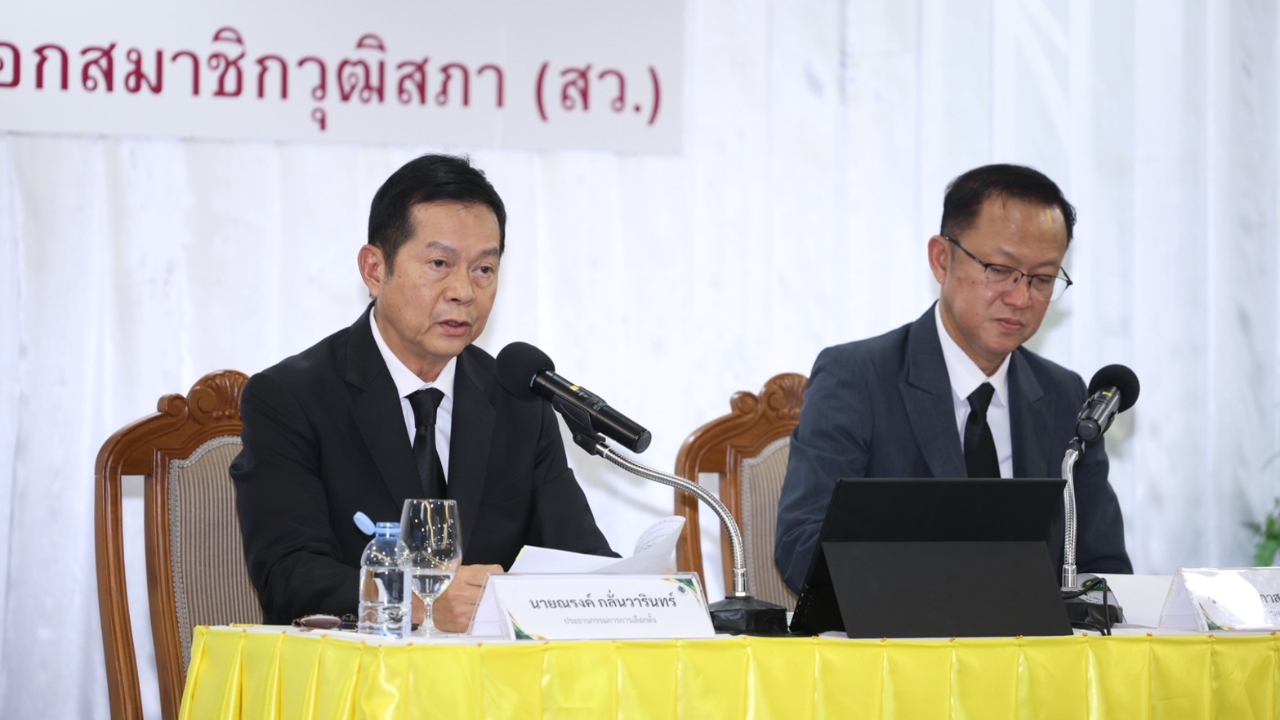
The Election Commission (EC) stated that referring 77 individuals to the Supreme Court does not mean they are yet offenders. However, the EC believes violations occurred and thus referred the cases to the court for fact verification. It explained that the issue of documents submitted to the Administrative Court, which allows the introduction of other materials, is not considered an offense, and this does not constitute wrongdoing by the candidates.
On 14 Sep 2026 at 16:00 GMT+7, at the Election Commission Office, Mr. Narong Khanvarin, Chairman of the Election Commission, and Acting Lt. Pasakorn Siripakayaporn, Deputy Secretary-General of the Election Commission, jointly held a press conference to report on the commission's investigation into the election of members of the Senate.
Acting Lt. Pasakorn stated that in the case of collusion in the Senate election, 427 individuals were accused. According to Election Commission regulations, once evidence or complaints arise, an investigation committee is appointed—in this case, the 26th committee. Then, the Secretary-General, or in this case the Deputy Secretary-General acting in that role, reviews the case. Next, it proceeds to the 36th Subcommittee for adjudication, before reaching the final stage with the Election Commission itself.
Each stage of case consideration may have differing opinions because each has the responsibility to examine, assess, and screen evidence and legal matters within their authority. Opinions at any subcommittee level serve only as supporting information for the Election Commission's final decision.
Regarding why the 36th Subcommittee was specially appointed, Acting Lt. Pasakorn explained that due to the large number of accused individuals in this case, a special subcommittee of seven members was necessary to handle the complex details involved.
Concerning the Senate election documents submitted before the election, the Election Commission had issued a regulation prohibiting the distribution or introduction of campaign documents at polling stations, specifically in Clause 7, Paragraph 2. However, the Central Administrative Court later annulled this provision. Without a legal basis to define this as an offense, candidates can submit any documents inside polling places.
Regarding images showing documents or notes collected during the national election, there appear to be two types of documents: one, notes taken to prevent forgetting, and two, documents linked or connected to persons involved. In such cases, the investigation committee will examine these and, if connections are found, will file charges against all individuals named in the documents.
Mr. Narong added that among the 77 accused individuals referred to the court, these persons are not considered to have committed offenses yet. The commission only has evidence from investigations believing they violated legal provisions and must present this evidence in court to prove their innocence.
When asked about the behavior of the 77 accused individuals sent to court, Mr. Narong said each case is considered individually. For example, in Nong Bua Lamphu province, one accused current senator was found to have induced voters with money to secure votes for himself. The investigation revealed financial links following certain patterns. The commission reviewed complaints, objections, defenses, explanations, and evidence including witness testimony, financial trails, and telephone records, concluding that this individual violated the allegations, leading to criminal prosecution.
Similarly, in other provinces where offenses occurred, cases are considered individually and referred to the Supreme Court. The commission uses similar investigative and discretionary processes to determine whether corrupt practices took place in the Senate election.