

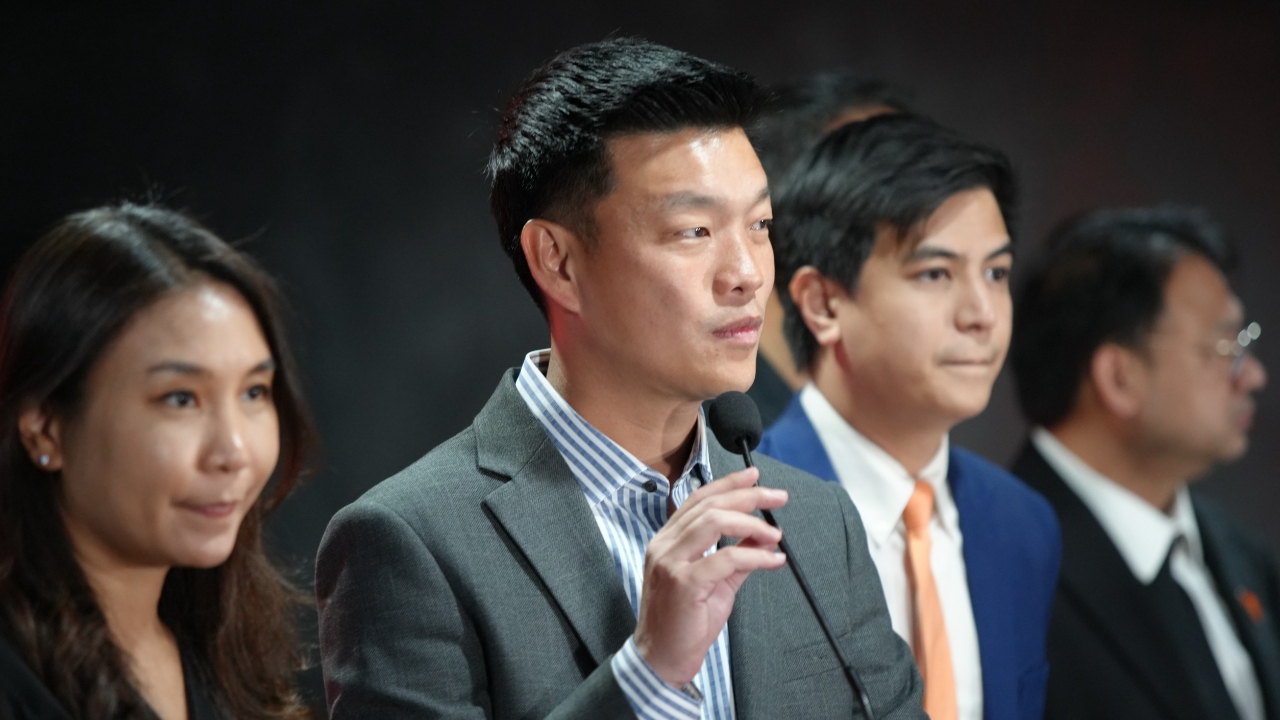
“Teng Natthapong” criticized the decision as a selective cutoff after the EC referred only 77 of 427 accused cases to court, viewing it as political favoritism. He plans to sue the EC for neglecting their duties and to push for a no-confidence debate, revealing attempts by the parliamentary speaker to restrict the censure motion.
At 17:45 on 14 Sep 2026 GMT+7. Natthapong Ruangpanyawut, party-list MP and leader of the Prachachon Party (PPC). Along with party MPs, he held a press conference after the Election Commission (EC) voted on the Senate election fraud case, stating The outcome was not unanimous but a majority vote, referring only 26 senators to court, with zero politicians referred. The Senate election fraud case is among the largest scams in Thai political history, driven by a political group aiming to dominate the country and control political institutions through illegal and anti-public processes.
Natthapong added that the EC majority voted to prosecute only a small fraction of those the 26th EC investigation panel found involved in the Senate election fraud, indicting just 26 senators and no political office holders—no ministers, MPs, or executives from the Bhumjaithai Party.


This decision selectively excludes most accused from Supreme Court scrutiny, despite clear evidence such as ballot orders, voting statistics, financial trails, audio clips, coordination records at ballot centers, and phone logs indicating organized wrongdoing. Such evidence should not be fragmented or reduced to individual prosecutions separated from the systemic nature of the fraud. The evidence is clearer than in previous Senate election cases the EC prosecuted, which relied on just a few chat messages about vote trading via Line.
"For these reasons, the Prachachon Party considers the EC's discretion here as violating legal principles and its own standards, constituting improper performance or neglect of duty under the Election Commission Act. Considering that 4 of 7 EC members were appointed with the current Senate's endorsement, this majority decision may be seen as political quid pro quo with those involved in the fraud."
Today's EC decision not only lets most accused Senate election fraud suspects evade justice but highlights problems with independent agencies under the 2017 Constitution, which cannot operate free from political interference and instead lack accountability to the public and law.

Therefore, to hold those involved in the Senate election fraud legally accountable and restore democratic checks and balances, the Prachachon Party will proceed as follows:
1. Initiate and support legal actions against the EC for improper performance or neglect of duty under criminal law and the Election Commission Act.
2. Pursue legal actions to ensure evidence regarding accused persons not prosecuted by the EC is examined in court.
3. Investigate political office holders related to the Senate election fraud through parliamentary mechanisms, such as filing no-confidence motions, and via social campaigns to ensure political accountability democratically.
4. Promote constitutional amendments and related laws to limit the Senate's illegitimate powers and reform independent agencies for efficiency, transparency, and democratic legitimacy, including empowering citizens to initiate oversight and removal of officials in independent agencies.
5. Advance the drafting of a new constitution per the 8 Feb 2026 referendum, with a constitution drafting assembly directly elected by the people, without granting special powers or conditions allowing the Senate to block the people's will.

When asked about the EC’s unclear explanation for not prosecuting 'blue' politicians and citing incomplete financial trails, Natthapong said the Senate election was a coordinated process, not to be judged case by case. He noted the EC chair's comment about witness 16/26’s inconsistent testimony, suggesting political pressure may influence testimony. The EC majority's refusal to prosecute politicians signals a belief that no politicians were involved in the largest political fraud in Thai history.
"Regarding legal actions, the Prachachon Party is ready to pursue all channels, needing to identify direct victims. Details on prosecution routes will be provided soon by the legal team."
Regarding whether the no-confidence debate would impact the government given the EC’s non-prosecution, Natthapong said the key now is demanding straightforward parliamentary checks on the government. He mentioned information suggesting the parliamentary speaker may try to limit the no-confidence motion’s scope, especially under the current government. Historically, no-confidence debates can scrutinize ministers individually, and past non-transparent actions are subject to censure. He urged public attention to parliamentary debate mechanisms and whether the government will allow opposition questioning.