

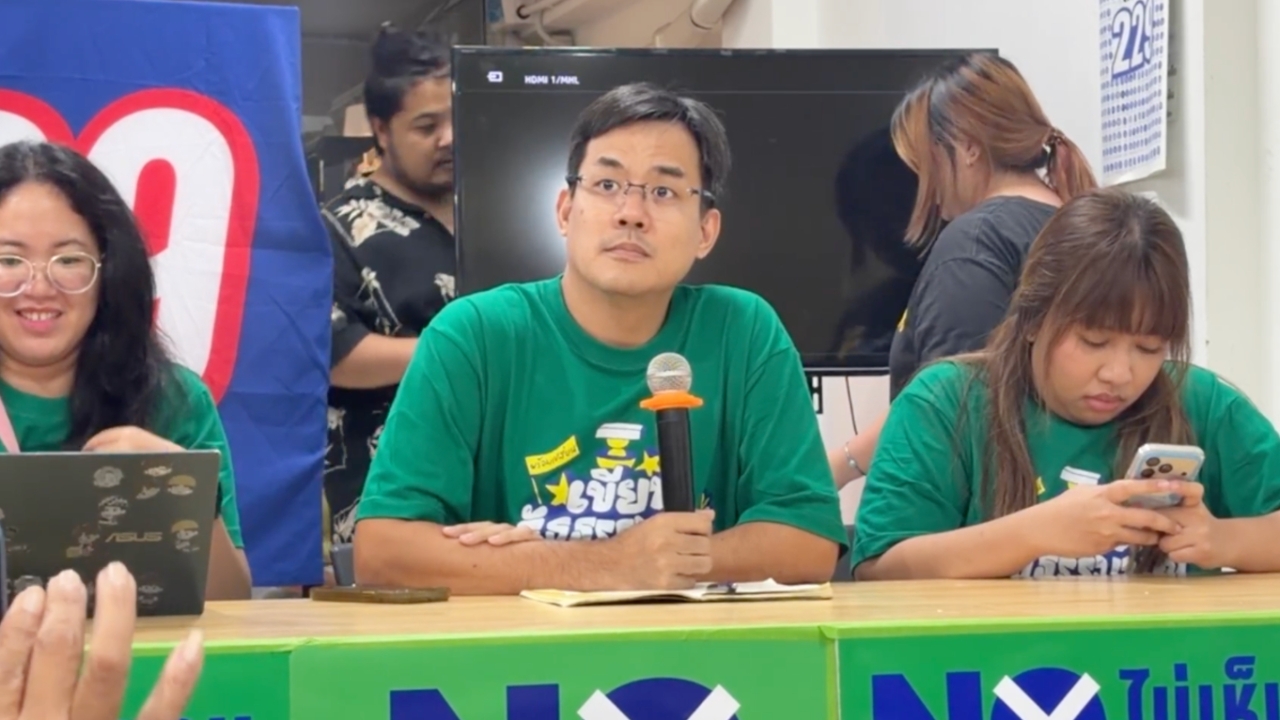
“Pao Yingcheep” delivered an iLaw statement criticizing the Senate for overstepping by assuming judicial roles. He stressed that the names of those not prosecuted will definitely be disclosed, citing witness number 16/26 as “Ekarat Changlao” and announced plans to release his testimony at 8 p.m. tonight.,
On 14 Sep 2026 GMT+7, at the iLaw office, Mr. Yingcheep Atchanon, director of the Internet Law Project (iLaw), together with Boonyanuch Matthujak, Kalyakorn Sunthornpruek, and Patcha Chaimongkolsap, iLaw staff, issued a statement following the Election Commission’s (EC) decision to file charges at the Supreme Court against only 77 individuals involved in the Senate election fraud case, excluding anyone from the Bhumjaithai Party. The statement said: 1. The EC’s decision by majority not to prosecute the Bhumjaithai party executives but to file charges against only 26 senators and their network is unsurprising. It implies that the remaining 152 accused will not face prosecution. It is well known that this EC was appointed through Senate approval, and the Senate itself is linked to certain interests. Thus, the outcome is not unexpected.
2. The order to prosecute 26 senators demonstrates that the investigation uncovered evidence of actual fraud in the Senate elections. The EC decided to proceed under Section 77 of the 2018 Organic Act on the Election of Senators, which pertains to offering inducements during Senate elections.
However, the 2024 Senate election fraud was a large-scale operation; it is impossible that only a few individuals were involved. For example, EC Chairman Narong Khanvarin explained the financial path of Senator Sorachart Wichaya Suwanphrom from Group 13, professionals in science, technology, communications, and innovation from Nong Bua Lamphu province. Sorachart ranked fifth among 154 candidates in the peer election round and received 66 cross-votes, the highest in Group 13. It is unlikely Sorachart obtained these votes from only a few people evidenced by money transfers; many others must have contributed in this scheme.
The EC’s evaluation was done on an individual basis, assessing what evidence each person had, but it did not consider the overall systematic nature of the fraud, which could not have occurred with only a few individuals involved. Sorachart’s number appeared on the list of votes presented by witnesses alongside many others. Therefore, it is unreasonable to believe that other senators appearing on the same list were unaware of the fraud.
3. The EC is "overstepping" by assuming the role of a court. The EC’s duty is to investigate the Senate election fraud according to the Senate Election Act, which states that if there is credible evidence that a candidate or any person committed or was complicit in election fraud affecting the fairness of the election, the EC must file a petition with the Supreme Court to revoke the candidate’s eligibility or voting rights.
As EC Chairman Narong Khanvarin stated, some witnesses are not credible, testimonies are inconsistent, and no other evidence corroborating the alleged Senate election fraud was found. This was one reason for deciding not to prosecute the remaining accused. The EC is assuming a judicial role beyond its mandate.
It must be emphasized that the EC’s role when lacking evidence is to continue seeking additional proof to determine whether there is "credible evidence" of the alleged Senate election fraud, not to prematurely dismiss witnesses and halt evidence gathering. The role of judging the credibility and weight of evidence lies with the Supreme Court, a judicial body that is more impartial than the EC, which was appointed with Senate approval.
The EC’s decision not to submit the remaining accused for trial at the Supreme Court’s election case division also "closes the door" on the court’s investigative process, which could have summoned further evidence. It also "denies" the public the opportunity to observe the trial process for those the EC decided not to prosecute openly.
4. Going forward, iLaw will gradually disclose information related to those not prosecuted, based on investigation files. To be clear, witness number 16/26 at the center of controversy is Mr. Ekarat Changlao, former MP for Bhumjaithai Party’s District 4. During the 2024 Senate election, Ekarat was an MP for Bhumjaithai and was involved in bringing witness number 21/26, Mr. Atsadang Saweangkan, into the Senate candidacy in Khon Kaen province, who ultimately became a senator. Atsadang’s number, 150, appears on the same voting list as Sorachart’s.
Additionally, one witness stated that Mr. Ekarat Changlao called Mr. Newin Chidchob, and there is evidence in the case files confirming this call. Therefore, it would be unreasonable to claim that Ekarat’s testimony is baseless or unreliable. Tonight at 8 p.m., we will release Ekarat Changlao’s full testimony.
5. It is now clear that the EC, appointed through Senate approval, has used its authority to protect the "blue" senators. Thailand is moving toward drafting a new constitution, with a draft proposed by the Bhumjaithai Party granting "blue" senators discretionary power to select constitutional drafters and to approve or reject the new constitution at will.
We firmly oppose this. It is necessary to break away from this system. Currently, our only path is to oppose the drafting process dominated by the "blue" senators by jointly proposing a people’s draft constitution, with an elected Constituent Assembly and no interference from the "blue" senators.