

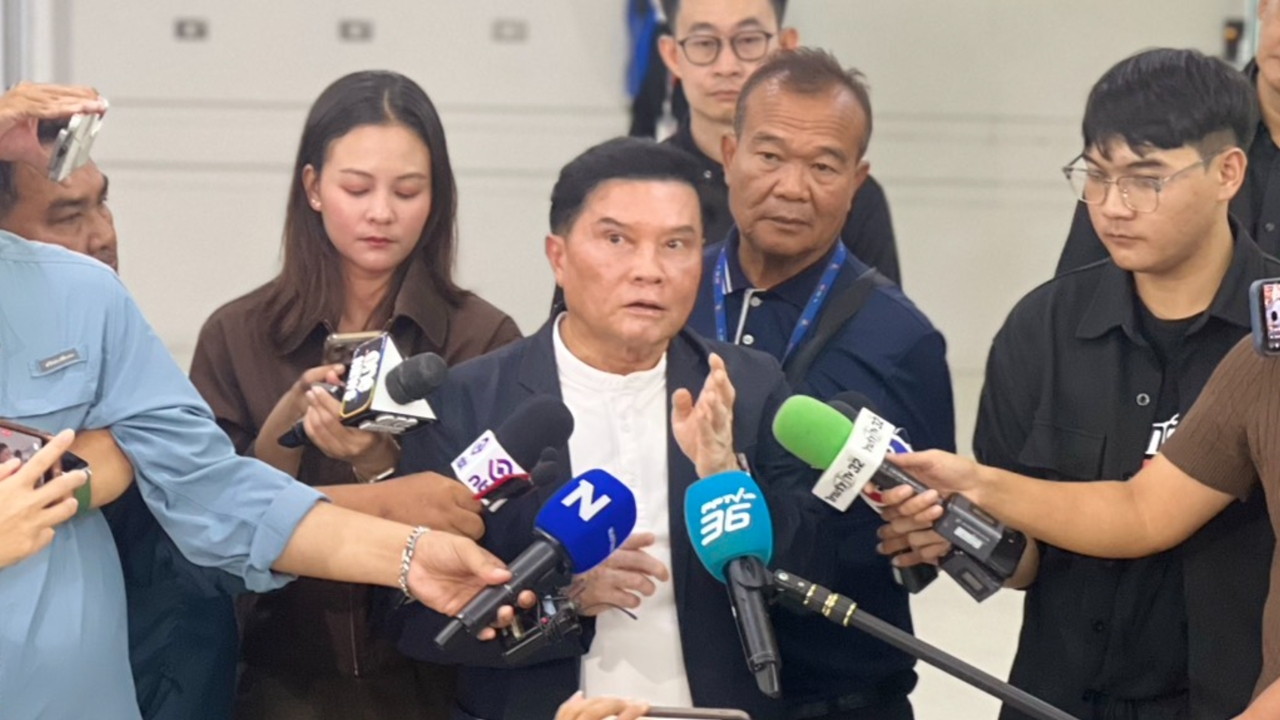
Sittichot, the Election Commission minority member, opens up about the Senate vote-rigging case, noting that the first two allegations did not receive unanimous decisions. He reveals that the 4 to 3 majority vote rejected continuing the investigation into some financial pathways, making it impossible to trace the origin of certain money transfers.
On 15 September 2026 at 17:40 GMT+7, at the Election Commission Office (EC), Mr. Sittichot Intharawiset, an Election Commissioner and minority vote in the Senate vote-rigging case, gave an interview saying he was dissatisfied with the outcome. He followed the news and the statement by Mr. Narong Klanwarin, EC Chairman, who said prior to the press briefing there was an agreement to clarify each allegation with the majority vote count for transparency, citing Constitutional Court documents that showed majority and minority votes for each charge.
“During the meeting, it was said there was no need to name who was in the majority or minority, but to clarify the majority vote count on each allegation. We respect both majority and minority votes. The chairman may not be in the majority and may not know the minority reasons, so he must explain his position, but clarify that not all decisions were unanimous. Some who cited documents showed no involvement or role in the allegations. Some decisions had clear evidence from witnesses and forensic proof like phone records and financial trails, which are documented.”
Mr. Sittichot said, Regarding the key allegations 1 and 2 about actions by party officials, party executives, and MPs, the decisions were not unanimous. Some key individuals had a 5:2 vote to dismiss the complaint, or 6:1 votes on certain accused individuals. Some party executives not involved had unanimous dismissals. He emphasized that decisions were based on the evidence, not all 5:2 votes.
Asked about the potential culpability of party executives under allegations 1 and 2 from a minority perspective, Sittichot admitted that he and Commissioner Chai Nakornchai were in the minority. He believed the evidence was credible, noting that misconduct was nationwide, not isolated. Some cases caught up with investigations in provinces like Nakhon Si Thammarat, Phuket, Nong Bua Lamphu, Uthai Thani, Nakhon Sawan, and Sukhothai, where meetings in hotels organized vote lists. Twelve such lists were found with numbers written down—top seven scorers appeared in these twelve numbers. Those involved in list-making were punished, demonstrating election fraud possibly subject to criminal charges under Section 77(1).
“If we look this way, all areas were connected to one party; no other party intervened. Everyone involved was party-affiliated. The group that made the lists coordinated with witnesses who reversed their testimonies. Initially, the testimony was that the party meeting assigned MPs or party personnel to carry out these acts, which did happen. I don’t necessarily trust the individual, but I believe their words were acted upon and occurred as stated. If a witness’s testimony can be verified, it’s credible.”
Mr. Sittichot continued that regarding phone numbers and financial trails, the witness testified about contacts within the party—party members, executives, or MPs—showing suspicious links. The investigation found these connections true. After election results, a Senate meeting was scheduled on 21 June 2026 at a Bangkok hotel, attended by party members. The witness, who was an MP’s secretary, ministerial office staff, and now a senator, testified to EC that this meeting was to select the Senate’s chairman and deputy chairman.
“Phones were collected, and a key party figure was seen leaving, possibly even the party leader, who was in a different room. These behaviors, including ministerial phone contacts during or after the election, all align. The minority opinion sees this as supporting the creation of vote-rigging lists in various provinces, as the witness described.”
Mr. Sittichot added that another witness named Direk corroborated this testimony. The facts matched witnesses numbered 16 and 26—two people—and a witness who reversed their testimony. He believed the recantation wasn’t due to intimidation because the witness was a respected MP of the party at the time. Anyone could threaten him, but he was influential. Another witness who reversed was the father-in-law of a key party leader, making intimidation unlikely. Also, a retraction letter was submitted after the 36th investigation panel was formed, probably on 30 October 2025, long after the original testimony.
“All these suspicious details combined give a full picture—the real 'elephant' is here. Smaller parts are wrong, but the whole elephant is this. The minority opinion therefore views allegations 1 and 2 as valid and connected. These are the only allegations. The chairman might not have had the numbers then; he told me today it was the majority opinion, but I don’t see it as majority yet.”

Sittichot explained that the EC’s decision to dismiss allegations 1 and 2 was not unanimous. For key individuals, the vote was 5:2. Asked if he worried about facing a Section 157 lawsuit against EC, he said he didn’t need to defend himself, as he had evidence and legal reasoning in his brief explanations aligned with the law and court decisions, referencing tangible witness evidence.
Asked whether the EC’s divided decision reflected internal discord, Sittichot said each commissioner distinguished the facts differently. This was not factionalism but reasoned disagreement. The reasoning highlighted small details from various groups to reveal the bigger picture, similar to Constitutional Court reviews that analyzed details to rule a party’s acts as subversive. Here, minor details were used to reveal the full 'elephant,' not just its trunk. Only when all pieces combine do you see the whole elephant.
Asked if any evidence implicated ministers as masterminds of the Senate vote-rigging scheme, Sittichot said some witnesses mentioned this, but only as statements without supporting evidence—just words alone. “As I said, words alone can’t be trusted. Even people don’t always believe what they say. But if what they say did happen, then it’s credible.”
Asked whether witness testimonies conflicted, Sittichot said there were some conflicts. Witnesses 16 and 26 testified that if national-level senators to be elected numbered 15-20, one real Senate seat quota would be assigned, with names forwarded to party authorities via phone lines to MPs and ministers to be included in vote lists. The two witnesses gave conflicting accounts—one said two names could be forwarded. This was investigated more than a year after the events. These acts were concealed, and at every meeting phones were collected, photography forbidden, and all communication devices seized, but with many people involved it was hard to fully control.
Witness 16, who reversed testimony, claimed the vote lists didn’t exist and were made later after panel 26’s investigation. He asked to review CCTV from the national Senate election day, 26 June 2024. Cameras showed voters pulling out vote lists to copy, proving the lists existed then, not fabricated later by panel 26. Some who were caught documented photos, though unsure if still on their phones. This showed the lists preexisted, not fabricated by panel 26. Justice requires fairness to see if anyone was harassed to dismiss charges. But if the lists truly exist, widespread across provinces and leading to nearly all being sued, then it must be considered who created them and how serious the offense was.
“Panel 26 was formed because investigators in all complaint provinces were cut off at district level with claims like ‘I applied myself, paid my own money, I was interested in politics but saw others better so didn’t choose myself,’ despite poverty and employer mandates. This was clear but cut off. So legal cooperation was needed, with requests for help from the DSI, Anti-Money Laundering Office, and provincial police to collaborate from the start. I informed EC this was necessary to coordinate properly. EC was denied access elsewhere, but police were allowed access and gave truthful cooperation, leading to panel 26’s formation.”
Sittichot also said there are two meanings of vote lists: one is a Senate voter’s note of preferred candidates, which is allowed. The illegal form is numerical lists made by others. This was not their idea but imposed. The Supreme Court ruled this was not a free choice by voters but election fraud undermining honesty and fairness without needing other legal provisions. This explains why some voters found their names missing from lists and then complained as witnesses.
Asked if revealing this now could change outcomes, Sittichot said nothing can change since the decision is final, except if the Supreme Court addresses it. The court’s hearing can summon other witnesses, and may prosecute people not initially sued, depending on its discretion or if direct victims file complaints. The court’s broad authority will determine the country’s path.

Regarding senators who registered in the wrong group but remain senators, Sittichot cited a Supreme Court ruling on one case where a Senate candidate applied under the agricultural group ‘or others in the same manner,’ supported by two valid endorsers. The district election official accepted the candidacy as legitimate.
Later, someone complained to the provincial election official that the candidate was improperly registered, not really an agricultural worker. The Supreme Court ruled that the district official acted correctly since the candidate self-identified in that group and the complaint was dismissed. If such a case were brought to EC and then to the Supreme Court, it would be different, but this case never reached EC.
There was also a case of senators who sold noodles and pork, not matching their occupational groups, but no complaint was made to the district election officials. Instead, the complaint was to EC, which ruled the candidacy valid after the provincial official investigated and found the person genuinely worked in that profession. The opponent did not claim otherwise. Normally, if evidence arises that a senator lacks qualifications, EC refers the case to the Constitutional Court for removal. Here, a complaint went to the Supreme Court; the process is ongoing, as everyone has the right to petition the court.
Asked about accusations that he was a 'blue' EC commissioner, Sittichot said the opinions are evidence. If the opinions are valid, regardless of which side benefits, that is the outcome. He urged focusing on the reasoning behind each commissioner’s decisions about group affiliation. EC commissioners are at the last stage of their careers and want to serve the country well. The answer lies in the reasoning, not politics.
Regarding opposition claims that at least two EC commissioners were involved in the Senate vote-rigging scheme, Sittichot said he had not seen evidence. Suspicions about participation in collecting vote lists are not proof of involvement in the scheme since everyone knew lists were being collected. The lists themselves cannot yet be proven as created by illegal acts or simply personal notes; this remains unproven.
While boarding a vehicle, Sittichot also revealed he did not know how politics would evolve and could not predict it. When reporters asked, he explained, The votes on allegations 1 and 2 were not unanimous, with majority and minority opinions and notable differences. Asked if he felt relieved after speaking out, Sittichot said he felt more at ease because someone had called him the previous night, so he needed to clarify that there were both majority and minority votes.