

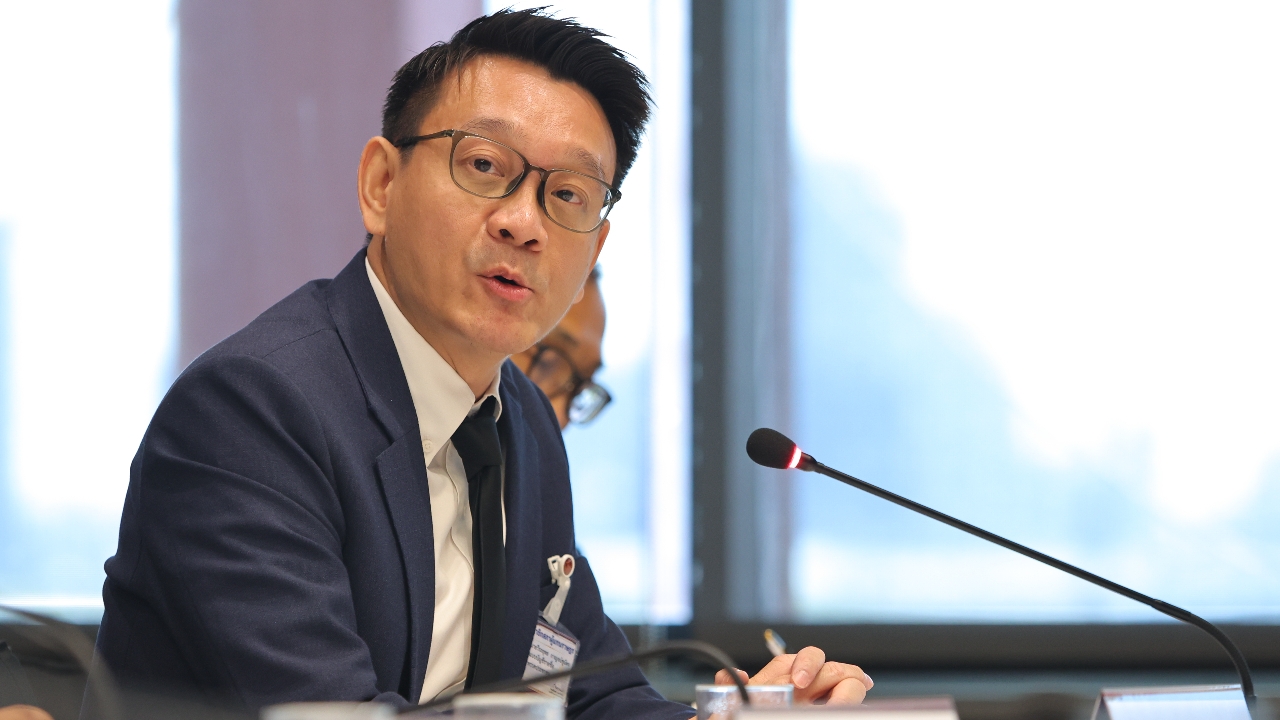
'Veerayut' highlights that 'Thai Help Thai Plus' does not focus on those bearing energy costs, urging direct support for farmers, fishermen, and transport sectors, while proposing four measures to preserve Thailand's automotive supply chain and stressing that adjusting EV taxes alone is insufficient to address the issue of rising energy costs.
On 16 September 2026 at the Parliament building, the Prachachon Party held a press conference on the 12th shadow cabinet meeting. Veerayut Kanchuchat, Deputy Leader of the Prachachon Party, shared the party's views on the government's latest economic stimulus policies, especially the extension of the Thai Help Thai Plus program, or the 60/40 measure, and the proposed adjustments to electric vehicle (EV) taxes.
Veerayut stated that retail fuel prices have risen again since late July, continuing through August and September, increasing by about 5 baht per liter on average. Diesel prices have reached 40 baht per liter. This raises the question: since the government borrowed 400 billion baht partly to ease expenses caused by the energy crisis, why has the money not been used to directly aid those impacted by rising energy costs?
Especially farmers, fishermen, and the transport sector—three groups directly affected by fuel prices—yet there is no targeted support policy. Farmers bear fuel costs for tractors, harvesters, and water pumps, alongside increased fertilizer prices, which has raised their operating costs continuously over the past three to four months.
Veerayut added that for the Thai Help Thai Plus extension, the budget involved could approach 200 billion baht, likely used to stimulate consumption. This appears more aimed at maintaining political popularity rather than directly helping those affected by the energy crisis.
Regarding the idea of reallocating funds set aside for the energy transition to the Thai Help Thai Plus program, the emergency loan decree allows such fund transfers legally. However, it is worth noting that the energy transition plan itself remains unclear, and using approximately 200 billion baht solely to stimulate consumption also presents problems.
Veerayut further commented that the bigger issue is the government lacks concrete economic policies elsewhere, such as support for SMEs and addressing falling agricultural product prices. While the government acknowledges multiple crises, its proposed solutions mainly focus on the 60/40 measure.
Concerning automotive industry policy, the Prachachon Party has long urged the government to address industry challenges, but the government only began to act after regional investment base competition surfaced. The current approach leans toward tax measures, especially raising excise taxes on imported EVs. If the real goal is to preserve Local Content, emphasis should be on using domestic parts and raw materials and adding value within Thailand's supply chain. Raising excise tax is an indirect measure and insufficient to guarantee achieving these goals.
Veerayut then proposed four direct measures to be implemented:
1. Enforce stricter verification criteria for Local Content of EV manufacturers receiving subsidies and undergoing compensatory production, to ensure genuine use of domestic parts.
2. Promote investments that advance Thailand's automotive industry toward future vehicles, not just traditional Local Content, such as supporting domestic research and development centers and developing software systems for modern vehicles.
3. Allocate budget and establish KPIs for developing workforce skills in the automotive sector, which employs about 400,000 to 500,000 people, to enable workers from internal combustion engine industries to transition to hybrid and EV sectors.
4. Support SMEs in the automotive parts industry, especially Tier 3 and Tier 4 operators, to adapt machinery and production processes to meet environmental regulations in export markets, which increasingly require carbon emission traceability.