

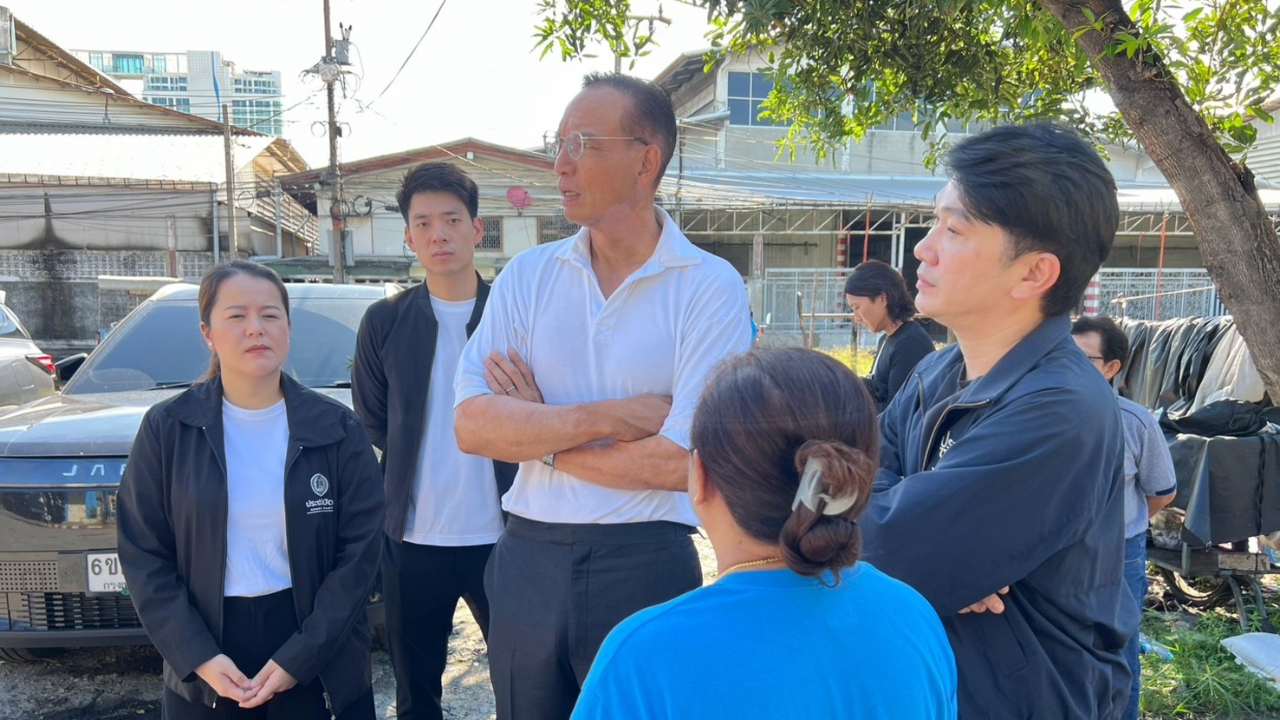
Korn and Siripa visited the oil leak site, raised five suspicious points, questioned the Energy Ministry’s standards in addressing the issue, and recommended collaborating with experts to promptly use intelligent pigging technology to locate the leak, warning against superficial fixes.
On 16 Sep 2026 GMT+7, Siripa Intawichian, Deputy Spokesperson of the Democrat Party, spoke about visiting the oil leak area in Khlong Toei district alongside Korn Chatikavanij, Deputy Leader of the Democrat Party. She stated that recent data found oil leaking from an underground cavity, and tests showed the oil was old with high sulfur content. However, reports from Bangchak representatives indicated multiple leak points, with only one underground cavity found. At some sites, damaged oil pipe insulation was found, so it is premature to conclude the leaks are not from the oil pipeline. Excavations are ongoing to uncover more leak points, leaving several suspicious issues:
1. Why did the Energy Ministry perform pipeline pressure testing at a fixed 28 bar for only one hour, when actual oil transport uses 30-40 bar? This test pressure is below international standards and the 2021 ministerial regulation on pipeline oil transport, which requires testing according to the American Society of Mechanical Engineers (ASME) B31.4 standard. This standard mandates testing at a minimum of 1.25 times the pipeline’s design pressure, maintaining pressure for 2-8 hours depending on distance, pipe size, and oil temperature.

2. Why has the ministry not expedited the use of internal pipeline inspection technology by sending sensor-equipped intelligent devices along the flow to detect damage such as corrosion, cracks, or wall abnormalities (intelligent pigging)? This should be used to inspect the entire pipeline route to clearly identify leak points and create a full underground pipeline map to confirm safety from Phra Khanong to Bang Pa-in. The intelligent pigging technology must be capable of detecting micro leaks with an accuracy within 1-2 meters.
3. Could the oil found in the cavities or soil under the pipes be oil that has seeped out over a long period, or residual fuel oil from machinery used in past construction or operations in the area? Although this oil is old with high sulfur content, it can still be re-refined to remove sulfur and contaminants and converted into lubricants or lower-grade oil, reducing the likelihood of intentional dumping. Scientific test results should be disclosed to assess the possible origins of the oil.
4. There are risks and dangers when using excavation machinery to open the ground near pipes fully filled with oil and cavities containing oil, as sparks generated during excavation could trigger explosions.
5. Although the oil pipeline has been in use for over 30 years, ministerial regulations on pipeline oil transport still apply. For example, underground oil pipelines must have yellow warning tape buried at least 0.30 meters deep with black lettering along the pipeline. The regulations should be reviewed to add markings on road surfaces indicating underground oil pipelines to inform the public of hazardous material transport beneath.
